








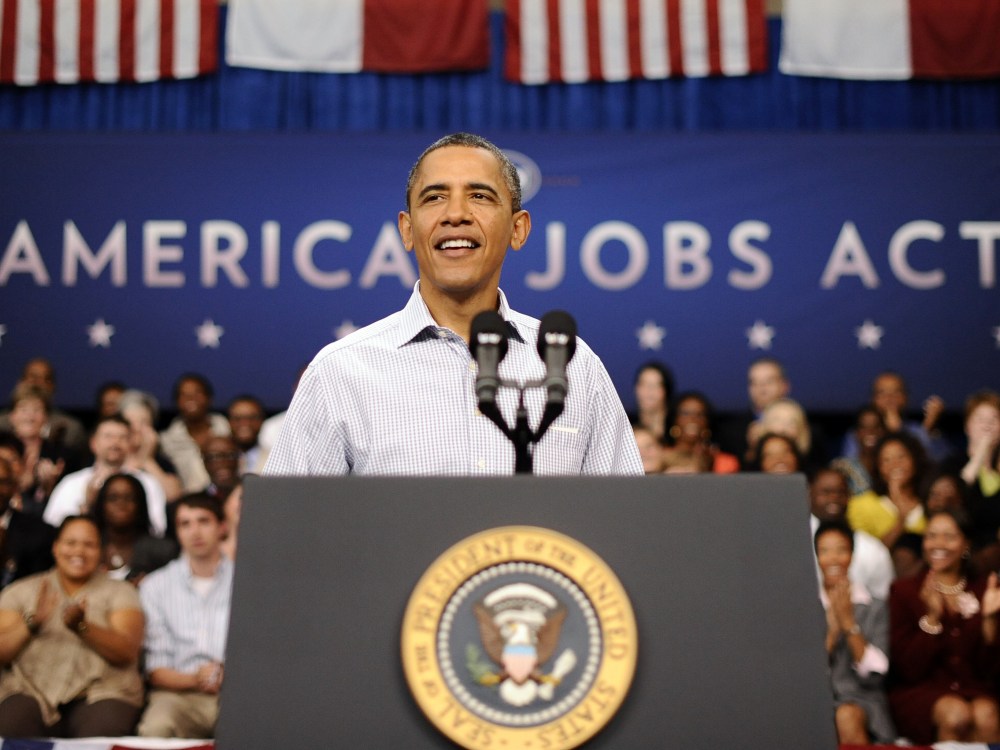
More than five years after the start of the Great Recession, America is still in the throes of a jobs crisis. But Washington seems to have given up.
On Thursday, the two-year term of the President’s Council on Jobs and Competitiveness—an advisory panel of CEOs, labor leaders and others aimed at helping spur job growth—is set to expire. Though there are still more than 12 million Americans officially out of work—more than 19 million if you count those who have given up looking—the White House hasn’t said whether it’ll extend the council’s term, and did not respond to an inquiry from msnbc.com. The council, chaired by G.E. chief Jeff Immelt, hasn’t met in more than a year.
Congress has appeared even less interested. When President Obama did unveil a serious package of jobs proposals in 2011, and went to the Capitol to urge lawmakers to “pass this jobs bill right away”, House Republicans responded, by and large, with a collective shrug.
“When I travel around the country discussing economic policy, the first question on everyone’s mind is, in so many words: Why is D.C. ignoring the economy?,” Jared Bernstein, a former economic adviser to the Obama White House and an msnbc contributor, told msnbc.com.
The ongoing urgency of the problem was underscored Wednesday, when the government reported that the economy actually shrank by 0.1% in the last three months of 2012. No one’s predicting another recession, but even the most optimistic forecasters say it’ll take until 2016 to get joblessness, currently at a dismal 7.8%, down to a reasonable level. If growth stays at 2012’s tepid pace, it’ll take far longer.
On Wednesday, White House spokesman Jay Carney blamed the weak growth numbers on Republicans. “There is more work to do and our economy is facing headwinds—and that is Republicans in Congress,” Carney said, suggesting that the GOP-driven showdowns over the fiscal cliff and the sequester had affected economic confidence.
The human cost of the crisis can’t be gauged with statistics alone. Nearly five million Americans have been out of work for six months or longer, making it even harder for them to get back into the job market, thanks in part to discrimination against the jobless. And even those Americans who are working aren’t exactly flush: With unemployment so high, employers have little incentive to pay more, leading to stagnant wage growth in recent years, despite record corporate profits.
And yet, rather than take measures to put Americans back to work, Washington has instead been consumed by a debate about how to cut the deficit. That focus hasn’t just distracted policymakers from the jobs crisis—it has actively exacerbated the problem. That’s because the measures needed to balance the budget also have the effect of stymieing economic growth.
Mark Zandi of Moody’s Analytics found earlier this month that the spending cuts and tax hikes in the recent deals to avert the fiscal cliff and to temporarily raise the debt ceiling cut more than one percentage point from GDP growth. That will mean 725,000 fewer jobs created, and a half-percentage-point rise in the unemployment rate, compared to what would have happened had fiscal policy remained unchanged. By the end of the year, Zandi predicted, unemployment will still be at 7.5%. When the Great Recession officially began in December 2007, it was 5%. Lately, a growing number of economic experts across the ideological spectrum has begun to challenge the deficit focus, arguing that the near-term priority should be boosting growth. “The federal government is not on the verge of bankruptcy,” Martin Wolf, the respected financial columnist for The Financial Times wrote last week (sub. req.). “If anything, the tightening has been too much and too fast. The fiscal position is also not the most urgent economic challenge. It is far more important to promote recovery.” Lawrence Summers, who forged a reputation as a centrist while serving as President Clinton’s Treasury Secretary, agreed, urging policymakers in a recent online column to “end the damaging obsession with the deficit,” and not to “lost sight of infrastructure, jobs and growth.” President Obama appears eager to leave the deficit issue behind. To the relief of many progressives, he didn’t mention the budget gap in his inauguration speech last week. But the speech’s central themes were calls to action on issues like gun control, immigration and climate change. Beyond vague references to a “rising middle class” and the scourge of income inequality, Obama gave little sign that he planned an aggressive push on jobs. And he’ll be forced to return to the budget battles, whether he likes it or not, in February when automatic spending cuts are scheduled to go into effect. Obama will next have the public’s attention at his State of the Union address, scheduled for February 12. The millions of Americans still out of work will be hoping he uses the opportunity to turn the conversation back to jobs.
Zachary Roth Recommended


