The Rachel Maddow Show WEEKNIGHTS 9PM ETMorning Joe WEEKDAYS 6AM ETDeadline: White House with Nicolle Wallace Weekdays 4PM ETThe Beat with Ari Melber Weeknights 6PM ETThe Weeknight Weeknights 7PM ETAll in with Chris Hayes TUESDAY-FRIDAY 8PM ETThe Briefing with Jen Psaki TUESDAYS – FRIDAYS 9PM ETThe Last Word with Lawrence O’Donnel Weeknights 10PM ETThe 11th Hour with Stephanie Ruhle Weeknights 11PM ET
Al Franken’s financial reform proposal: A sampling of the reaction
As the Securities and Exchange Commission commissioners, debt-issuers and others credit-rating industry participants held a round table discussion on Tuesday
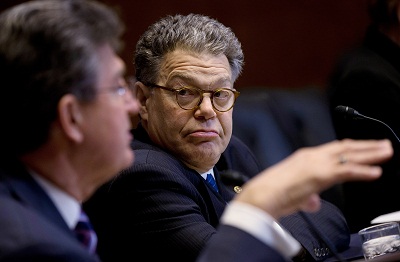
Sen. Al Franken (D-MN) listens during a Senate Committee meeting March 21, 2013 in Washington, DC.Getty Images
By
Clare Kim
As the Securities and Exchange Commission commissioners, debt-issuers and others credit-rating industry participants held a round table discussion on Tuesday to assess the current credit-rating industry, the world wide web exploded with commentary, reacting to Minnesota Senator Al Franken’s interview on msnbc’s The Last Word with Lawrence O’Donnell. Sen. Franken explained in his interview his proposed legislation that offers changes to the credit-rating system by implementing an independent board that decides which rating firm rates a financial product, and while the three-panel round-table analyzed the Franken Amendment, people on the internet also reviewed whether substantial changes to the rating process are necessary.
Here is some of the online reaction.
On Twitter:
@thelastword @alfranken It is about time a US Senator tells the truth that our financial systems is fixed.Thank you
This should have been taken care of with Dodd Frank, but it wasn’t. The credit rating agencies were just as responsible for the 2008 economic crisis like the banks were.
On a very simple scale, Wall Street bundled lots of horrible loans with some good/okay loans. They figured out the credit rating agencies would give those loans Triple A ratings when bundled. If at first they didn’t get a Triple A rating, they would bundle that bad bundle with slightly better loans and try again. The agencies were paid by Wall Street, and they wanted more business so they generally gave very high ratings without much trouble.
Wall Street got “smart” and figured out they could sell “insurance” on those loan bundles. As long as some of the loans didn’t default, they were fine and would make a decent amount of money doing nothing. If a small number of loans did default, they would essentially lose a s***-ton of money. The loans were rated Triple A however, and Wall Street is all about short term profit, so they didn’t care. They’d be rich anyway. Wall Street also knew that if things started going poorly then everyone, essentially the world’s economy, would be FUBAR. There was a LOT of money tied up in these and other similar financial instruments.
Finally, Wall Street also knew that the US government takes good care of its rich friends and would keep things from getting too bad. I think, however, that they even estimated how bad things would get and that’s why we saw some firms die off.
So, as usual, it boils down to ignorance and greed. If this whole thing was a massive domino structure, the first domino to tip would be the bad loans. The hundreds of remaining dominos were all set up by Wall Street and the ratings agencies.
Edit: fixed a couple of words. Also, when I refer to Wall Street, it’s all the usual players Goldman, Lehman, Bear, etc.
S&P and Moody’s do their due diligence on the numbers and apply a reasonable rating for securities’ creditworthiness based on the information they’re provided. In the case of the 2008 financial crisis, many of the subprime mortgages were classified higher than they should have been, keeping the yields low and making it look like a solid investment for pensions and other types of slow growth investments (which is why 401ks were absolutely eviscerated during the crash). We can blame Moodys and S&P and rightfully should, but at the same time, it wasn’t a function of maliciousness – it was a function of misunderstanding.
Now this is all because the banks provided information to them they ALSO thought was correct – for the most part, they believed the MBS were good investments. But it doesn’t require a vivid imagination to see how this could be manipulated simply submitting bad information on purpose to the credit agencies, like you pointed out.
One of the first chapters in Nate Silver’s The Signal and the Noise addresses this and talks about how, while the probability was quite low of it happening, it happened.
If you read the actual FCIC report on the crisis, I think your views on this would change a bit. There are admissions by the ratings agencies (Moody’s I recall in particular) detailing that their methods simply could not provide any reliable indications regarding the soundness of some of these MBS’s and their derivatives. But they still gave out AAA ratings. A lot of them. And that says nothing of the fact that in the rush to keep pace with the market they just stopped caring to actually investigate numbers and just started assigning AAA ratings. Perhaps that last statement is a bit hyperbolic, but the report makes it clear that the mentality was “who cares, AAA.”
The notion that they gave AAA ratings based on the information they had is a little naive. The notion that sophisticated market players of all sorts in this debacle can simply say “housing prices have never as a group decreased in the US” and call that due diligence is absurd. There were clear indications of fraud and improper lending practices and everyone was instead playing a game of “musical chairs” (to quote the CitiGroup CEO from the report).
I watched this interview last night and there were a few things that stuck out to me that I’m confused about. Franken talks about the conflict of interest which is inherent in the banks paying the rating agencies to rate their products, which I understand very well. I work for a CPA firm as an auditor and we have the same issue in our profession.
However, I don’t understand this idea of shopping around for ratings. Maybe I’m just ignorant to how the system actually works, but I’ve got my fair share of hours on a Bloomberg terminal pulling bond CUSIPs and looking at information. All 3 of the ratings agencies issued their own ratings for virtually every single instrument I pulled, and generally speaking they weren’t very far off from each other. And lest you think that they only needed one AAA to make it, I can assure you that as their auditors (who sign off on their financials) we took a conservative approach and would typically use the lowest rating to test their presentation of their securities in their investment disclosures.
Due to my personal experience and knowledge described above, I have trouble connecting the dots as to how his proposed committee does anything to fix a problem. I don’t think giving a special interest board the power to choose one rating agency to rate securities is a good idea. In fact, I think it’s a terrible idea and is far too much of a concentration of immense power. If this goes wrong then you effectively have no good rating agency at all, and regardless of what reddit thinks, the rating agencies generally speaking do a pretty good job.
The ratings fell apart in the 2008 crisis because we had a systemic problem. All of the AAA rated securities weren’t necessarily rated AAA because the underlying securities were high quality, but rather because the issuing firms had purchased default swaps against them, which were effectively credit default insurance. That’s where AIG comes in. AIG had written these “insurance policies” (credit default swaps). The problem is that they weren’t all supposed to go bad at the same time. That created a systemic problem in which the entire system goes under.
This is an important learning lesson for understanding the differences between systemic and non-systemic risks. Non-systemic risk is diluted through diversification. The more you diversify your investments, the more you reduce non-systemic risks. However, at least in theory, you can’t avoid systemic risk. This is the risk of the entire systemic infrastructure failing. Of course, we can attempt to put regulations and safeguards into play, but more often than not, at least in my opinion, they tend to attempt to address specific types of symptoms rather than real problems, because it’s rare that you can actually address these kinds of issues.
It’s so easy to look in hindsight and say that the ratings agencies, banks, and other players “should have known” what was going on, and obviously they did start to catch on at the end, but the fact is that in 2005-2006 no one (including “Main Street”) gave a s*** because we were all sucking down the dough.
TL;DR: I don’t think Franken’s proposed solution will be effective, and has potential to further damage free market regulation of credit risk.
On Facebook:
Maureen Megill Larkin Thank you and Sen Franken for shedding light on the greed and corruption in the financial sector. I hope he is successful in his quest to pass legislation to regulate plain thievery by banks.
John T Freeman The whole thing about people working in the Financial System & Wall Street getting away with crashing US economy & sucking the life out of Americans is an historical tragic event. This event is a crime that should be punished. Average people lost much of their wealth in the form of home equality while Wall Street & Banking Industry got government bail outs. This has been outrageous!
Brad Turek The rating agencies should be punished for their unmistakable role in the real estate bubble, the subsequent credit crisis which then led to the near economic collapse of this country.