








It’s been three years, as of Tuesday, since Congress last raised the federal minimum wage. And many advocates for the poor say that with low-wage workers struggling, it’s time to do it again.
A group of prominent liberal-leaning economists including Joseph Stiglitz, Jeffrey Sachs, Laura Tyson, and Robert Reich sent a letter Monday to congressional leaders urging them to raise the minimum wage from its current level of $7.25 per hour to $9.80 by 2014. “At a time when persistent high unemployment is putting enormous downward pressure on wages, such a minimum wage increase would provide a much-needed boost to the earnings of low-wage workers,” the group wrote.
Stiglitz is a former chief economist for the World Bank, Sachs runs Columbia University’s Earth Institute, Tyson served as President Clinton’s top economic adviser, and Reich served as Clinton’s Labor Secretary.
Sen. Tom Harkin and Rep. George Miller, Democrats from Iowa and California respectively, have introduced measures to raise the minimum wage to $9.80. But President Obama hasn’t made the issue a priority. Mitt Romney, meanwhile, has twisted himself in knots on the subject, first saying he supports indexing the minimum wage to inflation, then backing down after an outcry from conservatives.
A coalition of liberal and labor groups is organizing rallies Tuesday in support of a raise, in 30 cities across the country. Some rallies will target companies owned by Bain Capital, the private-equity firm founded by Romney.
A raise wouldn’t just benefit the roughly 20 million American workers who make the current minimum, supporters argue. “Another nearly 9 million workers whose wages are just above the new minimum would likely see a wage increase through ‘spillover’ effects, as employers adjust their internal wage ladders,” the economists wrote in the letter to Congress.
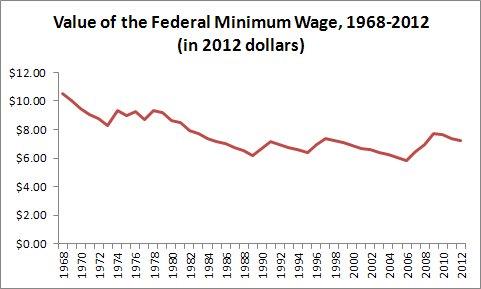
Advocates of a raise note that the value of the minimum wage has steadily declined in recent decades. In 1968, it was worth over $10 in 2012 dollars, almost one third more than it is today, according to the chart below, which was compiled by the National Employment Law Project (NELP), a labor-backed group.
Opponents argue that the move would raise the cost of hiring for employers, especially small businesses, exacerbating the unemployment problem. But in their letter, organized by the Economic Policy Institute, a liberal Washington think tank, the economists noted that “the weight of evidence now show[s] that increases in the minimum wage have had little or no negative effect on the employment of minimum wage workers, even during times of weakness in the labor market.” Indeed, they added, a raise would likely stimulate the economy and boost job growth, because low-income workers have little choice but to spend new income, rather than save it. In addition, new data compiled by NELP (pdf) show that two out of three low-wage workers are employed not by small businesses but by large corporations. Most such corporations have recovered from the Great Recession and are in strong financial positions, NELP’s data show.
Zachary Roth Recommended


