








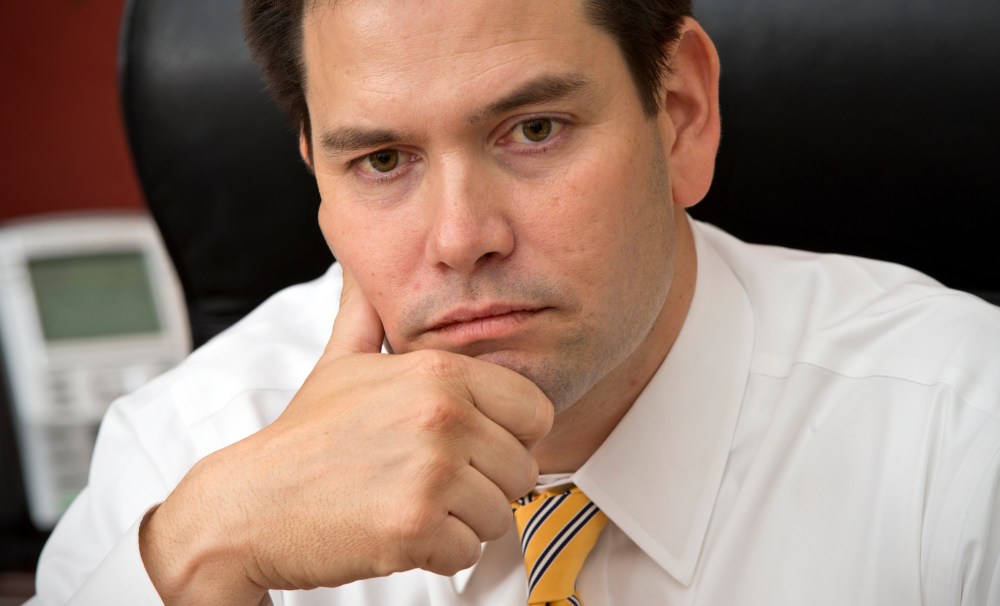
National Review has published some excerpts from Sen. Marco Rubio’s rebuttal to the 2012 State of the Union. Here’s a taste:
Economic growth is the best way to help the middle class. Unfortunately, our economy actually shrank during the last three months of 2012. But if we can get the economy to grow at just 4% a year, it would create millions of middle class jobs. And it could reduce our deficits by almost $4 trillion dollars over the next decade. Tax increases can’t do this. Raising taxes won’t create private sector jobs. And there’s no realistic tax increase that could lower our deficits by almost $4 trillion.
So Rubio proposes an economic plan of his own:
The real cause of our debt is that our government has been spending 1 trillion dollars more than it takes in every year. That’s why we need a balanced budget amendment. The biggest obstacles to balancing the budget are programs where spending is already locked in. One of these programs, Medicare, is especially important to me. It provided my father the care he needed to battle cancer and ultimately die with dignity. And it pays for the care my mother receives now. I would never support any changes to Medicare that would hurt seniors like my mother. But anyone who is in favor of leaving Medicare exactly the way it is right now, is in favor of bankrupting it.
It should come as no surprise that a Republican—even the fresh-faced future of the Republican Party—would call for severe reductions in government spending as a pathway to growth. But it is a little odd that he would do so only after noting America’s recent 0.1% decline in GDP. After all, one of the major contributor’s to the economy’s negative growth was a 6.6% drop in government spending.
On top of that, the Congressional Budget Office names “scheduled automatic reductions in federal spending” as a major contributing factor to what they say will be weak GDP growth for the near future. If achieving growth is really a priority for Rubio, then reducing the deficit through spending cuts is an exceedingly odd strategy for doing so.
Nonetheless, Rubio’s State of the Union rebuttal calls for reforming the social safety net to reduce spending. But his speech also goes much further than that, even endorsing one of the most extreme pro-austerity policies: a balanced budget amendment. Senate Republicans reportedly plan to introduce such an amendment the day after the State of the Union. Their version of the bill is expected to cap total government spending at 18% of GDP and “require a supermajority for tax hikes and debt-limit increases.” Not only would such an amendment hobble the federal government’s spending capacity, but it would also make it far harder to raise the revenue required for what spending it is capable of. If this is the policy which Rubio intends to endorse, then his speech amounts to a repudiation of economic growth, not an endorsement.
Ned Resnikoff is an urban policy analyst, researcher, writer, and editor. His byline has appeared in a variety of publications, including the New York Times, San Francisco Chronicle, Dissent, and The Nation. He writes the newsletter Public Comment, which can be found at publiccomment.blog. Recommended


