








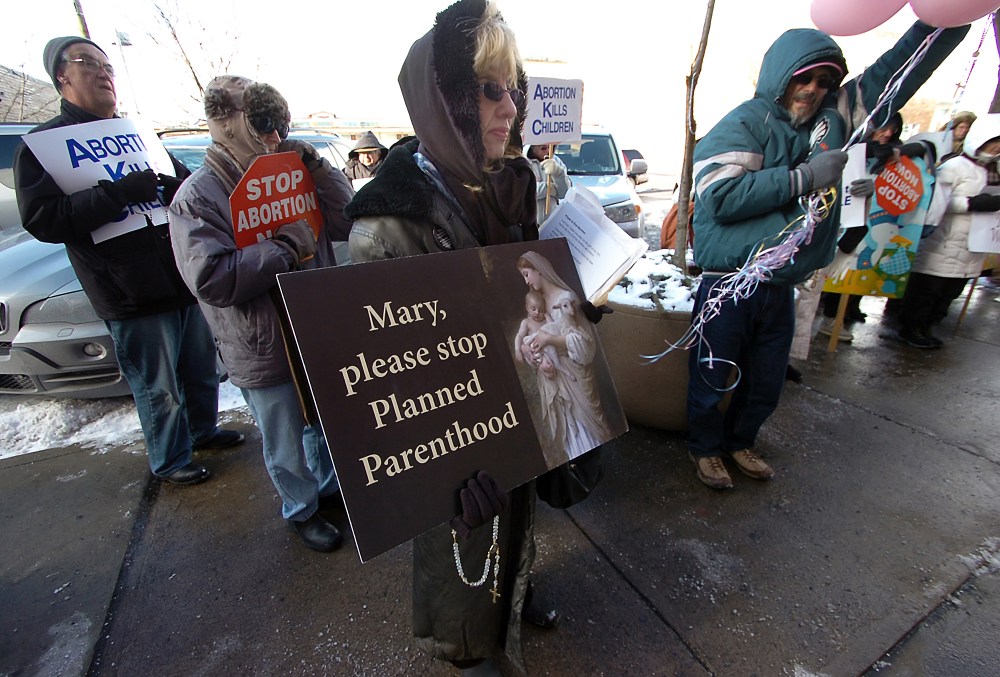
The issue of abortion hinges on the question of personhood. Nearly everyone believes that persons have a special moral status: Taking the life of another person, barring extreme circumstances, is a grievous sin. Pro-lifers argue that the same is true of abortion, because fetuses are persons—hence the term “pro-life.” Most pro-choicers, on the other hand, would argue that fetuses are not persons until they reach a certain late stage of development, either at the moment of birth or some time prior to it.
Most pro-choicers subscribe to that view—but not at all. In a column timed to coincide with Roe v. Wade’s fortieth anniversary, Salon’s Mary Elizabeth Williams argued that “a fetus can be a human life without having the same rights as the woman in whose body it resides.” (Williams, like most laymen, uses the term “human” and “person” interchangeably, though many philosophers argue that there is some distinction between their meanings.)
In 1971, the moral philosopher Judith Jarvis Thomson made a similar claim in “A Defense of Abortion.” She argued that abortion could still be morally permissible even if “the fetus has already become a human person well before birth,” because “the right to life consists not in the right not to be killed, but rather in the right not to be killed unjustly.” If a woman terminates the life of her own fetus in a way that can be considered just, then no one’s right to life has been violated.
Most of Thomson’s essay is taken up with delineating some of the circumstances in which one person may justifiably take the life of another. For example: a group of music lovers has attached your circulatory system to that of an unconscious violinist in order to save his life. You did not consent to the operation, but now that the two of you are joined together, the music lovers tell you that unplugging the violinist would kill him. The music lovers say you must remain attached to the violinist, and therefore virtually incapacitated, for nine months. Thomson replies that remaining joined to the musician would be a “great kindness,” but not a moral obligation.
But there are two potential problems with Thomson’s argument. First, her response to the thought experiment is not intuitively obvious. A more stringent moral code might very well require you to save the violinist’s life, and Thomson doesn’t adequately explain why that code is unreasonable instead of merely demanding. Second, by accepting that a fetus may be a full human person, both Thomson and Williams may concede too much to the pro-life position.
In explaining why she believes “the fetus has already become a person well before birth,” Thomson points out “how early in its life it begins to acquire human characteristics.” For example, by the tenth week, “brain activity is detectable,” and the fetus has a face and internal organs. Along the same lines, Williams asks, rhetorically, “Are you less of a human life when you look like a tadpole than when you can suck on your thumb?”
Both Thomson and Williams seem to take it as a given that there is a firm, bright line separating persons from non-persons. Another philosopher, pragmatist Richard Rorty, might call this the essentialist position: the belief that persons have some special, transcendental property that sets them apart from all other animals. Many people hold that view, but Rorty believed that Darwinism made it untenable. In Philosophy and Social Hope, he wrote, “Darwin made it hard for essentialists to think of the higher anthropoids as having suddenly acquired an extra added ingredient called ‘reason’ or ‘intelligence,’ rather than simply more of the sort of cunning which the lower anthropoids had already manifested.” Just as it is difficult to determine at what point a fetus is imbued with personhood, Darwin undermined the predominant belief that there was a clear metaphysical demarcation between humans and all other species. As a result, post-Darwin thinkers “found it very hard to think of themselves as having a transcendental or noumenal [thing-in-itself] side.” In other words, taking Darwin seriously could mean “accepting that we differ from other animals simply in the complexity of our behavior.” In this view, humans just happen to be at one particular end of a spectrum. That does not mean that humans do not have special moral status; only that moral status comes from being higher up on the spectrum. Fetuses, since they don’t exhibit the behavioral complexity of autonomous humans, might be placed lower on the spectrum. Another way of looking at personhood comes from the field of experimental philosophy, a discipline which combines psychological testing with traditional philosophy. Joshua Knobe, a pioneer in the field, says his research shows that most people use two criteria to determine what a person is: behavioral complexity and the ability to experience strong emotions. According to a Salon interview with Knobe, “When asked to imagine ‘a robot exactly like a human,’ [most people] will argue that it is not a person because it can’t possibly have genuine phenomenological experiences like pleasure and pain. Animals, on the other hand, ‘have phenomenological traits [the capacity to experience strong feelings] but not complex reasoning,’ so they can’t be persons either.” If we accepted that definition, those who argue that fetuses are persons would have the burden of demonstrating that they have a capacity for both. Failing that, they’re left with the challenge of constructing another, more plausible account of what makes a person.
Ned Resnikoff is an urban policy analyst, researcher, writer, and editor. His byline has appeared in a variety of publications, including the New York Times, San Francisco Chronicle, Dissent, and The Nation. He writes the newsletter Public Comment, which can be found at publiccomment.blog. Recommended


