








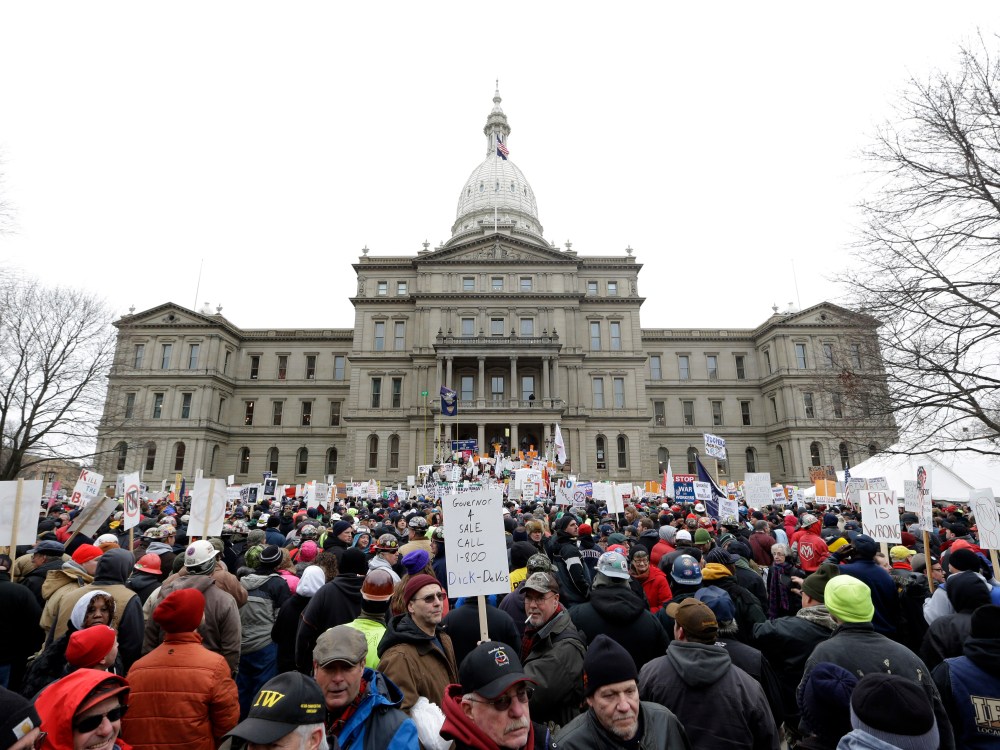
American labor unions have been playing defense for the past four decades, but veteran labor journalist Harold Meyerson says 2012 was a particularly rough year for the movement. The past twelve months, he writes in The American Prospect, “will chiefly be remembered for two major defeats in industrial Midwestern states that had formerly been union strongholds: Wisconsin and Michigan.”
Though Wisconsin unions scored a judicial victory against Republican Governor Scott Walker’s anti-collective bargaining legislation, they failed to depose Walker in a special recall election. And in Michigan, a historic labor stronghold, Republicans successfully passed anti-union “right-to-work” legislation.
Though Meyerson doesn’t mention it, Michigan wasn’t even the only state to pass right-to-work legislation this year—Indiana went right-to-work in February. Including Indiana and Michigan, 24 states now have right-to-work laws.
If there was a silver lining for organized labor this year, it had little to do with either traditional collective bargaining or inside-game legislative politics. The Chicago Teachers Union went on its first strike in a quarter of a century, and made some key gains in its next contract as a result. The Black Friday Wal-Mart walkout—the first labor action of that size to hit the world’s biggest private employer—made headlines and emboldened a growing international movement of dissident Wal-Mart employees.
In New York City, the fast food industry also experienced the biggest labor action in its history—and organizers say that’s just the beginning. In Arizona, hospitality workers union UNITE HERE worked towards a state-wide political realignment. If there’s a common theme to the labor movement’s recent victories, it’s that they occurred outside of the American unionism model which has persisted since the second half of the twentieth century. The CTU strike was the closest thing to a mainstream labor negotiation, since it involved collective bargaining over a contract; but strikes are exceedingly rare in modern America, and CTU is an unusually democratic and community-based union. The fast food and Wal-Mart strikes resembled labor actions of the Gilded Age and the thirties more closely than any major union campaigns in recent American history. Even UNITE HERE’s explicitly electoral campaign focused on consolidating a permanent base of power within the state instead of rallying behind a single candidate. For the large unions operating within America’s post-World War II status quo, the past year was a nearly unmitigated disaster. However, in low-wage service and retail workplaces—arguably America’s new economic center of gravity—labor was able to make some small but significant gains by reverting back to an older, more militant for of unionism.
Ned Resnikoff is an urban policy analyst, researcher, writer, and editor. His byline has appeared in a variety of publications, including the New York Times, San Francisco Chronicle, Dissent, and The Nation. He writes the newsletter Public Comment, which can be found at publiccomment.blog. Recommended


