








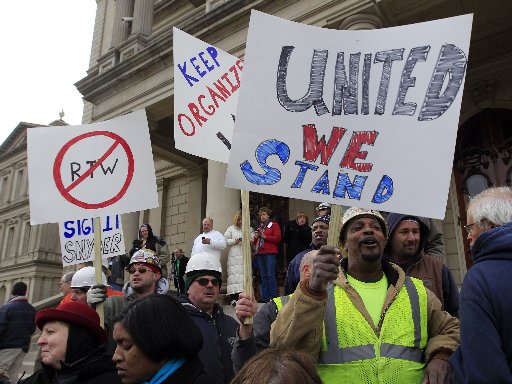
Michigan’s GOP-controlled House and Senate approved right-to-work legislation over the loud objections of Democratic legislators and protesters Thursday night.
Right-to-work laws, which are on the books in 23 other states, bar unions from automatically deducting union dues from the paychecks of all employees in a bargaining unit.
Opponents of right-to-work legislation argue that it creates a free rider problem by allowing employees to benefit from union representation without giving anything back. Unions often struggle to organize workers in right-to-work states, and a report by the Economic Policy Institute found that wages in those states for all workers are 3.2% lower than in non-right-to-work states.
“This is an incredible attack on working people in a place with a great tradition of working people making their voice heard,” SEIU spokesperson Peter Colavito told msnbc. “So obviously, we’re deeply disturbed by what’s happening now.”
Both chambers of the Michigan legislature approved a law applying to private sector unions, whereas only the Senate voted to approve a similar rule for public employee unions. Because state parliamentary rules mandate a five-day waiting period before one house of the legislature votes on a bill passed in the other chamber, the House will reconvene on Tuesday to consider final approval of the legislation.
Michigan’s Republican governor Rick Snyder, who had previously opposed right-to-work legislation, defended the new law on the grounds that it protects “freedom in the workplace” by allowing non-union employees in unionized workplaces to avoid paying any dues to the union which represents their co-workers.
With the 2012 legislature winding down, Republicans introduced the bills in both chambers and them rammed them through in a matter of hours. Pro-labor protesters converged on the state capital, where they were confronted—and, in some cases, pepper sprayed—by police, according to the AP.
The White House reiterated President Obama’s opposition to right-to-work laws in a statement released Thursday: “The president believes our economy is stronger when workers get good wages and good benefits, and he opposes attempts to roll back their rights,” said White House spokesman Matt Lehrich. If Michigan’s right-to-work bills withstand further legislative consideration and possible court challenges, it wound represent a serious blow to organized labor in a region that has traditionally been one of its major strongholds. In the 1930s, the United Auto Workers—then a member of the militant Congress of Industrial Organizations—managed to organize many of the state’s automotive plants through a series of dramatic strikes and sit-downs. However, the UAW failed to organize automotive plants in the South over the next several decades, and its fortunes gradually faded alongside those of both organized labor and American manufacturing. On Election Day 2012, the Michigan labor movement suffered another political blow when voters rejected Proposal 2, a referendum which would have lifted restrictions on workers’ ability to organize or enforce their contracts with management. The failure of that legislation, and the fading union popularity that it seemed to indicate, may have emboldened the state’s Republican Party.
Ned Resnikoff is an urban policy analyst, researcher, writer, and editor. His byline has appeared in a variety of publications, including the New York Times, San Francisco Chronicle, Dissent, and The Nation. He writes the newsletter Public Comment, which can be found at publiccomment.blog. Recommended


