








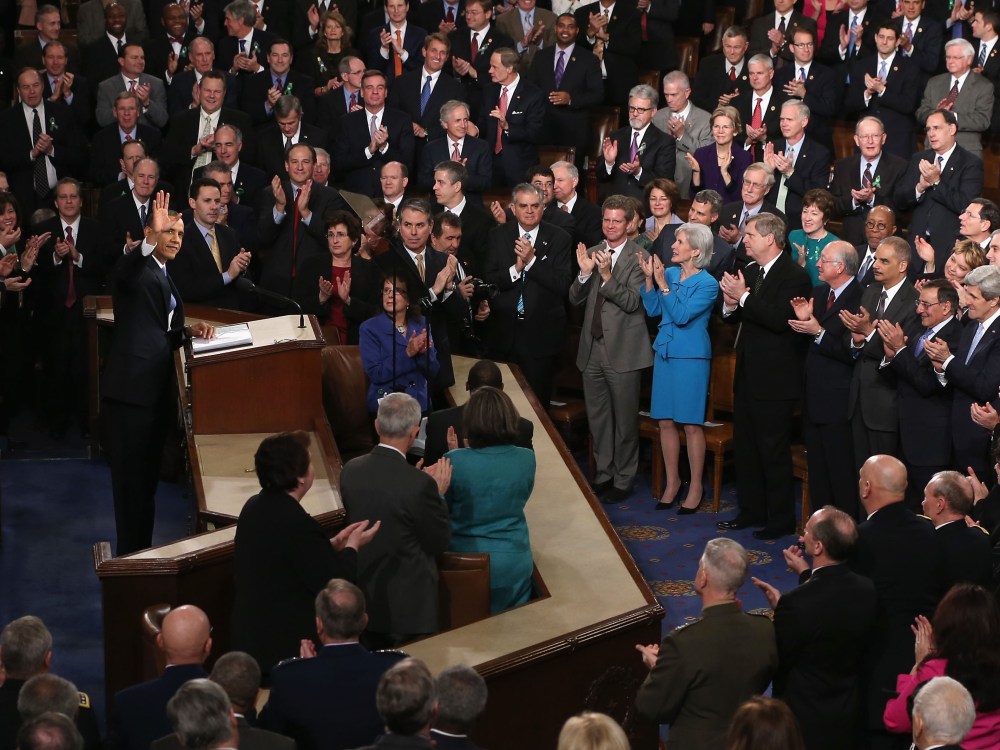
The reviews are in: President Obama’s 2013 State of the Union address was “unapologetically liberal,” “an incredibly ambitious speech,” “an expansive progressive agenda,” a “progressive vision in forceful terms,” “proudly liberal,” and so on. What else can you say of a speech that calls for an indexed minimum wage, universal preschool, climate change legislation and a major infrastructure overhaul?
But “liberal” and “progressive” are hazy categories, even when coupled with amplifying adjectives like “unapologetic” and “forceful.” The real question is not whether President Obama’s second term vision is liberal; instead, the question is what kind of liberalism his agenda seeks to promote. The State of the Union is the president’s second term agenda laid out before the horse-trading and compromises start in earnest. It is his high bid.
With that in mind, one of the most important lines of the night might well be President Obama’s deficit pledge. “Nothing I’m proposing tonight should increase our deficit by a single dime,” he said, early in the speech. “It is not a bigger government we need, but a smarter government that sets priorities and invests in broad-based growth.”
All well and good—nobody’s against “smarter government”—but massive public service expansions tend to require significant public investment. Repairing America’s bridges and roads won’t come cheap.
Fortunately, the president used his speech clarified where the money for fixing America’s infrastructure would come from: something called the “Partnership to Rebuild America,” which he said would bring in “private capital to upgrade what our businesses need most: modern ports to move our goods; modern pipelines to withstand a storm; modern schools worthy of our children.”
It remains to be seen whether the president intends to use private investment to fund other major State of the Union line items. Signs point towards “yes” on climate change, given that Obama called for a “a bipartisan, market-based solution” to our warming planet. As for universal preschool, the president might argue that even a massive public expenditure on the program will be deficit-neutral in the long run, going off of his claim that “[e]very dollar we invest in high-quality early childhood education can save more than seven dollars later on.”
However, the president might instead opt to take another route to the same destination: charter preschools. After all, it wasn’t long after he expressed his desire for universal pre-K that the president applauded the P-TECH charter school in Brooklyn, opened in partnership with IBM. At the very least, President Obama’s embrace of P-TECH suggests that the Democratic Party is now wholly behind the charter school movement.
None of these “market-based solutions” are terribly new. State and local governments, responding to massive budget shortfalls, have been outsourcing public services into private hands for years. Even the Affordable Care Act is a sort of “bipartisan, market-based” solution: the basic framework came from an earlier, industry-friendly Republican proposal, and the final legislation didn’t even include a public option.
The results of these experiments have been mixed, since they lend themselves to abuse when private motives conflict with the public good. These policies give private interests greater control over what should be collective endeavors—and while that is not always the wrong strategy, it is one which should be pursued with extreme caution.
At least we can say that these policies on the state and local level are borne out of necessity, as nearly every state in the country has a balanced budget amendment. But the federal government has no such obligation to shirk deficit spending; President Obama has just vowed to do so anyway. It’s not hard to see why he would do that, given the current mania for deficit reduction and the fact that market-friendly solutions tend to be political winners. When private industry is retained to manage a public good, it may at first look like everyone’s a winner: The government’s budget remains unscathed, companies turn a profit, and citizens receive a desired service. What’s left out of the equation is power—private industry’s increasing power over the public sphere, and over those things which should be collective endeavors. The concept of “power” was also markedly absent from the portion of Obama’s speech focusing on labor issues. While the president again promised to make it easier for Americans to obtain a job, and to make those jobs slightly more tolerable through policies such as a minimum wage increase, he never once spoke of giving workers more power over the conditions of their own labor. A higher minimum wage would surely be a good thing, but it would also be a gift from above—not a policy that would markedly increase any employees’ leverage against the hegemony of the boss. Policies that would do that, such as making it easier for workers to win collective bargaining agreements, evidently did not merit a mention. “[I]n the wealthiest nation on Earth, no one who works full-time should have to live in poverty,” said the president. And while the sentiment is laudable, Obama’s qualification—”no one who works full-time“—is telling. As long as you earn a paycheck or are trying to earn a paycheck, the State of the Union brings hope that your standard of living may eventually rise. If, on the other hand, you drop out of the labor market, then you’re on your own. This is liberalism, to be sure—but a new, peculiar, deracinated kind of liberalism. In the liberal philosophy expressed by this State of the Union, economic equality and workplace democracy are dead; they have been replaced with “opportunity.” Collective struggle and mutual obligation live on in generic paeans to the republican spirit; but market logic takes precedence. At least we can still dream big—but only provided it doesn’t add to the deficit.
Ned Resnikoff is an urban policy analyst, researcher, writer, and editor. His byline has appeared in a variety of publications, including the New York Times, San Francisco Chronicle, Dissent, and The Nation. He writes the newsletter Public Comment, which can be found at publiccomment.blog. Recommended


