








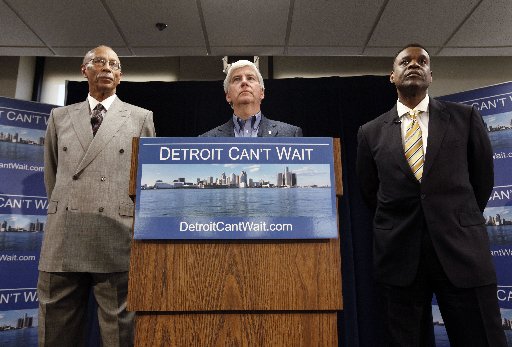
Sometimes the most radical ideas are those which at first sound most banal. For example, when Detroit Emergency Manager (EM) Kevyn Orr and Michigan governor Rick Snyder describe the citizens of Detroit as “customers,” it barely registers as a platitude. At first glance, it’s just another example of how marketing-speak has encroached on the language of politics; similar to how a candidate for higher office might say that government ought to be run like a business, or compare the president to a CEO.
But the description of citizens as customers—an analogy repeatedly invoked by Snyder to justify suspending the powers of Detroit’s local government and putting the city under Emergency Management—is different. It refers not only to citizens, but to the fundamental character of the government’s relationship with its citizens.
At its most basic level, the relationship between a business and its customers is anti-democratic. The customer has one major decision to make: she can purchase the business’s product, or she can spend her money elsewhere. If she’s lucky, maybe the business offers her some opportunity to customize the product. Or maybe it puts her in a focus group, so it can learn how to better cater to her desires. But at no point does the customer have any ownership stake in the business. The business may offer her choices, but it has total control over what those choices are. If the customer doesn’t like those choices, all she can do to change them is walk away entirely.
In a sense, Michigan’s Emergency Manager law does turn citizens into customers. Emergency Managers offer up the city as a product, paid for in tax dollars, and citizens can either accept that product or move away. But the citizens don’t own the city in any meaningful sense, even if they’ve lived there all their lives. The EM owns the city, and he makes the rules.
This is not how citizenship is supposed to function in a republic. In a republic, the state is owned by the citizens, and the task of governance is a collective enterprise in which all citizens are invited—even obliged—take part. Citizens don’t passively receive a product or service; they build that product themselves, together. They argue, they deliberate, they deconstruct, and they create. As the essayist William Deresiewicz has written, “Citizens do more than express a preference every other year. Citizens don’t just look after themselves, they take responsibility for the collective good—or rather, they look after themselves by taking responsibility for the collective good.” Consumers, on the other hand, just “use stuff up.” Snyder’s political project has been to turn the people of Michigan from citizens of a republic into consumers of a product. As a result, he has presided over an unprecedented strengthening of the Emergency Manager law and instituted EMs across the state. He has signed right-to-work laws which undermine the concept of democratic citizenship within the workplace. What’s more, he’s justified his actions with colorless platitudes about freedom and customer service. But don’t let the banality fool you: this is a radical project, one which changes the very meaning of citizenship into something unrecognizable to members of a democracy.
Ned Resnikoff is an urban policy analyst, researcher, writer, and editor. His byline has appeared in a variety of publications, including the New York Times, San Francisco Chronicle, Dissent, and The Nation. He writes the newsletter Public Comment, which can be found at publiccomment.blog. Recommended


