








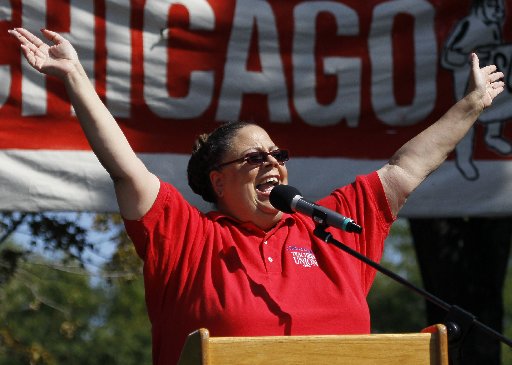
The latest issue of Rethinking Schools has a lengthy interview with Chicago Teachers Union president Karen Lewis. CTU was behind one of the most high-profile and potent strikes of the past year, and Lewis had some striking thoughts on the key to her union’s success:
It all comes down to how you teach people to fight with the tools they have. We have been fighting with the bosses’ tools. We can spend a lot of time doing legislation. I think that’s fine—have a legislative approach. But understand that you don’t control that process. We can talk about electing the right people, but ultimately, unless we have a state house full of teachers and paraprofessionals and clinicians, I don’t think we’ll get what we want coming out of state legislatures. You need to have good relationships with legislators; you need to have members get in touch and let them know what’s important to you. That’s one tool. But it’s not the only tool.
Our best tool is our ability to put 20,000 people in the street. I don’t care if one rich guy buys up all the ad space. The tool that we have is a mass movement. We have the pressure of mass mobilization and organizing.
Regular readers of The Ed Show blog have heard this before, but it bears repeating: For the left, nothing really beats traditional social movement organizing. The social movement activists of yore recognized, as Karen Lewis does, the real nature of politics: It’s not just about elections and legislation. “Politics,” properly understood, is the nature of how humans relate to each other in a society.
Social movements situate “non-political” spaces such as the workplace, the household, the street, the “Whites Only” diner, and so on, in their proper political context. They recognize that power does not just flow from the legislature, and not everything depends on who has the legislator’s ear. That is not to say that these movements found no place for the inside game—otherwise, we might not have the Civil Rights Act, the National Labor Relations Act and the Equal Pay Act. But as Lewis says, “that’s one tool.” No successful social movement in American history has confined its understanding of the political to what occurs in Washington.
When one accepts a narrower understanding of the political, one accepts that the only available tools are—to borrow Lewis’ phrase—the bosses’ tools. The way progressive groups obsess over how to use those tools explains much of the movement’s current weakness. The newly-minted Organizing For Action, the Democracy Initiative and the coalition of unions and liberal groups which lobbied Congress during the fiscal cliff battle have poured countless resources into seizing control of the bosses’ tools. At times, they’ve borrowed the language of the civil rights movement while disregarding the bulk of what the civil rights movement actually did. If politics consists solely of competition among elites, then the left is doomed. But if politics also means using mass power against elite institutions—as the Chicago Teachers Union did—then it might just have a fighting chance.
Ned Resnikoff is an urban policy analyst, researcher, writer, and editor. His byline has appeared in a variety of publications, including the New York Times, San Francisco Chronicle, Dissent, and The Nation. He writes the newsletter Public Comment, which can be found at publiccomment.blog. Recommended


