








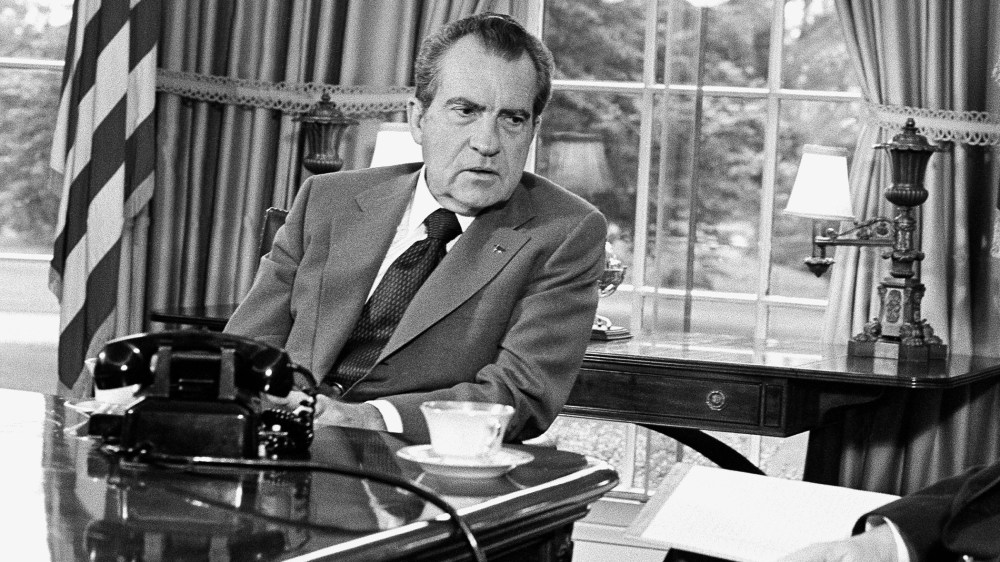
Today marks the 41st anniversary of the landmark case United States vs. Nixon, where the Supreme Court ruled unanimously against President Nixon. The text of United States v. Nixon — with a twist: Annotations have been added by the host of shift’s The Docket: Seema Iyer.
Click the yellow highlights to read the notes. Powered by Genius.com.
United States Supreme Court
UNITED STATES v. NIXON, (1974) No. 73-1766
Argued: July 8, 1974 Decided: July 24, 1974
[ Footnote * ] Together with No. 73-1834, Nixon, President of the United States v. United States, also on certiorari before judgment to the same court.
Following indictment alleging violation of federal statutes by certain staff members of the White House and political supporters of the President, the Special Prosecutor filed a motion under Fed. Rule Crim. Proc. 17 (c) for a subpoena duces tecum for the production before trial of certain tapes and documents relating to precisely identified conversations and meetings between the President and others. The President, claiming executive privilege, filed a motion to quash the subpoena. The District Court, after treating the subpoenaed material as presumptively privileged, concluded that the Special Prosecutor had made a sufficient showing to rebut the presumption and that the requirements of Rule 17 (c) had been satisfied. The court thereafter issued an order for an in camera examination of the subpoenaed material, having rejected the President’s contentions (a) that the dispute between him and the Special Prosecutor was nonjusticiable as an “intra-executive” conflict and (b) that the judiciary lacked authority to review the President’s assertion of executive privilege. The court stayed its order pending appellate review, which the President then sought in the Court of Appeals. The Special Prosecutor then filed in this Court a petition for a writ of certiorari before judgment (No. 73-1766) and the President filed a cross-petition for such a writ challenging the grand-jury action (No. 73-1834). The Court granted both petitions. Held:
1. The District Court’s order was appealable as a “final” order under 28 U.S.C. 1291, was therefore properly “in” the Court of Appeals, 28 U.S.C. 1254, when the petition for certiorari before judgment was filed in this Court, and is now properly before this Court for review. Although such an order is normally not final and subject to appeal, an exception is made in a “limited class of [418 U.S. 683, 684] [418 U.S. 683, 685] No. 73-1766, 377 F. Supp. 1326, affirmed; No. 73-1834, certiorari dismissed as improvidently granted. BURGER, C. J., delivered the opinion of the Court, in which all Members joined except REHNQUIST, J., who took no part in the consideration or decision of the cases. Leon Jaworski and Philip A. Lacovara argued the cause and filed briefs for the United States in both cases. James D. St. Clair argued the cause for the President [418 U.S. 683, 686] in both cases. With him on the briefs were Charles Alan Wright, Leonard Garment, Michael A. Sterlacci, Jerome J. Murphy, Loren A. Smith, James R. Prochnow, Theodore J. Garrish, James J. Tansey, and Larry G. Gutterridge. William Snow Frates, Andrew C. Hall, Spencer H. Boyer, and Henry H. Jones filed a brief for respondent Ehrlichman in No. 73-1766. John M. Bray filed a brief for respondent Strachan in No. 73-1766.Fn Fn [418 U.S. 683, 686] Norman Dorsen and Melvin L Wulf filed a brief for the American Civil Liberties Union as amicus curiae urging affirmance of the District Court judgment. MR. CHIEF JUSTICE BURGER delivered the opinion of the Court. This litigation presents for review the denial of a motion, filed in the District Court on behalf of the President of the United States, in the case of United States v. Mitchell (D.C. Crim. No. 74-110), to quash a third-party subpoena duces tecum issued by the United States District Court for the District of Columbia, pursuant to Fed. Rule Crim. Proc. 17 (c). The subpoena directed the President to produce certain tape recordings and documents relating to his conversations with aides and advisers. The court rejected the President’s claims of absolute executive privilege, of lack of jurisdiction, and of failure to satisfy the requirements of Rule 17 (c). The President appealed to the Court of Appeals. We granted both the United States’ petition for certiorari before judgment (No. 73-1766), 1 and also the President’s cross-petition for certiorari [418 U.S. 683, 687] before judgment (No. 73-1834), 2 because of the public importance of the issues presented and the need for their prompt resolution. 417 U.S. 927 and 960 (1974). On March 1, 1974, a grand jury of the United States District Court for the District of Columbia returned an indictment charging seven named individuals 3 with various offenses, including conspiracy to defraud the United States and to obstruct justice. Although he was not designated as such in the indictment, the grand jury named the President, among others, as an unindicted coconspirator. 4 On April 18, 1974, upon motion of the Special [418 U.S. 683, 688] Prosecutor, see n. 8, infra, a subpoena duces tecum was issued pursuant to Rule 17 (c) to the President by the United States District Court and made returnable on May 2, 1974. This subpoena required the production, in advance of the September 9 trial date, of certain tapes, memoranda, papers, transcripts, or other writings relating to certain precisely identified meetings between the President and others. 5 The Special Prosecutor was able to fix the time, place, and persons present at these discussions because the White House daily logs and appointment records had been delivered to him. On April 30, the President publicly released edited transcripts of 43 conversations; portions of 20 conversations subject to subpoena in the present case were included. On May 1, 1974, the President’s counsel filed a “special appearance” and a motion to quash the subpoena under Rule 17 (c). This motion was accompanied by a formal claim of privilege. At a subsequent hearing, 6 further motions to expunge the grand jury’s action naming the President as an unindicted coconspirator and for protective orders against the disclosure of that information were filed or raised orally by counsel for the President. On May 20, 1974, the District Court denied the motion to quash and the motions to expunge and for protective orders. 377 F. Supp. 1326. It further ordered “the President or any subordinate officer, official, or employee with custody or control of the documents or [418 U.S. 683, 689] objects subpoenaed,” id., at 1331, to deliver to the District Court, on or before May 31, 1974, the originals of all subpoenaed items, as well as an index and analysis of those items, together with tape copies of those portions of the subpoenaed recordings for which transcripts had been released to the public by the President on April 30. The District Court rejected jurisdictional challenges based on a contention that the dispute was nonjusticiable because it was between the Special Prosecutor and the Chief Executive and hence “intra-executive” in character; it also rejected the contention that the Judiciary was without authority to review an assertion of executive privilege by the President. The court’s rejection of the first challenge was based on the authority and powers vested in the Special Prosecutor by the regulation promulgated by the Attorney General; the court concluded that a justiciable controversy was presented. The second challenge was held to be foreclosed by the decision in Nixon v. Sirica, 159 U.S. App. D.C. 58, 487 F.2d 700 (1973). The District Court held that the judiciary, not the President, was the final arbiter of a claim of executive privilege. The court concluded that, under the circumstances of this case, the presumptive privilege was overcome by the Special Prosecutor’s prima facie “demonstration of need sufficiently compelling to warrant judicial examination in chambers . . . .” 377 F. Supp., at 1330. The court held, finally, that the Special Prosecutor had satisfied the requirements of Rule 17 (c). The District Court stayed its order pending appellate review on condition that review was sought before 4 p. m., May 24. The court further provided that matters filed under seal remain under seal when transmitted as part of the record. On May 24, 1974, the President filed a timely notice of appeal from the District Court order, and the certified record from the District Court was docketed in the United [418 U.S. 683, 690] States Court of Appeals for the District of Columbia Circuit. On the same day, the President also filed a petition for writ of mandamus in the Court of Appeals seeking review of the District Court order. Later on May 24, the Special Prosecutor also filed, in this Court, a petition for a writ of certiorari before judgment. On May 31, the petition was granted with an expedited briefing schedule. 417 U.S. 927 . On June 6, the President filed, under seal, a cross-petition for writ of certiorari before judgment. This cross-petition was granted June 15, 1974, 417 U.S. 960 , and the case was set for argument on July 8, 1974. I The threshold question presented is whether the May 20, 1974, order of the District Court was an appealable order and whether this case was properly “in” the Court of Appeals when the petition for certiorari was filed in this Court. 28 U.S.C. 1254. The Court of Appeals’ jurisdiction under 28 U.S.C. 1291 encompasses only “final decisions of the district courts.” Since the appeal was timely filed and all other procedural requirements were met, the petition is properly before this Court for consideration if the District Court order was final. 28 U.S.C. 1254 (1), 2101 (e). The finality requirements of 28 U.S.C. 1291 embodies a strong congressional policy against piecemeal reviews, and against obstructing or impeding an ongoing judicial proceeding by interlocutory appeals. See, e. g., Cobbledick v. United States, 309 U.S. 323, 324 -326 (1940). This requirement ordinarily promotes judicial efficiency and hastens the ultimate termination of litigation. In applying this principle to an order denying a motion to quash and requiring the production of evidence pursuant [418 U.S. 683, 691] to a subpoena duces tecum, it has been repeatedly held that the order is not final and hence not appealable. United States v. Ryan, 402 U.S. 530, 532 (1971); Cobbledick v. United States, supra; Alexander v. United States, 201 U.S. 117 (1906). This Court has The requirement of submitting to contempt, however, is not without exception and in some instances the purposes underlying the finality rule require a different result. For example, in Perlman v. United States, 247 U.S. 7 (1918), a subpoena had been directed to a third party requesting certain exhibits; the appellant, who owned the exhibits, sought to raise a claim of privilege. The Court held an order compelling production was appealable because it was unlikely that the third party would risk a contempt citation in order to allow immediate review of the appellant’s claim of privilege. Id., at 12-13. That case fell within the “limited class of cases where denial of immediate review would render impossible any review whatsoever of an individual’s claims.” United States v. Ryan, supra, at 533. Here too, the traditional contempt avenue to immediate appeal is peculiarly inappropriate due to the unique setting in which the question arises. To require a President of the United States to place himself in the posture of disobeying an order of a court merely to trigger the procedural mechanism for review of the ruling would be [418 U.S. 683, 692] unseemly, and would present an unnecessary occasion for constitutional confrontation between two branches of the Government. Similarly, a federal judge should not be placed in the posture of issuing a citation to a President simply in order to invoke review. The issue whether a President can be cited for contempt could itself engender protracted litigation, and would further delay both review on the merits of his claim of privilege and the ultimate termination of the underlying criminal action for which his evidence is sought. These considerations lead us to conclude that the order of the District Court was an appealable order. The appeal from that order was therefore properly “in” the Court of Appeals, and the case is now properly before this Court on the writ of certiorari before judgment. 28 U.S.C. 1254; 28 U.S.C. 2101 (e). Gay v. Ruff, 292 U.S. 25, 30 (1934). 7 II In the District Court, the President’s counsel argued that the court lacked jurisdiction to issue the subpoena because the matter was an intra-branch dispute between a subordinate and superior officer of the Executive Branch and hence not subject to judicial resolution. That argument has been renewed in this Court with emphasis on the contention that the dispute does not present a “case” or “controversy” which can be adjudicated in the federal courts. The President’s counsel argues that the federal courts should not intrude into areas committed to the other branches of Government. [418 U.S. 683, 693] He views the present dispute as essentially a “jurisdictional” dispute within the Executive Branch which he analogizes to a dispute between two congressional committees. Since the Executive Branch has exclusive authority and absolute discretion to decide whether to prosecute a case, Confiscation Cases, 7 Wall. 454 (1869); United States v. Cox, 342 F.2d 167, 171 (CA5), cert. denied sub nom. Cox v. Hauberg, 381 U.S. 935 (1965), it is contended that a President’s decision is final in determining what evidence is to be used in a given criminal case. Although his counsel concedes that the President has delegated certain specific powers to the Special Prosecutor, he has not “waived nor delegated to the Special Prosecutor the President’s duty to claim privilege as to all materials . . . which fall within the President’s inherent authority to refuse to disclose to any executive officer.” Brief for the President 42. The Special Prosecutor’s demand for the items therefore presents, in the view of the President’s counsel, a political question under Baker v. Carr, 369 U.S. 186 (1962), since it involves a “textually demonstrable” grant of power under Art. II. The mere assertion of a claim of an “intra-branch dispute,” without more, has never operated to defeat federal jurisdiction; justiciability does not depend on such a surface inquiry. In United States v. ICC, 337 U.S. 426 (1949), the Court observed, “courts must look behind names that symbolize the parties to determine whether a justiciable case or controversy is presented.” Id., at 430. See also Powell v. McCormack, 395 U.S. 486 (1969); ICC v. Jersey City, 322 U.S. 503 (1944); United States ex rel. Chapman v. FPC, 345 U.S. 153 (1953); Secretary of Agriculture v. United States, 347 U.S. 645 (1954); FMB v. Isbrandtsen Co.,356 U.S. 481, 483 n. 2 (1958); United States v. Marine Bancorporation, ante, p. 602; and United States v. Connecticut National Bank, ante, p. 656. [418 U.S. 683, 694] Our starting point is the nature of the proceeding for which the evidence is sought – here a pending criminal prosecution. It is a judicial proceeding in a federal court alleging violation of federal laws and is brought in the name of the United States as sovereign. Berger v. United States, 295 U.S. 78, 88 (1935). Under the authority of Art. II, 2, Congress has vested in the Attorney General the power to conduct the criminal litigation of the United States Government. 28 U.S.C. 516. It has also vested in him the power to appoint subordinate officers to assist him in the discharge of his duties. 28 U.S.C. 509, 510, 515, 533. Acting pursuant to those statutes, the Attorney General has delegated the authority to represent the United States in these particular matters to a Special Prosecutor with unique authority and tenure. 8 The regulation gives the [418 U.S. 683, 695] Special Prosecutor explicit power to contest the invocation of executive privilege in the process of seeking evidence deemed relevant to the performance of these specially delegated duties. 9 38 Fed. Reg. 30739, as amended by 38 Fed. Reg. 32805. So long as this regulation is extant it has the force of law. In United States ex rel. Accardi v. Shaughnessy, 347 U.S. 260 (1954), regulations of the Attorney General delegated certain of his discretionary powers to the Board [418 U.S. 683, 696] of Immigration Appeals and required that Board to exercise its own discretion on appeals in deportation cases. The Court held that so long as the Attorney General’s regulations remained operative, he denied himself the authority to exercise the discretion delegated to the Board even though the original authority was his and he could reassert it by amending the regulations. Service v. Dulles, 354 U.S. 363, 388 (1957), and Vitarelli v. Seaton, 359 U.S. 535 (1959), reaffirmed the basic holding of Accardi. Here, as in Accardi, it is theoretically possible for the Attorney General to amend or revoke the regulation defining the Special Prosecutor’s authority. But he has not done so. 10 So long as this regulation remains in force the Executive Branch is bound by it, and indeed the United States as the sovereign composed of the three branches is bound to respect and to enforce it. Moreover, the delegation of authority to the Special Prosecutor in this case is not an ordinary delegation by the Attorney General to a subordinate officer: with the authorization of the President, the Acting Attorney General provided in the regulation that the Special Prosecutor was not to be removed without the “consensus” of eight designated leaders of Congress. N. 8, supra. The demands of and the resistance to the subpoena present an obvious controversy in the ordinary sense, but that alone is not sufficient to meet constitutional standards. In the constitutional sense, controversy means more than disagreement and conflict; rather it means the kind of controversy courts traditionally resolve. Here [418 U.S. 683, 697] at issue is the production or nonproduction of specified evidence deemed by the Special Prosecutor to be relevant and admissible in a pending criminal case. It is sought by one official of the Executive Branch within the scope of his express authority; it is resisted by the Chief Executive on the ground of his duty to preserve the confidentiality of the communications of the President. Whatever the correct answer on the merits, these issues are “of a type which are traditionally justiciable.” United States v. ICC, 337 U.S., at 430 . The independent Special Prosecutor with his asserted need for the subpoenaed material in the underlying criminal prosecution is opposed by the President with his steadfast assertion of privilege against disclosure of the material. This setting assures there is “that concrete adverseness which sharpens the presentation of issues upon which the court so largely depends for illumination of difficult constitutional questions.” Baker v. Carr, 369 U.S., at 204 . Moreover, since the matter is one arising in the regular course of a federal criminal prosecution, it is within the traditional scope of Art. III power. Id., at 198. In light of the uniqueness of the setting in which the conflict arises, the fact that both parties are officers of the Executive Branch cannot be viewed as a barrier to justiciability. It would be inconsistent with the applicable law and regulation, and the unique facts of this case to conclude other than that the Special Prosecutor has standing to bring this action and that a justiciable controversy is presented for decision. III The subpoena duces tecum is challenged on the ground that the Special Prosecutor failed to satisfy the requirements of Fed. Rule Crim. Proc. 17 (c), which governs [418 U.S. 683, 698] the issuance of subpoenas duces tecum in federal criminal proceedings. If we sustained this challenge, there would be no occasion to reach the claim of privilege asserted with respect to the subpoenaed material. Thus we turn to the question whether the requirements of Rule 17 (c) have been satisfied. See Arkansas Louisiana Gas Co. v. Dept. of Public Utilities, 304 U.S. 61, 64 (1938); Ashwander v. TVA, 297 U.S. 288, 346 -347 (1936) (Brandeis, J., concurring). Rule 17 (c) provides: A subpoena for documents may be quashed if their production would be “unreasonable or oppressive,” but not otherwise. The leading case in this Court interpreting this standard is Bowman Dairy Co. v. United States, 341 U.S. 214 (1951). This case recognized certain fundamental characteristics of the subpoena duces tecum in criminal cases: (1) it was not intended to provide a means of discovery for criminal cases, id., at 220; (2) its chief innovation was to expedite the trial by providing a time and place before trial for the inspection of [418 U.S. 683, 699] subpoenaed materials, 11 ibid. As both parties agree, cases decided in the wake of Bowman have generally followed Judge Weinfeld’s formulation in United States v. Iozia, 13 F. R. D. 335, 338 (SDNY 1952), as to the required showing. Under this test, in order to require production prior to trial, the moving party must show: (1) that the documents are evidentiary 12 and relevant; (2) that they are not otherwise procurable reasonably in advance of trial by exercise of due diligence; (3) that the party cannot properly prepare for trial without such production and inspection in advance of trial and that the failure to obtain such inspection may tend unreasonably to delay the trial; and (4) that [418 U.S. 683, 700] the application is made in good faith and is not intended as a general “fishing expedition.” Against this background, the Special Prosecutor, in order to carry his burden, must clear three hurdles: (1) relevancy; (2) admissibility; (3) specificity. Our own review of the record necessarily affords a less comprehensive view of the total situation than was available to the trial judge and we are unwilling to conclude that the District Court erred in the evaluation of the Special Prosecutor’s showing under Rule 17 (c). Our conclusion is based on the record before us, much of which is under seal. Of course, the contents of the subpoenaed tapes could not at that stage be described fully by the Special Prosecutor, but there was a sufficient likelihood that each of the tapes contains conversations relevant to the offenses charged in the indictment. United States v. Gross, 24 F. R. D. 138 (SDNY 1959). With respect to many of the tapes, the Special Prosecutor offered the sworn testimony or statements of one or more of the participants in the conversations as to what was said at the time. As for the remainder of the tapes, the identity of the participants and the time and place of the conversations, taken in their total context, permit a rational inference that at least part of the conversations relate to the offenses charged in the indictment. We also conclude there was a sufficient preliminary showing that each of the subpoenaed tapes contains evidence admissible with respect to the offenses charged in the indictment. The most cogent objection to the admissibility of the taped conversations here at issue is that they are a collection of out-of-court statements by declarants who will not be subject to cross-examination and that the statements are therefore inadmissible hearsay. Here, however, most of the tapes apparently contain conversations [418 U.S. 683, 701] to which one or more of the defendants named in the indictment were party. The hearsay rule does not automatically bar all out-of-court statements by a defendant in a criminal case. 13 Declarations by one defendant may also be admissible against other defendants upon a sufficient showing, by independent evidence, 14 of a conspiracy among one or more other defendants and the declarant and if the declarations at issue were in furtherance of that conspiracy. The same is true of declarations of coconspirators who are not defendants in the case on trial. Dutton v. Evans, 400 U.S. 74, 81 (1970). Recorded conversations may also be admissible for the limited purpose of impeaching the credibility of any defendant who testifies or any other coconspirator who testifies. Generally, the need for evidence to impeach witnesses is insufficient to require its production in advance of trial. See, e. g., United States v. Carter, 15 F. R. D. 367, [418 U.S. 683, 702] 371 (DC 1954). Here, however, there are other valid potential evidentiary uses for the same material, and the analysis and possible transcription of the tapes may take a significant period of time. Accordingly, we cannot conclude that the District Court erred in authorizing the issuance of the subpoena duces tecum. Enforcement of a pretrial subpoena duces tecum must necessarily be committed to the sound discretion of the trial court since the necessity for the subpoena most often turns upon a determination of factual issues. Without a determination of arbitrariness or that the trial court finding was without record support, an appellate court will not ordinarily disturb a finding that the applicant for a subpoena complied with Rule 17 (c). See, e. g., Sue v. Chicago Transit Authority, 279 F.2d 416, 419 (CA7 1960); Shotkin v. Nelson, 146 F.2d 402 (CA10 1944). In a case such as this, however, where a subpoena is directed to a President of the United States, appellate review, in deference to a coordinate branch of Government, should be particularly meticulous to ensure that the standards of Rule 17 (c) have been correctly applied. United States v. Burr, 25 F. Cas. 30, 34 (No. 14,692d) (CC Va. 1807). From our examination of the materials submitted by the Special Prosecutor to the District Court in support of his motion for the subpoena, we are persuaded that the District Court’s denial of the President’s motion to quash the subpoena was consistent with Rule 17 (c). We also conclude that the Special Prosecutor has made a sufficient showing to justify a subpoena for production before trial. The subpoenaed materials are not available from any other source, and their examination and processing should not await trial in the circumstances shown. Bowman Dairy Co. v. United States, 341 U.S. 214 (1951); United States v. Iozia, 13 F. R. D. 335 (SDNY 1952). [418 U.S. 683, 703] IV A Having determined that the requirements of Rule 17 (c) were satisfied, we turn to the claim that the subpoena should be quashed because it demands “confidential conversations between a President and his close advisors that it would be inconsistent with the public interest to produce.” App. 48a. The first contention is a broad claim that the separation of powers doctrine precludes judicial review of a President’s claim of privilege. The second contention is that if he does not prevail on the claim of absolute privilege, the court should hold as a matter of constitutional law that the privilege prevails over the subpoena duces tecum. In the performance of assigned constitutional duties each branch of the Government must initially interpret the Constitution, and the interpretation of its powers by any branch is due great respect from the others. The President’s counsel, as we have noted, reads the Constitution as providing an absolute privilege of confidentiality for all Presidential communications. Many decisions of this Court, however, have unequivocally reaffirmed the holding of Marbury v. Madison, 1 Cranch 137 (1803), that “[i]t is emphatically the province and duty of the judicial department to say what the law is.” Id., at 177. No holding of the Court has defined the scope of judicial power specifically relating to the enforcement of a subpoena for confidential Presidential communications for use in a criminal prosecution, but other exercises of power by the Executive Branch and the Legislative Branch have been found invalid as in conflict with the Constitution. Powell v. McCormack, 395 U.S. 486 (1969); Youngstown Sheet & Tube Co. v. Sawyer, 343 U.S. 579 (1952). In a [418 U.S. 683, 704] series of cases, the Court interpreted the explicit immunity conferred by express provisions of the Constitution on Members of the House and Senate by the Speech or Debate Clause, U.S. Const. Art. I, 6. Doe v. McMillan, 412 U.S. 306 (1973); Gravel v. United States, 408 U.S. 606 (1972); United States v. Brewster, 408 U.S. 501 (1972); United States v. Johnson, 383 U.S. 169 (1966). Since this Court has consistently exercised the power to construe and delineate claims arising under express powers, it must follow that the Court has authority to interpret claims with respect to powers alleged to derive from enumerated powers. Our system of government “requires that federal courts on occasion interpret the Constitution in a manner at variance with the construction given the document by another branch.” Powell v. McCormack, supra, at 549. And in Baker v. Carr, 369 U.S., at 211 , the Court stated: Notwithstanding the deference each branch must accord the others, the “judicial Power of the United States” vested in the federal courts by Art. III, 1, of the Constitution can no more be shared with the Executive Branch than the Chief Executive, for example, can share with the Judiciary the veto power, or the Congress share with the Judiciary the power to override a Presidential veto. Any other conclusion would be contrary to the basic concept of separation of powers and the checks and balances that flow from the scheme of a tripartite government. The Federalist, No. 47, p. 313 (S. Mittell ed. [418 U.S. 683, 705] 1938). We therefore reaffirm that it is the province and duty of this Court “to say what the law is” with respect to the claim of privilege presented in this case. Marbury v. Madison, supra, at 177. B In support of his claim of absolute privilege, the President’s counsel urges two grounds, one of which is common to all governments and one of which is peculiar to our system of separation of powers. The first ground is the valid need for protection of communications between high Government officials and those who advise and assist them in the performance of their manifold duties; the importance of this confidentiality is too plain to require further discussion. Human experience teaches that those who expect public dissemination of their remarks may well temper candor with a concern for appearances and for their own interests to the detriment of the decisionmaking process. 15 Whatever the nature of the privilege of confidentiality of Presidential communications in the exercise of Art. II powers, the privilege can be said to derive from the supremacy of each branch within its own assigned area of constitutional duties. Certain powers and privileges flow from the nature of enumerated powers; 16 the protection of the confidentiality of [418 U.S. 683, 706] Presidential communications has similar constitutional underpinnings. The second ground asserted by the President’s counsel in support of the claim of absolute privilege rests on the doctrine of separation of powers. Here it is argued that the independence of the Executive Branch within its own sphere, Humphrey’s Executor v. United States, 295 U.S. 602, 629 -630 (1935); Kilbourn v. Thompson, 103 U.S. 168, 190 -191 (1881), insulates a President from a judicial subpoena in an ongoing criminal prosecution, and thereby protects confidential Presidential communications. However, neither the doctrine of separation of powers, nor the need for confidentiality of high-level communications, without more, can sustain an absolute, unqualified Presidential privilege of immunity from judicial process under all circumstances. The President’s need for complete candor and objectivity from advisers calls for great deference from the courts. However, when the privilege depends solely on the broad, undifferentiated claim of public interest in the confidentiality of such conversations, a confrontation with other values arises. Absent a claim of need to protect military, diplomatic, or sensitive national security secrets, we find it difficult to accept the argument that even the very important interest in confidentiality of Presidential communications is significantly diminished by production of such material for in camera inspection with all the protection that a district court will be obliged to provide. [418 U.S. 683, 707] The impediment that an absolute, unqualified privilege would place in the way of the primary constitutional duty of the Judicial Branch to do justice in criminal prosecutions would plainly conflict with the function of the courts under Art. III. In designing the structure of our Government and dividing and allocating the sovereign power among three co-equal branches, the Framers of the Constitution sought to provide a comprehensive system, but the separate powers were not intended to operate with absolute independence. To read the Art. II powers of the President as providing an absolute privilege as against a subpoena essential to enforcement of criminal statutes on no more than a generalized claim of the public interest in confidentiality of nonmilitary and nondiplomatic discussions would upset the constitutional balance of “a workable government” and gravely impair the role of the courts under Art. III. C
Since we conclude that the legitimate needs of the judicial process may outweigh Presidential privilege, it is necessary to resolve those competing interests in a manner that preserves the essential functions of each branch. The right and indeed the duty to resolve that question does not free the Judiciary from according high respect to the representations made on behalf of the President. United States v. Burr, 25 F. Cas. 187, 190, 191-192 (No. 14,694) (CC Va. 1807). [418 U.S. 683, 708] The expectation of a President to the confidentiality of his conversations and correspondence, like the claim of confidentiality of judicial deliberations, for example, has all the values to which we accord deference for the privacy of all citizens and, added to those values, is the necessity for protection of the public interest in candid, objective, and even blunt or harsh opinions in Presidential decision-making. A President and those who assist him must be free to explore alternatives in the process of shaping policies and making decisions and to do so in a way many would be unwilling to express except privately. These are the considerations justifying a presumptive privilege for Presidential communications. The privilege is fundamental to the operation of Government and inextricably rooted in the separation of powers under the Constitution. 17 In Nixon v. Sirica, 159 U.S. App. D.C. 58, 487 F.2d 700 (1973), the Court of Appeals held that such Presidential communications are “presumptively privileged,” id., at 75, 487 F.2d, at 717, and this position is accepted by both parties in the present litigation. We agree with Mr. Chief Justice Marshall’s observation, therefore, that “[i]n no case of this kind would a court be required to proceed against the president as against an ordinary individual.” United States v. Burr, 25 F. Cas., at 192. But this presumptive privilege must be considered in light of our historic commitment to the rule of law. This [418 U.S. 683, 709] is nowhere more profoundly manifest than in our view that “the twofold aim [of criminal justice] is that guilt shall not escape or innocence suffer.” Berger v. United States, 295 U.S., at 88 . We have elected to employ an adversary system of criminal justice in which the parties contest all issues before a court of law. The need to develop all relevant facts in the adversary system is both fundamental and comprehensive. The ends of criminal justice would be defeated if judgments were to be founded on a partial or speculative presentation of the facts. The very integrity of the judicial system and public confidence in the system depend on full disclosure of all the facts, within the framework of the rules of evidence. To ensure that justice is done, it is imperative to the function of courts that compulsory process be available for the production of evidence needed either by the prosecution or by the defense. Only recently the Court restated the ancient proposition of law, albeit in the context of a grand jury inquiry rather than a trial, The privileges referred to by the Court are designed to protect weighty and legitimate competing interests. Thus, the Fifth Amendment to the Constitution provides that no man “shall be compelled in any criminal case to be a witness against himself.” And, generally, an attorney or a priest may not be required to disclose what has been revealed in professional confidence. These and other interests are recognized in law by privileges [418 U.S. 683, 710] against forced disclosure, established in the Constitution, by statute, or at common law. Whatever their origins, these exceptions to the demand for every man’s evidence are not lightly created nor expansively construed, for they are in derogation of the search for truth. 18 In this case the President challenges a subpoena served on him as a third party requiring the production of materials for use in a criminal prosecution; he does so on the claim that he has a privilege against disclosure of confidential communications. He does not place his claim of privilege on the ground they are military or diplomatic secrets. As to these areas of Art. II duties the courts have traditionally shown the utmost deference to Presidential responsibilities. In C. & S. Air Lines v. Waterman S. S. Corp., 333 U.S. 103, 111 (1948), dealing with Presidential authority involving foreign policy considerations, the Court said: In United States v. Reynolds, 345 U.S. 1 (1953), dealing [418 U.S. 683, 711] with a claimant’s demand for evidence in a Tort Claims Act case against the Government, the Court said: No case of the Court, however, has extended this high degree of deference to a President’s generalized interest in confidentiality. Nowhere in the Constitution, as we have noted earlier, is there any explicit reference to a privilege of confidentiality, yet to the extent this interest relates to the effective discharge of a President’s powers, it is constitutionally based. The right to the production of all evidence at a criminal trial similarly has constitutional dimensions. The Sixth Amendment explicitly confers upon every defendant in a criminal trial the right “to be confronted with the witnesses against him” and “to have compulsory process for obtaining witnesses in his favor.” Moreover, the Fifth Amendment also guarantees that no person shall be deprived of liberty without due process of law. It is the manifest duty of the courts to vindicate those guarantees, and to accomplish that it is essential that all relevant and admissible evidence be produced. In this case we must weigh the importance of the general privilege of confidentiality of Presidential communications in performance of the President’s responsibilities against the inroads of such a privilege on the fair [418 U.S. 683, 712] administration of criminal justice. 19 The interest in preserving confidentiality is weighty indeed and entitled to great respect. However, we cannot conclude that advisers will be moved to temper the candor of their remarks by the infrequent occasions of disclosure because of the possibility that such conversations will be called for in the context of a criminal prosecution. 20 On the other hand, the allowance of the privilege to withhold evidence that is demonstrably relevant in a criminal trial would cut deeply into the guarantee of due process of law and gravely impair the basic function of the courts. A President’s acknowledged need for confidentiality [418 U.S. 683, 713] in the communications of his office is general in nature, whereas the constitutional need for production of relevant evidence in a criminal proceeding is specific and central to the fair adjudication of a particular criminal case in the administration of justice. Without access to specific facts a criminal prosecution may be totally frustrated. The President’s broad interest in confidentiality of communications will not be vitiated by disclosure of a limited number of conversations preliminarily shown to have some bearing on the pending criminal cases. We conclude that when the ground for asserting privilege as to subpoenaed materials sought for use in a criminal trial is based only on the generalized interest in confidentiality, it cannot prevail over the fundamental demands of due process of law in the fair administration of criminal justice. The generalized assertion of privilege must yield to the demonstrated, specific need for evidence in a pending criminal trial. D We have earlier determined that the District Court did not err in authorizing the issuance of the subpoena. If a President concludes that compliance with a subpoena would be injurious to the public interest he may properly, as was done here, invoke a claim of privilege on the return of the subpoena. Upon receiving a claim of privilege from the Chief Executive, it became the further duty of the District Court to treat the subpoenaed material as presumptively privileged and to require the Special Prosecutor to demonstrate that the Presidential material was “essential to the justice of the [pending criminal] case.” United States v. Burr, 25 F. Cas., at 192. Here the District Court treated the material as presumptively privileged, proceeded to find that the Special [418 U.S. 683, 714] Prosecutor had made a sufficient showing to rebut the presumption, and ordered an in camera examination of the subpoenaed material. On the basis of our examination of the record we are unable to conclude that the District Court erred in ordering the inspection. Accordingly we affirm the order of the District Court that subpoenaed materials be transmitted to that court. We now turn to the important question of the District Court’s responsibilities in conducting the in camera examination of Presidential materials or communications delivered under the compulsion of the subpoena duces tecum. E Enforcement of the subpoena duces tecum was stayed pending this Court’s resolution of the issues raised by the petitions for certiorari. Those issues now having been disposed of, the matter of implementation will rest with the District Court. “[T]he guard, furnished to [the President] to protect him from being harassed by vexatious and unnecessary subpoenas, is to be looked for in the conduct of a [district] court after those subpoenas have issued; not in any circumstance which is to precede their being issued.” United States v. Burr, 25 F. Cas., at 34. Statements that meet the test of admissibility and relevance must be isolated; all other material must be excised. At this stage the District Court is not limited to representations of the Special Prosecutor as to the evidence sought by the subpoena; the material will be available to the District Court. It is elementary that in camera inspection of evidence is always a procedure calling for scrupulous protection against any release or publication of material not found by the court, at that stage, probably admissible in evidence and relevant to the issues of the trial for which it is sought. That being true of an ordinary situation, it is obvious that the District Court has [418 U.S. 683, 715] a very heavy responsibility to see to it that Presidential conversations, which are either not relevant or not admissible, are accorded that high degree of respect due the President of the United States. Mr. Chief Justice Marshall, sitting as a trial judge in the Burr case, supra, was extraordinarily careful to point out that Marshall’s statement cannot be read to mean in any sense that a President is above the law, but relates to the singularly unique role under Art. II of a President’s communications and activities, related to the performance of duties under that Article. Moreover, a President’s communications and activities encompass a vastly wider range of sensitive material than would be true of any “ordinary individual.” It is therefore necessary 21 in the public interest to afford Presidential confidentiality the greatest protection consistent with the fair administration of justice. The need for confidentiality even as to idle conversations with associates in which casual reference might be made concerning political leaders within the country or foreign statesmen is too obvious to call for further treatment. We have no doubt that the District Judge will at all times accord to Presidential records that high degree of deference suggested in United States v. Burr, supra, and will discharge his responsibility to see to [418 U.S. 683, 716] it that until released to the Special Prosecutor no in camera material is revealed to anyone. This burden applies with even greater force to excised material; once the decision is made to excise, the material is restored to its privileged status and should be returned under seal to its lawful custodian. Since this matter came before the Court during the pendency of a criminal prosecution, and on representations that time is of the essence, the mandate shall issue forthwith. MR. JUSTICE REHNQUIST took no part in the consideration or decision of these cases. Footnotes[ Footnote 1 ] See 28 U.S.C. 1254 (1) and 2101 (e) and our Rule 20. See, e. g., Youngstown Sheet & Tube Co. v. Sawyer, 343 U.S. 579 (1952); United States v. United Mine Workers, 330 U.S. 258 (1947); Carter v. Carter Coal Co, 298 U.S. 238 (1936); Rickert Rice Mills v. Fontenot, 297 U.S. 110 (1936); Railroad Retirement Board v. Alton R. Co., 295 U.S. 330 (1935); Norman v. Baltimore & Ohio R. Co, 294 U.S. 240 (1935). [ Footnote 2 ] The cross-petition in No. 73-1834 raised the issue whether the grand jury acted within its authority in naming the President as an unindicted coconspirator. Since we find resolution of this issue unnecessary to resolution of the question whether the claim of privilege is to prevail, the cross-petition for certiorari is dismissed as improvidently granted and the remainder of this opinion is concerned with the issues raised in No. 73-1766. On June 19, 1974, the President’s counsel moved for disclosure and transmittal to this Court of all evidence presented to the grand jury relating to its action in naming the President as an unindicted coconspirator. Action on this motion was deferred pending oral argument of the case and is now denied. [ Footnote 3 ] The seven defendants were John N. Mitchell, H. R. Haldeman, John D. Ehrlichman, Charles W. Colson, Robert C. Mardian, Kenneth W. Parkinson, and Gordon Strachan. Each had occupied either a position of responsibility on the White House staff or a position with the Committee for the Re-election of the President. Colson entered a guilty plea on another charge and is no longer a defendant. [ Footnote 4 ] The President entered a special appearance in the District Court on June 6 and requested that court to lift its protective order regarding the naming of certain individuals as coconspirators and to any additional extent deemed appropriate by the Court. This motion of the President was based on the ground that the disclosures to the news media made the reasons for continuance of the protective order no longer meaningful. On June 7, the District Court removed its protective order and, on June 10, counsel for both parties jointly moved this Court to unseal those parts of the record which related to the action of the grand jury regarding the President. After receiving [418 U.S. 683, 688] a statement in opposition from the defendants, this Court denied that motion on June 15, 1974, except for the grand jury’s immediate finding relating to the status of the President as an unindicted coconspirator. 417 U.S. 960. [ Footnote 5 ] The specific meetings and conversations are enumerated in a schedule attached to the subpoena. App. 42a-46a. [ Footnote 6 ] At the joint suggestion of the Special Prosecutor and counsel for the President, and with the approval of counsel for the defendants, further proceedings in the District Court were held in camera. [ Footnote 7 ] The parties have suggested that this Court has jurisdiction on other grounds. In view of our conclusion that there is jurisdiction under 28 U.S.C. 1254 (1) because the District Court’s order was appealable, we need not decide whether other jurisdictional vehicles are available. [ Footnote 8 ] The regulation issued by the Attorney General pursuant to his statutory authority, vests in the Special Prosecutor plenary authority to control the course of investigations and litigation related to “all offenses arising out of the 1972 Presidential Election for which the Special Prosecutor deems it necessary and appropriate to assume responsibility, allegations involving the President, members of the White House staff, or Presidential appointees, and any other matters which he consents to have assigned to him by the Attorney General.” 38 Fed. Reg. 30739, as amended by 38 Fed. Reg. 32805. In particular, the Special Prosecutor was given full authority, inter alia, “to contest the assertion of `Executive Privilege’ . . . and handl[e] all aspects of any cases within his jurisdiction.” Id., at 30739. The regulation then goes on to provide: [418 U.S. 683, 695] [ Footnote 9 ] That this was the understanding of Acting Attorney General Robert Bork, the author of the regulation establishing the independence of the Special Prosecutor, is shown by his testimony before the Senate Judiciary Committee: Hearings on the Special Prosecutor before the Senate Committee on the Judiciary, 93d Cong., 1st Sess., pt. 2, p. 450 (1973). Acting Attorney General Bork gave similar assurances to the House Subcommittee on Criminal Justice. Hearings on H. J. Res. 784 and H. R. 10937 before the Subcommittee on Criminal Justice of the House Committee on the Judiciary, 93d Cong., 1st Sess., 266 (1973). At his confirmation hearings, Attorney General William Saxbe testified that he shared Acting Attorney General Bork’s views concerning the Special Prosecutor’s authority to test any claim of executive privilege in the courts. Hearings on the Nomination of William B. Saxbe to be Attorney General before the Senate Committee on the Judiciary, 93d Cong., 1st Sess., 9 (1973). [ Footnote 10 ] At his confirmation hearings, Attorney General William Saxbe testified that he agreed with the regulation adopted by Acting Attorney General Bork and would not remove the Special Prosecutor except for “gross impropriety.” Id., at 5-6, 8-10. There is no contention here that the Special Prosecutor is guilty of any such impropriety. [ Footnote 11 ] The Court quoted a statement of a member of the advisory committee that the purpose of the Rule was to bring documents into court “in advance of the time that they are offered in evidence, so that they may then be inspected in advance, for the purpose . . . of enabling the party to see whether he can use [them] or whether he wants to use [them].” 341 U.S., at 220 n. 5. The Manual for Complex and Multidistrict Litigation published by the Federal Judicial Center recommends that use of Rule 17 (c) be encouraged in complex criminal cases in order that each party may be compelled to produce its documentary evidence well in advance of trial and in advance of the time it is to be offered. P. 150. [ Footnote 12 ] The District Court found here that it was faced with “the more unusual situation . . . where the subpoena, rather than being directed to the government by defendants, issues to what, as a practical matter, is a third party.” United States v. Mitchell, 377 F. Supp. 1326, 1330 (DC 1974). The Special Prosecutor suggests that the evidentiary requirement of Bowman Dairy Co. and Iozia does not apply in its full vigor when the subpoena duces tecum is issued to third parties rather than to government prosecutors. Brief for United States 128-129. We need not decide whether a lower standard exists because we are satisfied that the relevance and evidentiary nature of the subpoenaed tapes were sufficiently shown as a preliminary matter to warrant the District Court’s refusal to quash the subpoena. [ Footnote 13 ] Such statements are declarations by a party defendant that “would surmount all objections based on the hearsay rule . . .” and, at least as to the declarant himself, “would be admissible for whatever inferences” might be reasonably drawn. United States v. Matlock, 415 U.S. 164, 172 (1974). On Lee v. United States, 343 U.S. 747, 757 (1952). See also C. McCormick, Evidence 270, pp. 651-652 (2d ed. 1972). [ Footnote 14 ] As a preliminary matter, there must be substantial, independent evidence of the conspiracy, at least enough to take the question to the jury. United States v. Vaught, 485 F.2d 320, 323 (CA4 1973); United States v. Hoffa, 349 F.2d 20, 41-42 (CA6 1965), aff’d on other grounds, 385 U.S. 293 (1966); United States v. Santos, 385 F.2d 43, 45 (CA7 1967), cert. denied, 390 U.S. 954 (1968); United States v. Morton, 483 F.2d 573, 576 (CA8 1973); United States v. Spanos, 462 F.2d 1012, 1014 (CA9 1972); Carbo v. United States, 314 F.2d 718, 737 (CA9 1963), cert. denied, 377 U.S. 953 (1964). Whether the standard has been satisfied is a question of admissibility of evidence to be decided by the trial judge. [ Footnote 15 ] There is nothing novel about governmental confidentiality. The meetings of the Constitutional Convention in 1787 were conducted in complete privacy. 1 M. Farrand, The Records of the Federal Convention of 1787, pp. xi-xxv (1911). Moreover, all records of those meetings were sealed for more than 30 years after the Convention. See 3 Stat. 475, 15th Cong., 1st Sess., Res. 8 (1818). Most of the Framers acknowledged that without secrecy no constitution of the kind that was developed could have been written. C. Warren, The Making of the Constitution 134-139 (1937). [ Footnote 16 ] The Special Prosecutor argues that there is no provision in the Constitution for a Presidential privilege as to the President’s [418 U.S. 683, 706] communications corresponding to the privilege of Members of Congress under the Speech or Debate Clause. But the silence of the Constitution on this score is not dispositive. “The rule of constitutional interpretation announced in McCulloch v. Maryland, 4 Wheat. 316, that that which was reasonably appropriate and relevant to the exercise of a granted power was to be considered as accompanying the grant, has been so universally applied that it suffices merely to state it.” Marshall v. Gordon, 243 U.S. 521, 537 (1917). [ Footnote 17 ] “Freedom of communication vital to fulfillment of the aims of wholesome relationships is obtained only by removing the specter of compelled disclosure. . . . [G]overnment . . . needs open but protected channels for the kind of plain talk that is essential to the quality of its functioning.” Carl Zeiss Stiftung v. V. E. B. Carl Zeiss, Jena, 40 F. R. D. 318, 325 (DC 1966). See Nixon v. Sirica, 159 U.S. App. D.C. 58, 71, 487 F.2d 700, 713 (1973); Kaiser Aluminum & Chem. Corp. v. United States, 141 Ct. Cl. 38, 157 F. Supp. 939 (1958) (Reed, J.); The Federalist, No. 64 (S. Mittell ed. 1938). [ Footnote 18 ] Because of the key role of the testimony of witnesses in the judicial process, courts have historically been cautious about privileges. Mr. Justice Frankfurter, dissenting in Elkins v. United States, 364 U.S. 206, 234 (1960), said of this: “Limitations are properly placed upon the operation of this general principle only to the very limited extent that permitting a refusal to testify or excluding relevant evidence has a public good transcending the normally predominant principle of utilizing all rational means for ascertaining truth.” [ Footnote 19 ] We are not here concerned with the balance between the President’s generalized interest in confidentiality and the need for relevant evidence in civil litigation, nor with that between the confidentiality interest and congressional demands for information, nor with the President’s interest in preserving state secrets. We address only the conflict between the President’s assertion of a generalized privilege of confidentiality and the constitutional need for relevant evidence in criminal trials. [ Footnote 20 ] Mr. Justice Cardozo made this point in an analogous context. Speaking for a unanimous Court in Clark v. United States, 289 U.S. 1 (1933), he emphasized the importance of maintaining the secrecy of the deliberations of a petit jury in a criminal case. “Freedom of debate might be stifled and independence of thought checked if jurors were made to feel that their arguments and ballots were to be freely published to the world.” Id., at 13. Nonetheless, the Court also recognized that isolated inroads on confidentiality designed to serve the paramount need of the criminal law would not vitiate the interests served by secrecy: [ Footnote 21 ] When the subpoenaed material is delivered to the District Judge in camera, questions may arise as to the excising of parts, and it lies within the discretion of that court to seek the aid of the Special Prosecutor and the President’s counsel for in camera consideration of the validity of particular excisions, whether the basis of excision is relevancy or admissibility or under such cases as United States v. Reynolds, 345 U.S. 1 (1953), or C. & S. Air Lines v. Waterman S. S. Corp., 333 U.S. 103 (1948). [418 U.S. 683, 717]
Joseph Neese Recommended


