The Rachel Maddow Show WEEKNIGHTS 9PM ETMorning Joe WEEKDAYS 6AM ETDeadline: White House with Nicolle Wallace Weekdays 4PM ETThe Beat with Ari Melber Weeknights 6PM ETThe Weeknight Weeknights 7PM ETAll in with Chris Hayes TUESDAY-FRIDAY 8PM ETThe Briefing with Jen Psaki TUESDAYS – FRIDAYS 9PM ETThe Last Word with Lawrence O’Donnel Weeknights 10PM ETThe 11th Hour with Stephanie Ruhle Weeknights 11PM ET
GOP to donors: Democratic Senate majority is in serious trouble
The National Republican Senatorial Committee is making the case to top donors and senators in a new memo obtained by NBC News that a GOP majority is within thei
The National Republican Senatorial Committee is making the case to top donors and senators in a new memo obtained by NBC News that a GOP majority is within their grasp.
Republicans have gotten two good bits of news lately, bolstering their path forward in 2014. First, that former Democratic Gov. Brian Schweitzer won’t run in the Montana open seat, giving the GOP an even better path to pick up the seat, though both sides still have thin benches. But with Schweitzer’s decision, Republicans have an increasingly plausible way forward to the majority, as we noted last week in our new Senate rankings.
And in Maine, GOP Sen. Susan Collins shot down speculation that she was interested in becoming the next secretary of Homeland Security–a relief to Republicans who knew that an open seat in Maine, where President Obama won by more than 15 points last year, would be difficult to hold.
In their memo sent this week to Republicans senators and donors, NRSC executive director Rob Collins writes that Schweitzer’s news was another benefit for them in an open seat, with Democrats still searching for strong recruits in South Dakota and West Virginia open seats, along with needing to defend Democratic incumbents sitting in red states, including Mark Pryor in Arkansas, Mark Begich in Alaska, Mary Landrieu in Louisiana, and Kay Hagan in North Carolina.
“Montana now joins West Virginia and South Dakota as the third red state where Democrats have not only failed to land their top candidates, but to recruit anyone capable of winning a general election matchup,” Collins wrote. “We know there is a tremendous amount of work ahead for us to win those seats, but the ramifications of the Democratic recruiting failures are huge.”
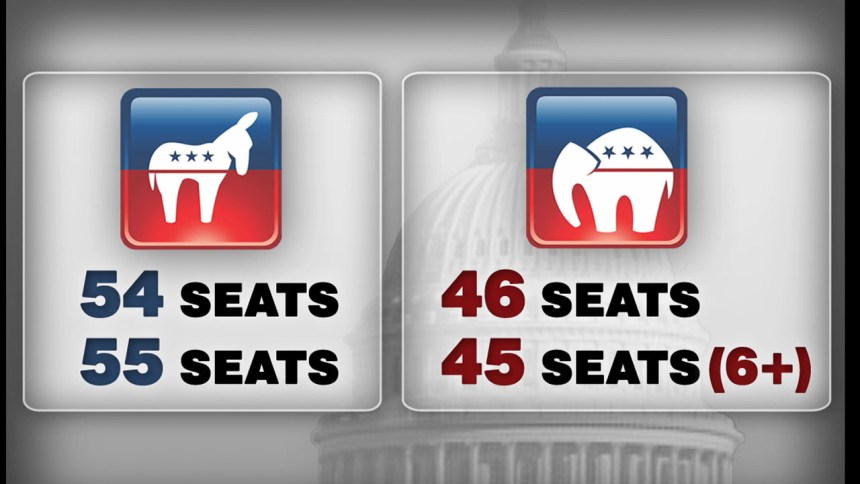
Collins argued that if those three open seats are in their column, Republicans need only to win three additional seats to get to the six they need, if a Democrat, as expected, wins back the New Jersey Senate seat in the October special election.
“We will continue to be thorough, disciplined and patient as we continue to research, recruit and build state of the art, winning campaigns in each of these states,” wrote Collins.
Collins noted that Sen. Susan Collins is the only one of 14 GOP incumbents sitting in a state that President Obama won last year, but that “she is well positioned to win. This strategic advantage will allow us to spend a majority of our time, energy and resources on offense and winning a majority—all while being true to our original mandate of bringing back all of our incumbents.”
Democrats look to at least two other GOP-held states, though, where they hope they can make races competitive. The top of that list: Senate Minority Leader Mitch McConnell of Kentucky, where Democrats believe they have a top recruit in Secretary of State Alison Lundergan Grimes, and McConnell also now faces a likely primary challenge from investment banker Matt Bevin. And in Georgia, where a messy GOP primary is shaping up, Democrat Michelle Nunn, daughter of former Sen. Sam Nunn, is expected to announce her candidacy soon.
Collins wrote that he knows both Grimes and Nunn will be well-financed, but argued that “every single dollar that Democrats pour into the Bluegrass state is a dollar that will not be used to save Mark Pryor or Mary Landrieu. Every dollar that Democrats use to entice Michelle Nunn is a dollar that Kay Hagan and Mark Begich will not have. After what many pundits and even Democrats called, one of ‘the worst rollouts ever,” does anyone really believe that Alison Lundergan Grimes is worth a $26 million investment?”
Collins admitted that the path to 50 isn’t a given for his party, though, and that Democrats will have a sophisticated operation, building off of President Obama’s successful 2012 re-election. And in past cycles where Republicans also had good chances to pick up Democratic-seats, they failed with flawed nominees — Nevada, Delaware and Colorado in 2010, and in Indiana and Missouri in 2012.
“We aren’t sending this memo to crow about our success or to fool ourselves about the hard work ahead. In 2012 Democrats built and ran the nastiest campaigns our nation has ever seen. We know that they will ignore policy and focus on personal destruction. That process has already started. It isn’t just a page in their playbook – it is their playbook,” added Collins.
“We will respond with thoughtful, positive campaigns that will work hard to cut through the attacks ads and earn every vote. We will focus on the issues that matter most to middle-class families and workers and articulate a vision for moving our country in a positive direction. A vision where everyone who wants a quality job has one; where world-class health care is affordable and efficient, where our kids – all kids – have a fair shot to earn their success. Together we can build a functional, common sense Republican majority where helping people prioritized over protecting the politically powerful.”
Democrats know that the math going into 2014 was never in their favor, but point out that in open states where Republicans could have had an opening, including Michigan and Iowa, they haven’t landed top candidates yet, and must get through primaries in several other states first. And while the math was in their favor in recent cycles, Republicans have only defeated three Democratic incumbents in the last decade.
“Republicans inherited a very friendly map, but they have failed to put any blue or purple states into play. Even in the red states, Republicans are mired in divisive primaries that pit Tea Party conservatives against establishment Republicans favored by the Washington elite. The party has failed to unite behind a candidate in any of the most competitive states they cite,” said Democratic Senatorial Campaign Committee communications director Matt Canter. “Democrats have had tremendous recruiting success in Iowa and Michigan, where Democrats now are the undisputed favorites. Grimes’ candidacy fundamentally changes the map, forcing Republicans to spend millions playing defense, and Democrats are confident that she can defeat McConnell. Democrats also believe that a Todd Akin conservative will emerge in Georgia and provide a pick up opportunity for the right moderate Democrat with an independent Georgia brand.”
The decision of former Governor Brian Schweitzer to stay out of the Montana Senate race has caused many national observers to acknowledge what we’ve been saying for months – the Democratic majority is in serious trouble.
Like Reps. John Barrow and Stephanie Herseth-Sandlin, national Democrats were for Schweitzer before they were against him, and their stated reason for the switch was a mountain of bad behavior. On this we agree. However while others spent time (and far more money) crowing about grinding out a special election win in a state with a 3-1 registration advantage, we have been doing the hard work of recruiting and researching to build the next Republican majority.
Combined with a deteriorating national environment for our opponents; the work is paying off.
The New York Times’ Nate Silver wrote that Schweitzer’s announcement marked the, “latest in a series of favorable developments for Republicans as they seek control of the chamber,” and that an analysis shows that “Republicans might now be close to even-money to win control of the chamber after next year’s elections.”
Montana now joins West Virginia and South Dakota as the third red-state where Democrats have not only failed to land their top candidates, but to recruit a candidate capable of winning a general election matchup.
We know there is a tremendous amount of work ahead for us to win those seats, but the ramifications of the Democratic recruiting failures are huge.
As this trend continues, Republicans will need to win just three of the following states to take the majority and stop the agenda of higher taxes, bankrupting spending, and the implementation of ObamaCare:
We will have a lot more to say about these states in the coming weeks and months, but right now suffice to say that we feel very confident about the campaigns that are forming. In the meantime, we will continue to be thorough, disciplined and patient as we continue to research, recruit and build state of the art campaigns in each of these states.
But we can’t build our majority if we don’t first make sure we have secured our incumbents. All of the national party committees were created to first focus on reelecting incumbents. On that front the news is great. Our incumbents are energized and focused on winning their campaigns. Of the fourteen Republicans Senators up for reelection in 2014, only one is in a state won by President Obama, and all are well positioned to win. This strategic advantage will allow us to spend a majority of our time, energy and resources on offense —all while being true to our original mandate of bringing back all of our incumbents.
On the other side, Democrats are in trouble. With recruiting misses in IA, SD, GA, WVA, MT they have become more aggressive with ill-conceived promises to undecided recruits.
Last weekend, nearly two-dozen Democratic Senators and novice candidate Alison Lundergan Grimes huddled in Martha’s Vineyard to strategize for 2014. According to Democratic strategists, Grimes told the group that she would need $26-30 million in order run a competitive raise.
Alison Grimes says she needs $26 million to run; our friends tell us that big money promises to Governor Schweitzer were coming from the 508 area code on Saturday and we would imagine Michelle Nunn’s leverage for national money just got a lot better.
One starts to wonder where all this money is coming from.
But we get it, Senate Democrats raise a lot of money, they always have. They raise it from everywhere—their per candidate PAC contributions are almost double what the Senate Republicans raised last cycle. But the weight of fulfilling just a few of these $26 million promises quickly starts to cause candidates to make bad decisions and forces the national parties to deprioritize protecting incumbents.
Bad decisions like Alison Grimes made last weekend, when she decided that her first campaign appearance would be in Martha’s Vineyard networking with the rich and powerful. Or like the Democratic decision to use money that had been targeted for endangered incumbents like Mark Pryor, Mary Landrieu, Kay Hagan and Mark Begich to be used instead on long shot candidates like Alison Lundergan Grimes in Kentucky and Michelle Nunn in Georgia.
Every single dollar that Democrats pour into the Bluegrass State is a dollar that will not be used to save Mark Pryor or Mary Landrieu. Every dollar that Democrats use to entice Michelle Nunn is a dollar that Kay Hagan and Mark Begich will not have. After what many pundits and even Democrats called, one of “the worst rollouts ever,” does anyone really believe that Alison Lundergan Grimes is worth a $26 million investment?
Eight weeks of shaky recruiting capped by the Montana shocker forced Democrats to hit the panic button 16 months before Election Day. They did so because they are looking at the same data we are and came to the same conclusion: the odds of holding the majority just went from bad to worse for Chuck Schumer.
Their knee-jerk reaction? Throw endangered incumbents in red states overboard.
We look at things a little differently at the NRSC. We are focused on supporting incumbents and recruiting strong candidates to run against every Democrat incumbent in every state.
Democrats spent millions of dollars to pull a lackluster candidate Ed Markey across the finish line in Massachusetts, the bluest state in America. They can’t find ANYONE to run in West Virginia, Montana, or Georgia. They are stuck with b-level talent in Iowa, a third-string candidate in South Dakota, and their 11th choice in Kentucky who by all accounts appears to be ill-prepared for a campaign for the United States Senate.
Even before Brian Schweitzer took a pass, Democrats were in trouble. Now every dollar Democrats choose to spend losing a flight of fancy in Kentucky represents a dollar they choose not to use to defend endangered incumbents in Arkansas, North Carolina, Louisiana, and Alaska. It is a dollar they have chosen not to spend defending open seats in Montana, South Dakota, West Virginia, Iowa, or Michigan.
This mistake has been made before. In 2004, Democrats spent nearly $3 million trying to expand their map to defeat Senator Lisa Murkowski in red-Alaska and over $2 million trying to win an open seat in deep red-Oklahoma. The opportunity cost? They could only spend about $1 million in South Dakota defending their Leader Tom Daschle. Leader Daschle lost by less than 5,000 votes, and Senators Murkowski and Coburn were sworn into the Senate in January 2005.
Nine years later, Senate Democrats are allowing their hubris to gloss over the lessons of the past.
We aren’t sending this memo to crow about our success or to fool ourselves about how much hard work has to be done. In 2012 Democrats built and ran the nastiest campaigns our nation has ever seen. We know they will ignore policy and focus on personal destruction. That process has already started. It isn’t just a page in their playbook – it is their playbook.
We will respond with thoughtful, positive campaigns that will work hard to cut through the attacks ads and earn every vote. We will focus on the issues that matter most to middle-class families and workers and articulate a vision for moving our country in a positive direction. A vision where everyone who wants a quality job has one; where world-class health care is affordable and efficient, where our kids – all kids – have a fair shot to earn their success. Together we can build a functional; common sense Republican majority where helping people is the priority over protecting the politically powerful.
Thank you for all that you are doing to help Republicans win the majority in the United States Senate in 2014.