








New York Times: ” The Senate is expected to reject decisively a House bill that would delay the full effect of President Obama’s health care law as a condition for keeping the government running past Monday, as Senator Harry Reid, the Democratic majority leader, expressed confidence that he had public opinion on his side. Angering Republicans who lead the House, Mr. Reid kept the Senate shuttered on Sunday, in a calculated move to stall action on the House measure until Monday afternoon, just hours before the government’s spending authority runs out at midnight.”
Washington Post: “Senators are not due at the Capitol until lunchtime Monday, when Reid will move to table the House amendments. That exercise requires a simple majority and can be accomplished solely with Democratic votes. By midafternoon, House GOP leaders are likely to again be facing a decision about how to handle the simple six-week government funding bill the Senate approved last week.”
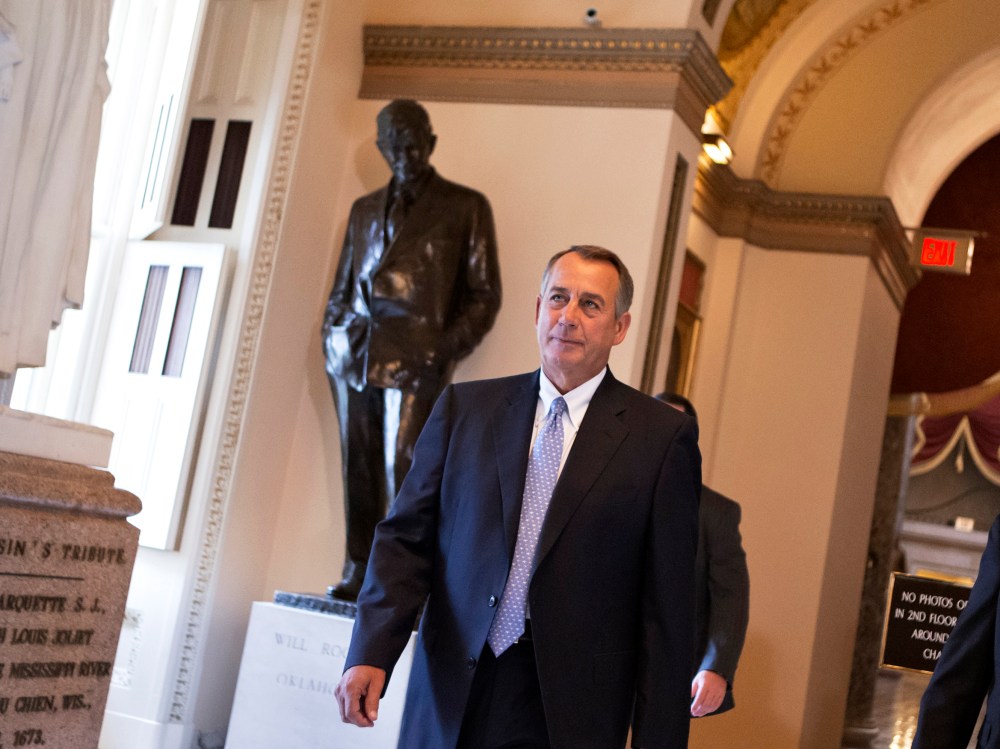
Politico: “It’s a pivotal moment for Boehner, perhaps the biggest crisis of his speakership, and he’s heading into it with a weak hand. The best Boehner can hope for is a draw. At worst, he could be endangering his troubled 17-seat majority as well as his own hold on the speaker’s gavel….Boehner, who also faces in coming weeks an even more daunting battle with Obama and Reid over raising the $16.7 trillion debt ceiling, may need a shutdown now in order to reassert control over his members and cool their passion for a winner-takes-all showdown with Democrats.”
Roll Call: “Senate Democrats have no appetite for entertaining a yearlong delay of Obamacare, but what about repealing the medical device tax? Senate Majority Whip Richard J. Durbin said Sunday that also looks to be a non-starter, at least in the form sent over by the House in the middle of the night.”
Wall Street Journal: “Each is the architect of his party’s budget priorities, yet both President Barack Obama and Republican Rep. Paul Ryan have largely removed themselves from talks in Washington’s latest standoff for reasons that help explain why the country has moved to the brink of a government shutdown. The president and Mr. Ryan crafted the competing budget blueprints that Democrats and Republicans put before voters in 2012 elections. If only to replay the debates of that election, they would seem obvious choices to broker a way out of the impasse.For the moment, though, beyond public statements, Mr. Obama has played no inside role in the unfolding drama. And Mr. Ryan has been almost entirely silent. New players have emerged to fill the vacuum, notably Sen. Ted Cruz of Texas and others in the GOP who want to undo the president’s health-care law.”
NBC’s Carrie Dann: “If past is prologue, a looming government shutdown could actually cost U.S. taxpayers money. A lot of money. According to the Office of Management and Budget, the two shutdowns in 1995 and 1996 cost taxpayers $1.4 billion combined. Adjust for inflation and you’ve got $2 billion in today’s dollars. Those two shutdowns lasted a total of 27 days, but there’s no telling how long the government could be shuttered this time around if Congress fails to act by Monday at midnight. Even shorter shutdowns have proven successful at draining government funds.”
Washington Post: “A prolonged government shutdown — followed by a potential default on the federal debt — would have economic ripple effects far beyond Washington, upending financial markets, sending the unemployment rate higher and slowing already tepid growth, according to a wide range of economists. A shutdown of a few days might do little damage, but economists, lawmakers and analysts are increasingly bracing for a shutdown that could last a week or more, given the distance between Republicans and Democrats. Such an outcome would suck money out of the economy and spread anxiety among consumers and businesses in a way that is likely to hold back economic activity.”
Los Angeles Times: “The last week of standoffs and stalemates in Washington won’t help Congress’ dismal approval ratings. And the likelihood that most government programs will begin shutting down Tuesday already has started disrupting the lives of millions of federal government workers, contractors and their families. But for one group — fundraisers who collect cash for members of Congress and those hoping to join the club — the shutdown threat is a windfall.”
NBC News: “The White House says despite watching Congress careen toward a government shutdown, it isn’t making President Barack Obama reconsider ways to sidestep Congress on the debt ceiling. ‘Only Congress can raise the debt limit. Period,’ a White House official told First Read. ‘We have said coin and 14th Amendment aren’t workable.’”
Charlotte Observer: ‘The U.S. Department of Justice will file a lawsuit Monday to stop North Carolina’s new voter ID law, which critics have said is the most sweeping law of its kind, according to a person briefed on the department’s plans. Attorney General Eric Holder, who has said he will fight state voting laws that he sees as discriminatory, will announce the lawsuit at noon Monday, along with the three U.S. attorneys from the state. Critics said the law will disenfranchise African-American and elderly voters, while the Republican-led General Assembly in Raleigh said the law will protect the state’s voters from potential fraud.”
New York Times’ Jonathan Martin writes that progressives, disappointed with Obama and uneasy with “a possible restoration of the Clintons” have made some look at newly elected Sen. Elizabeth Warren (D-Mass). as a potential 2016 candidate. Warren “said in an interview that she was not interested in seeking the presidency. And despite talk of a draft movement among some activists, it is difficult to imagine her taking on former Secretary of State Hillary Rodham Clinton. But in seizing on issues animating her party’s base — the influence of big banks, soaring student loan debt and the widening gulf between the wealthy and the working class — Ms. Warren is challenging the centrist economic approach that has been the de facto Democratic policy since President Bill Clinton and his fellow moderates took control of the party two decades ago.”
Roll Call: “[A]mid the party’s formal push to have more female members, it’s become increasingly clear that some contenders need extra help and resources in their races. And while the National Republican Congressional Committee insists it will stay on the sidelines, several House GOP women are taking the lead to publicly recruit, endorse and fundraise for female House candidates.” CALIFORNIA. Fresno Bee: “A Woodlake woman who became the first Latina chief of staff to a U.S. senator has now set her eyes on the House of Representatives, as she embarks on a high-profile challenge to freshman Rep. David Valadao….Amanda Renteria, a 38-year-old graduate of Woodlake High School, Stanford and Harvard Business School, says she is running as a way ‘to give people a voice and a vote that they haven’t had before.’” TEXAS. Dallas Morning News: “Wendy Davis offered a preview Sunday of her bid for governor, saying GOP leaders shouldn’t be bragging about the Texas economy and then shortchanging public education, highways and health care. The Democratic state senator said she opposes raising sales or property taxes. But she told an overflow crowd in advance of her expected Thursday announcement for governor that it’s time political leaders in Austin stop the partisanship and listen to what Texans really care about.” Politico: “Sen. Ted Cruz refused point-blank to endorse his Texas Republican colleague Sen. John Cornyn in his upcoming reelection bid at an event here Friday. ‘I think it is very likely I’m going to stay out of all incumbent runs,’ Cruz responded, when posed with an endorsement question at the annual Texas Tribune festival.” VIRGINIA. Washington Post: “The National Rifle Association is wading into the Virginia governor’s race with a six-figure ad campaign, potentially reviving a debate over gun issues that has been mostly dormant in the contest. Beginning Monday, the group will begin airing $500,000 worth of statewide television and online ads hitting Democrat Terry McAuliffe for his firearms stances, according to NRA spokesman Andrew Arulanandam. The campaign is designed to benefit Attorney General Ken Cuccinelli II (R), a longtime gun rights advocate who has lagged behind McAuliffe on the financial front and can use the help on the airwaves.” Also from the Post: “With portions of the Affordable Care Act set to kick in next week,” Cuccinelli “is airing its first ad explicitly aimed at the health-reform measure. The ad, titled “Obamacare,” focuses on Cuccinelli’s (R) long-standing opposition to President Obama’s signature legislation while blaming” McAuliffe “for the measure’s perceived faults.”
Jessica Taylor Recommended


