








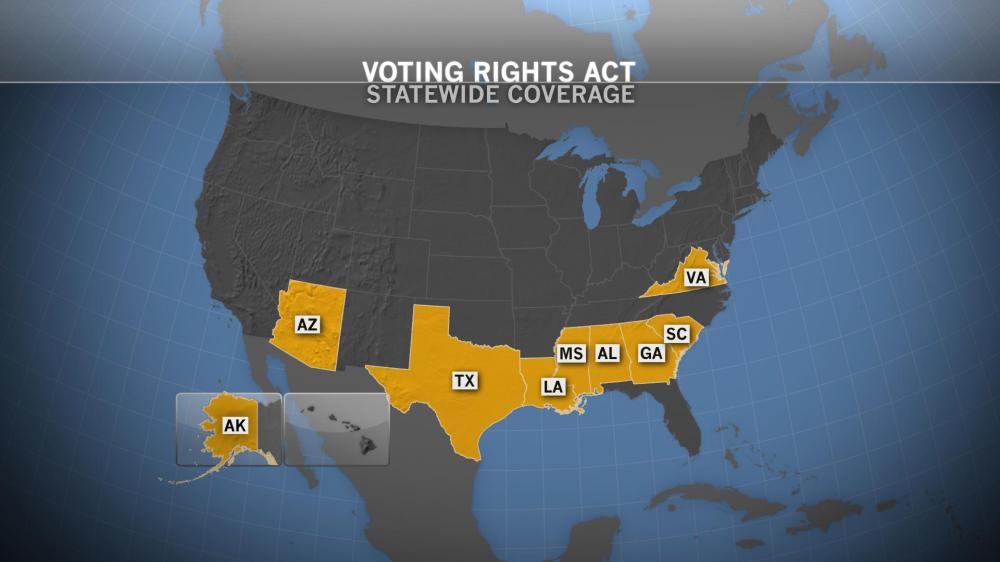
This week the Supreme Court will hear arguments in Shelby v Holder, one of the most important cases of the year because it’s a challenge to the Voting Rights Act of 1965, a federal civil rights law that has been reaffirmed several times by the court and reenacted several times by Congress, most recently in 2006 in a House vote of 390-33 and a Senate vote of 98-0.
Yet many think the voting rights act will be declared unconstitutional by this court because its conservative wing deems it unfair to treat different states differently. The VRA singles out nine states and several counties and requires them to clear any significant changes in voting laws with the Justice Department before enacting them.
This means the states must prove those changes aren’t discriminatory. The states singled out by the VRA are Alabama, Georgia, Louisiana, Mississippi, South Carolina, Texas, Virginia (all states of the old Confederacy), and Alaska and Arizona. Is the law outdated? Has the south changed so much that it no longer needs to be on virtual probation with respect to its electoral laws?
Since 2005, seven of the nine states covered by the VRA have passed voter ID laws. Only 16% of non VRA states have tried to enact them. States that historically enacted suppressive laws are still at it. In 2008 Texas passed a voter ID law that a three-judge federal court unanimously struck down because Texas couldn’t prove it wouldn’t harm the voting rights of Texans of color.
The court found the law tantamount to a poll tax because it imposed an implicit fee on the privilege to vote. If you don’t have a driver’s license it will probably mean time off from work to get one, and the court recognized that as a problem.
The opinion stated “a law that forces poor citizens to choose between their wages and their franchise unquestionably denies or abridges their right to vote.” Courts have also pushed back against Florida’s attempt to constrain early voting because it’s a form of voting used disproportionately by poorer African-Americans. Georgia and Tennessee have also tried to cut early voting.
It seems many agree with Doug Preisse, the Republican Party chairman of Franklin County, Ohio, who emailed this to the Columbus Dispatch in 2012: “I actually feel we shouldn’t contort the voting process to accommodate the urban–read African-American–voter turnout machine.” No one is asking for contortion, Doug: just fairness. But the GOP sees the white share of the electorate shrinking year after year and sees a future where whites are no longer the majority in America: thus, their path to victory may lie in trying to suppress the electorate of color. So at a time when the franchise is under attack, the Supremes convene to hear arguments in a case that could remove the most powerful tool created to protect voters of color. And many think the Supremes will knock this down. I am typically an optimistic person but this makes me fear for the future.
Toure Recommended


