








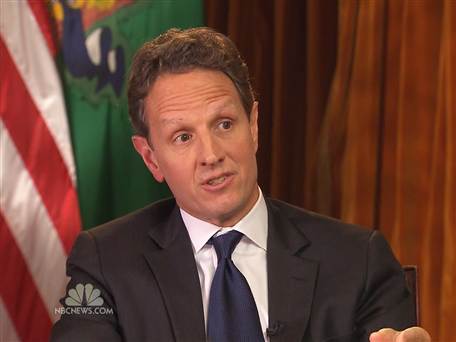
Timothy Geithner will make his exit as U.S Treasury secretary Friday, leaving behind a four-year legacy marked from the outset by an economy that had sunk into a recession as unemployment skyrocketed, leaving America in a rut. But with indicators of a more robust U.S. economy on the horizon, Geithner’s influence as a key player in the Obama administration’s handling of the economy is not lost on his most ardent supporters–or critics.
Upon leaving his post as the head of the New York Federal Reserve Bank, Geithner came into office in 2009 while the economy was in a free-fall. Millions of Americans were out of work in the face of a housing crisis. By contrast, Geithner’s exit from the Treasury Department Friday was met with soaring new-home sales across the country as the unemployment rate holds at 7.8%. In an exit interview with the Wall Street Journal, Geithner voiced confidence in a continued economic bounce-back.
“I think in the recovery, if you do basketball, we’re in the early part of the fourth quarter because unemployment is still very high and still going come down gradually over time,” Geithner said.
According to a recent Gallup poll 25% of Americans have faith in job prospects–the highest it has been since March 2008. Another Gallup poll shows that 44% of Americans are confident that the economy is on an upward climb.
But the path to recovery did not initially earn Geithner stripes in popularity. From managing the design of the Troubled Asset Relief Program (TARP), to tackling the AIG bailout, Geithner’s path in stabilizing the U.S. financial system without damaging the economy was met with both praise, and harsh skepticism. Geithner and Ben Bernanke, the Federal Reserve Chairman, defended the move to rescue the insurance giant, arguing that if the government had let AIG fail, it would have threatened the entire U.S. financial system. The decision to bail out the auto industry was another political point of contention during the 2012 presidential race, an idea Geithner was involved in crafting and selling to Congress.
Geithner always believed he was brought in to deal with the policy-making in handling the economic crisis, and not to directly go after the big banks responsible for the crash as he told the New Republic during an exit interview, “I never felt that was my thing. I had some views on the issue, but I didn’t give them much weight. I thought my job was to figure out the financial parts.”
As Geithner is set to exit on Friday, President Obama has nominated his old Chief of Staff Jack Lew, who has a background in budget fights, not Wall Street like Geithner had, showing a major shift in the White House and national economic priorities and how the Obama administration anticipates the next fight over the nation’s debt. With Geithner’s departure before Jack Lew has been officially confirmed, Deputy Secretary Neil Wolin will run the department in the interum. “When the history books are written,” President Obama said, “Tim Geithner is going to go down as one of our finest secretaries of the Treasury.” Before Geithner left he did make sure to make the rounds and thank those have helped him through the years. He told Politico, “We did some very hard and consequential things together, and I want to make sure they’re justifiably proud of what they did, even though I know we have a lot of unfinished business, a lot of challenges ahead.” Where will Geithner go from here? One thing we know is he is not eyeing for Ben Bernake’s position. He has told Politico “Not a chance,” that he wants to run the Federal Reserve Chairman. He continued to say, “I have great respect for the institution, but that will be someone else’s privilege.”
Abby Borovitz Recommended


