The Rachel Maddow Show WEEKNIGHTS 9PM ETMorning Joe WEEKDAYS 6AM ETDeadline: White House with Nicolle Wallace Weekdays 4PM ETThe Beat with Ari Melber Weeknights 6PM ETThe Weeknight Weeknights 7PM ETAll in with Chris Hayes TUESDAY-FRIDAY 8PM ETThe Briefing with Jen Psaki TUESDAYS – FRIDAYS 9PM ETThe Last Word with Lawrence O’Donnel Weeknights 10PM ETThe 11th Hour with Stephanie Ruhle Weeknights 11PM ET
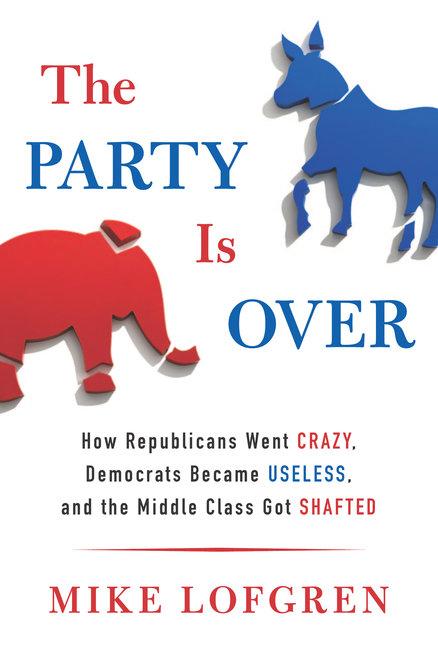
During today’s guest spot we are talking to author, Mike Lofgren, about his book The Party is Over: How Republicans Went Crazy, Democrats Became Useless, and
The Party is Over
By
The Cycle Staff
During today’s guest spot we are talking to author, Mike Lofgren, about his book The Party is Over: How Republicans Went Crazy, Democrats Became Useless, and the Middle Class Got Shafted. With more than 20 years of experience on the Hill, Mike Lofgren writes about how America’s broken political system got the way it is now, who benefits from it, who loses, and what can be done to fix the problem.
Be sure to tune in at 3pm for the full conversation and below check out an excerpt from his book.
Having observed politics up close and personal for most of my adult lifetime, I have come to the conclusion that the rise of politicized religious fundamentalism may have been the key ingredient in the transformation of the Republican Party. Politicized religion provides a substrate of beliefs that rationalizes—at least in the minds of its followers—all three of the GOP’s main tenets: wealth worship, war worship, and the permanent culture war.
Religious cranks ceased to be a minor public nuisance in this country beginning in the 1970s and grew into a major element of the Republican rank and file. Pat Robertson’s strong showing in the 1988 Iowa presidential caucus signaled the gradual merger of politics and religion in the party. Unfortunately, at the time I mostly underestimated the implications of what I was seeing. It did strike me as oddly humorous that a fundamentalist staff member in my congressional office was going to take time off to convert the heathen in Greece, a country that had been overwhelmingly Christian for almost two thousand years. I recall another point, in the early 1990s, when a different fundamentalist GOP staffer said that dinosaur fossils were a hoax. As a mere legislative mechanic toiling away in what I held to be a civil rather than ecclesiastical calling, I did not yet see that ideological impulses far different from mine were poised to capture the party of Lincoln.
The results of this takeover are all around us: If the American people poll more like Iranians or Nigerians than Europeans or Canadians on questions of evolution, scriptural inerrancy, the presence of angels and demons, and so forth, it is due to the rise of the religious right, its insertion into the public sphere by the Republican Party, and the consequent normalizing of formerly reactionary beliefs. All around us now is a prevailing anti-intellectualism and hostility to science. Politicized religion is the sheet anchor of the dreary forty-year-old culture wars.
The Constitution notwithstanding, there is now a de facto religious test for the presidency: Major candidates are encouraged (or coerced) to share their feelings about their faith in a revelatory speech, or a televangelist like Rick Warren will dragoon the candidates (as he did with Obama and McCain in 2008) to debate the finer points of Christology, offering himself as the final arbiter. Half a century after John F. Kennedy put to rest the question of whether a candidate of a minority denomination could be president, the Republican Party has reignited the kinds of seventeenth-century religious controversies that advanced democracies are supposed to have outgrown. And some in the media seem to have internalized the GOP’s premise that the religion of a candidate is a matter for public debate.
Throughout the 2012 Republican presidential campaign, Mitt Romney was dogged with questions about his religion. The spark was a hitherto obscure fundamentalist preacher from Texas, Robert Jeffress, who attacked Romney’s Mormonism by doubting whether he could really be considered a Christian. The media promptly set aside the issues that should have been paramount— Romney’s views on economic and foreign policy—in order to spend a week giving respectful consideration to an attention-grabbing rabble-rouser. They then proceeded to pester the other candidates with the loaded question of whether they thought Romney was a Christian. CNN’s Candy Crowley was particularly egregious in this respect, pressing Herman Cain and Michele Bachmann for a response and becoming indignant when they refused to answer. The question did not deserve an answer, because Crowley had set it up to legitimate a false premise: that Romney’s religious belief was a legitimate issue of public debate. This is a perfect example of how the media reinforce an informal but increasingly binding religious test for public office that the Constitution formally bans. Like the British constitution, the test is no less powerful for being unwritten.
The religious right’s professed insistence upon “family values” might appear at first blush to be at odds with the anything but saintly personal behavior of many of its leading proponents. Some of this may be due to the general inability of human beings to reflect on conflicting information: I have never ceased to be amazed at how facts manage to bounce off people’s consciousness like pebbles off armor plate. But there is another, uniquely religious aspect that also comes into play: the predilection of fundamentalist denominations to believe in practice, even if not entirely in theory, in the doctrine of “cheap grace,” a derisive term coined by the theologian Dietrich Bonhoeffer. By that he meant the inclination of some religious adherents to believe that once they had been “saved,” not only would all past sins be wiped away, but future ones, too—so one could pretty much behave as before. Cheap grace is a divine get- out-of-jail-free card. Hence the tendency of the religious base of the Republican Party to cut some slack for the peccadilloes of candidates who claim to have been washed in the blood of the Lamb and reborn to a new and more Christian life. The religious right is willing to overlook a politician’s individual foibles, no matter how poor an example he or she may make, if they publicly identify with fundamentalist values. In 2011 the Family Research Council, the fundamentalist lobbying organization, gave Representative Joe Walsh of Illinois an award for “unwavering support of the family.” Representative Walsh’s ex-wife might beg to differ, as she claims he owes her over one hundred thousand dollars in unpaid child support, a charge he denies.
Of course, the proper rituals must be observed before an erring politician can obtain absolution. In November 2011, at a forum sponsored by religious conservatives in Iowa, all of the GOP presidential candidates struck the expected notes of contrition and humility as they laid bare their souls before the assembled congregation (the event was held in a church). Most of them, including Cain, who was then still riding high, choked up when discussing some bleak midnight of their lives (he chose not to address the fresh sexual harassment charges against him, which surely would have qualified as a trying personal experience preying on his mind). Even the old reprobate Gingrich misted up over some contrived misdeed intended to distract attention from his well-known adventures in serial matrimony.
All of these gloomy obsequies of repentance having been observed, Gingrich gave a stirring example of why he is hands-down the best extemporaneous demagogue in contemporary America. Having purged his soul of all guilty transgressions, he turned his attention to the far graver sins bedeviling the American nation:
“If we look at history from the mid-1960s, we’ve gone from a request for toleration to an imposition of intolerance. We’ve gone from a request to understand others to a determination to close down those who hold traditional values. I think that we need to be very aggressive and very direct. The degree to which the left is prepared to impose intolerance and to drive out of existence traditional religion is a mortal threat to our civilization and deserves to be taken head-on and described as what it is, which is the use of government to repress the American people against their own values.”
That is as good an example as any of cheap grace as practiced by seasoned statesmen like Gingrich—a bid for redemption turned on its head to provide a forum for one of the Republican Party’s favorite pastimes: taking opportunistic swipes at the dreaded liberal bogeyman. How quickly one forgets one’s own moral lapses when one can consider the manifold harms inflicted on our nation by godless leftists!
– – – – – – – – – –
Some liberal writers have opined that the socioeconomic gulf separating the business wing of the GOP and the religious right make it an unstable coalition that could crack. I am not so sure. There is no basic disagreement on which direction the two factions want to take the country, merely how far it should go. The plutocrats would drag us back to the Gilded Age; the theocrats to the Salem witch trials. If anything, the two groups are increasingly beginning to resemble each other. Many televangelists have espoused what has come to be known as the prosperity gospel—the health-and- wealth/name-it-and-claim-it gospel of economic entitlement. If you are wealthy, it is a sign of God’s favor. If not, too bad! This rationale may explain why some poor voters will defend the prerogatives of billionaires. In any case, at the beginning of the 2012 presidential cycle, those consummate plutocrats the Koch brothers pumped money into Bachmann’s campaign, so one should probably not make too much of a potential plutocrat-theocrat split.
Most of the religious enthusiasts I observed during my tenure on the Hill seemed to have little reluctance to mix God and Mammon. Rick Santorum did not blink at legislative schemes to pay off his campaign contributors: In 2005 he introduced a bill to forbid the National Weather Service from providing weather forecasts for free that commercial forecasters—like AccuWeather, a Pennsylvania- based company which had contributed to his campaign—wanted to charge for. Tom DeLay’s purported concern about the dignity and sanctity of human life, touchingly on display during the controversy over whether Terri Schiavo’s husband had the right to tell doctors to remove her feeding tube after seeing her comatose for fifteen years, could always be qualified by strategic infusions of campaign cash. DeLay’s quashing of bills to prohibit serious labor abuses demonstrates that even religious virtue can be flexible when there are campaign donations involved.
One might imagine that the religious right’s agenda would be incompatible with the concerns for privacy and individual autonomy by those who consider themselves to belong to the libertarian wing of the Republican Party—the “don’t tread on me,” “live free or die” crowd that Grover Norquist once called the “leave me alone” conservatives. Given their profound distaste for an oppressive and intrusive federal government, one would think they might have trepidations about a religious movement determined to impose statutory controls on private behavior that libertarians nominally hold to be nobody’s business, and particularly not the government’s business.
Some more libertarian-leaning Republicans have in fact pushed back against the religious right. Former House majority leader Dick Armey expressed his profound distaste for the tactics of the religious right in 2006—from the safety of the sidelines—by blasting its leadership in unequivocal terms:
“[James] Dobson and his gang of thugs are real nasty bullies. I pray devoutly every day, but being a Christian is no excuse for being stupid. There’s a high demagoguery coefficient to issues like prayer in schools. Demagoguery doesn’t work unless it’s dumb, shallow as water on a plate. These issues are easy for the intellectually lazy and can appeal to a large demographic. These issues become bigger than life, largely because they’re easy. There ain’t no thinking.”
Armey had previously been an economics professor at several cow colleges in Texas, and when he came to Congress in 1985, libertarian economics was his forte. I do not recall religious issues motivating his political ideology; instead, economics was what gripped him, particularly the flat tax, which he tirelessly promoted. I believe his departure from Congress was impelled not only by the fact that he was not on the inside track to become Speaker, but also because of his disillusionment with the culture wars, as his passionate denunciation of Dobson suggests. But later, Barack Obama’s election and the rise of the Tea Party induced a miraculous change of heart in Armey, as no doubt did the need to raise money for his lobbying organization, known as FreedomWorks. By 2009, Armey had become a significant voice of the Tea Party. As such, he attempted to declare a truce between fiscal and social conservatives, who would thenceforth bury their squabbles and concentrate on dethroning the Kenyan usurper in the Oval Office. That meant soft-pedaling social issues that might alarm fiscally conservative but socially moderate voters, particularly women, who lived in the wealthier suburbs.
In September 2010 Armey took one step further in his reconciliation with the people he had called thugs and bullies when he announced that a GOP majority in Congress would again take up the abortion fight, which was only right and proper for those who held such a sincere moral conviction. When the Republicans duly won the House two months later, they did precisely that. State legislatures across the country followed suit: Ohio, Texas, and Virginia enacted the most severe abortion restrictions in any legislative session in memory. Suddenly Armey didn’t seem to have any problem with social issues preempting his economic agenda.
The Tea Party, which initially described itself as wholly concerned with debt, deficit, and federal overreach, gradually unmasked itself as being almost as theocratic as the activists from the religious right that Armey had denounced only a few years before. If anything, they were even slightly more disposed than the rest of the Republican Party to inject religious issues into the political realm. According to an academic study of the Tea Party, “[T]hey seek ‘deeply religious’ elected officials, approve of religious leaders’ engaging in politics and want religion brought into political debates.” The Tea Party faithful are not so much libertarian as authoritarian, the furthest thing from a “live free or die” constitutionalist.
Within the GOP libertarianism is a throwaway doctrine that is rhetorically useful in certain situations but often interferes with their core, more authoritarian, beliefs. When the two precepts collide, the authoritarian reflex prevails. In 2009 it was politically useful for the GOP to present the Tea Party as independent-leaning libertarians, when in reality the group was overwhelmingly Republican, with a high quotient of GOP activists and adherents of views common among the religious right. According to a 2010 Gallup poll, eight in ten Tea Party members identify themselves as Republicans. Another study found that over half identified as members of the religious right and 55 percent of Tea Partiers agree that “America has always been and is currently a Christian nation”—6 points more than even the percentage of self-described Christian conservatives who would agree to that. This religious orientation should have been evident from the brouhaha that erupted in mid- 2009 over the charge that the Obama administration’s new healthcare reform plan would set up “death panels.” While there was plenty to criticize about the health-care bill, the completely bogus charge garnered disproportionate attention. Republican political consultants immediately recognized that they had found a classic emotional issue that would resonate with the same people on the religious right who had been stirred up over the Terri Schiavo case. The Tea Party, a supposedly independent group of fiscal conservatives outraged by Obama’s profligate spending plans, fell prey to the hysteria Republican Party operatives whipped up over end-of- life counseling. This self-unmasking of the Tea Party may help explain why, after three years in existence, public support for the organization has been dropping precipitously.
Ayn Rand, an occasional darling of the Tea Party, has become a cult figure within the GOP in recent years. It is easy enough to see how her tough-guy, every-man-for-himself posturing would be a natural fit with the Wall Street bankers and the right-wing politicians they fund—notwithstanding the bankers’ fondness for government bailouts. But Rand’s philosophy found most of its adherents in the libertarian wing of the party, a group that overlaps with, but is certainly not identical to, the “business conservatives” who fund the bulk of the GOP’s activities. There has always been a strong strain of rugged individualism in America, and the GOP has cleverly managed to co-opt that spirit to its advantage. The problem is that Rand proclaimed at every opportunity that she was a militant atheist who felt nothing but contempt for Christianity as a religion of weaklings possessing a slave mentality. So how do Republican candidates manage to bamboozle what is perhaps the largest single bloc in their voting base, the religious fundamentalists, about this? Certainly the ignorance of many fundamentalist values voters about the wider world and the life of the mind goes some distance toward explaining the paradox: GOP candidates who enthuse over Rand at the same time as they thump their Bibles never have to explain this stark contradiction because most of their audience is blissfully unaware of who Ayn Rand was and what she advocated. But voters can to some extent be forgiven their ignorance, because politicians have grown so skillful at misdirecting them about their intentions.
This camouflaging of intentions is as much a strategy of the religious right and its leaders—James Dobson, Tony Perkins, Pat Robertson, and the rest—as it is of the GOP’s more secular political leaders in Washington. After the debacle of the Schiavo case and the electoral loss in 2008, the religious right pulled back and regrouped. They knew that the full-bore, “theoconservative” agenda would not sell with a majority of voters. This strategy accounts for Robertson, founder of the Christian Coalition (who famously said that God sent a hurricane to New Orleans to punish the sodomites), stating the following in October 2011: “Those people in the Republican primary have got to lay off of this stuff. They’re forcing their leaders, the front-runners, into positions that will mean they lose the general election.” I doubt he thought the candidates held positions that were too extreme, merely that they should keep quiet about those positions until they had won the election. Max Blumenthal, author of Republican Gomorrah, argues that this is a “lying for Jesus” strategy that fundamentalists often adopt when dealing with the snares of a wicked and Godless world. Since Satan is the father of lies, one can be forgiven for fighting lies with lies.
Hence the policies pursued for at least two decades by the religious right on the federal, state, and local levels. It usually starts at the school board, after some contrived uproar over sex education or liberal indoctrination. The stealthily fundamentalist school board candidates pledge to clean up the mess and “get back to basics.” After a few years they capture a majority on the board, and suddenly “Catcher in the Rye” is heaved out of the curriculum and science teachers are under pressure to teach the (imaginary) controversy about evolutionary biology. This was the path to greater glory of Michele Bachmann: Her first run for public office, barely a dozen years ago, was for a seat on the school board in Stillwater, Minnesota. Up until then she had drawn a taxpayer-funded salary for five years working as an attorney for the Internal Revenue Service, not, of course, because she was one of those lazy, good-for-nothing government bureaucrats that Republican candidates routinely denounce. She was secretly studying the ways of the government beast so as to defeat it later on.
Bachmann, Rick Perry, and numerous other serving representatives and senators have all had ties to Christian Dominionism, a doctrine proclaiming that Christians are destined to dominate American politics and establish a new imperium resembling theocratic government. According to one profile of Perry, adherents of Dominionism “believe Christians—certain Christians—are destined to not just take ‘dominion’ over government, but stealthily climb to the commanding heights of what they term the ‘Seven Mountains’ of society, including the media and the arts and entertainment world.” Note the qualifier: “stealthily.”
At the same religious forum where the GOP candidates confessed their sins, Bachmann went so far as to suggest that organized religion should keep its traditional legal privilege of tax exemption while being permitted to endorse political candidates from the pulpit. The fact that government prohibits express political advocacy is in her imagination muzzling preachers rather than just being a quid pro quo for tax-exempt status equivalent to that imposed on any 501(c)3 or 501(c)4 nonprofit organization. But for Bachmann and others of like mind, this is persecution of a kind that fuels their sense of victimhood and righteous indignation.