National Correspondent Suzy Khimm answered your questions Tuesday about the state of mental health services in the country. Read on for a recap of the conversation.
PaolaPT: Do you think there is a direct correlation between overcrowding in prisons and the decline of psychiatric beds in hospitals?
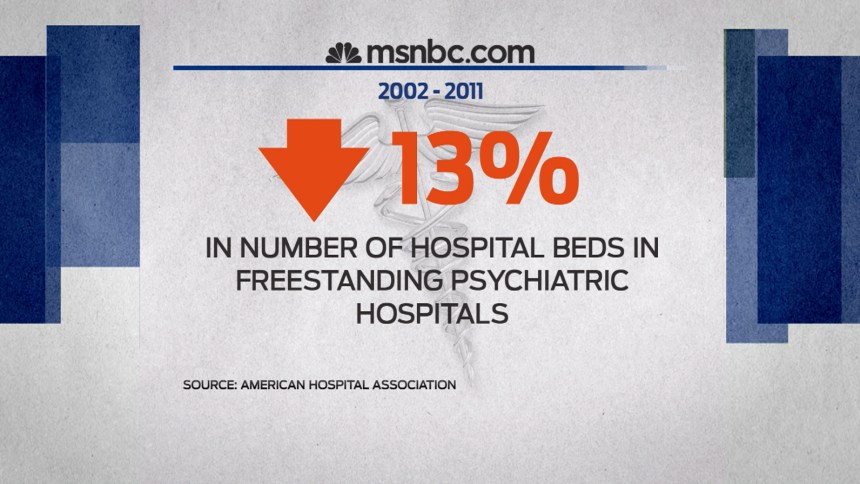
Suzy Khimm: Yes, researchers have confirmed as much. From a recent study from Oregon State University: “A decrease in the supply of psychiatric hospital beds is significantly associated with a greater probability of jail detention for minor charges among persons diagnosed with severe mental illness.” http://www.ncbi.nlm.nih.gov/pubmed/23999205 Mother Jones also has an illuminating chart here: http://www.motherjones.com/files/Mental_chartspg_630-.gif.

PaolaPT: Have there been reports on the cost of turning ER rooms into ‘warehouses’ versus the budget cuts that took place resulting in less beds for psychiatric patients?
Suzy Khimm: It has been extremely costly. In Washington State alone, officials estimate that “warehousing” such patients has cost $10.5 million—$2 million alone in one hospital. http://seattletimes.com/html/localnews/2021968893_psychiatricboardingxml.html
pl929: Are they changing anything to our laws to not just hold them for seventy two hours max? and do you think there should be? Thank you.
Suzy Khimm: Civil commitment laws vary by state, and there’s definitely been debate over the length of time that people should be held; while we want to make sure that people don’t pose a serious threat to themselves or others, we also don’t want to detain people indefinitely in a way that violates their civil liberties.
In Virginia, the more controversial provision has been the initial 4-6 hour time limit on detaining someone—unless a bed can be found within that time period, a person must be released, even if there’s an order for involuntary commitment.
University of Virginia law professor Richard Bonnie has studied this closely and told me: “Potential solutions to these regional challenges include creating intensive alternatives to hospitalization such as secure crisis stabilization facilities and lengthening the period of time legally authorized to identify a bed while the person is in police custody. For example, the maximum emergency custody period could be raised to 8 hours rather than 6 hours.”
Abby Huntsman: How do we begin improving our mental health system?
Suzy Khimm: Mental health advocates point to a few major areas—the first being funding. During the financial crisis and recession, many cash-strapped states made big cuts to mental health care, totaling $1.6 billion in 28 states and the District of Columbia. Some states have begun to restore funding, but it’s only begun trickling back. More broadly speaking, policymakers and politicians need to make this a real priority—not just during times of crisis when tragedy strikes. To that end, there’s a danger in focusing narrowly on horrific events and violent acts by the mentally ill, which are rare and disappear all too quickly from the news cycle.
Krystal Ball: How do we make sure that the voiceless and powerless are not the first to suffer from budget cuts?
Suzy Khimm: I think it requires persistent advocacy on behalf of these groups, not just when tragedy strikes, and holding politicians accountable for their choices. Elzora Meshae Robinson: Did you read the final report of the Sandy Hook investigation? If so, what actions do you think should have been taken by people who probably saw warning signs in Adam Lanza (mainly his mom) that could have prevented the tragedy? To answer my own question a little, I think the most important thing anyone who even knows OF a person with mental issues, should do, is make sure that it’s impossible for them to have access to guns. The last thing they should do is take them to gun ranges to practice shooting, like Ms. Lanza, to her demise, unfortunately did with her son. Suzy Khimm: There’s definitely been a push after tragedies like Sandy Hook to better inform educators, officials, and the public at large about the warning signs of mental illness that could put individuals in danger of harming themselves or others. But the Sandy Hook report also revealed that there was a plan of action for Adam Lanza that recommended medication and other forms of treatment, which he refused. So there are certainly limits to what we can do to make sure that people seek treatment when necessary. The Alienist: The Community Mental Health Care System was supposed to be the safety net for the deinstitutionalized mentally ill. It has many components and would likely have worked well if it was funded and staffed adequately. We never built the complete system. Perhaps the plan was too large to be implemented at once. If so, then… 1. What is the absolute minimum program we need to identify, treat, and support the mentally ill, their families, and their communities? 2. How can we implement these programs in enough communities (not only in large cities) to provide services for all who need it? Suzy Khimm: I definitely agree that the transition away from big institutions to community mental health care has been incomplete and represents a major failure of our health care system and policymakers. And the problems are even more acute in non-urban and rural areas, as you mention. Various have tried to devise new standards for these outpatient services. But another issue that advocates and providers are concerned about are low reimbursement rates from both Medicaid and private insurers. http://www.bostonglobe.com/opinion/letters/2013/01/21/low-reimbursement-rates-compel-mental-health-clinics-cut-back/Raiwn2AZH6FB8Y3xTWPe0O/story.html
Gabriela Resto-Montero Recommended