








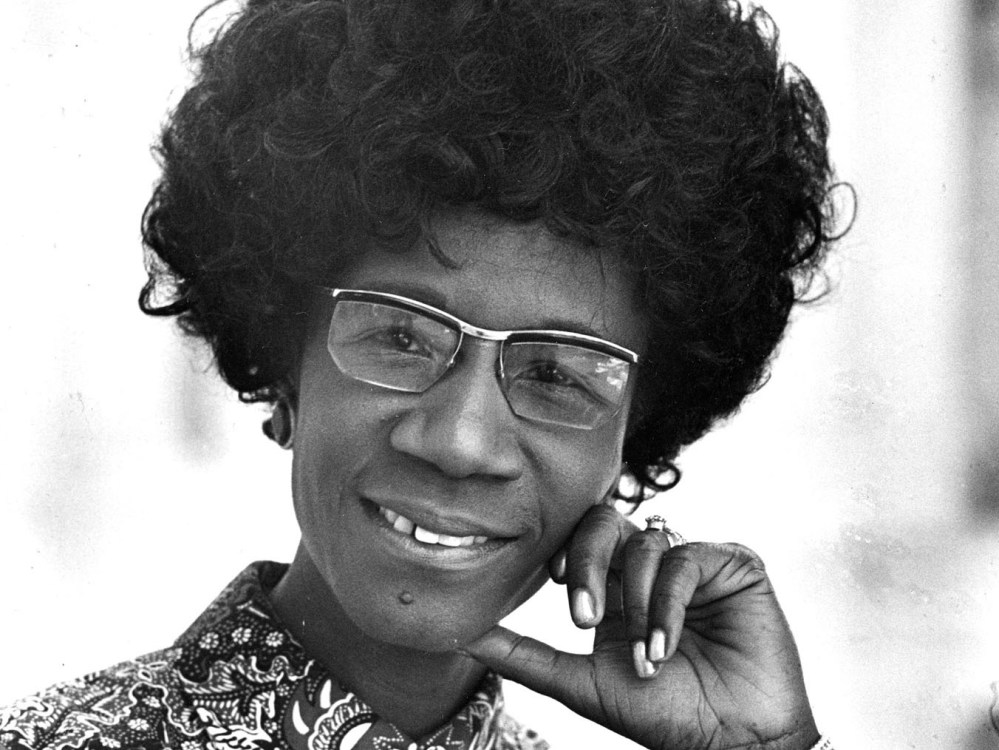
This week I’ve been thinking about Shirley Chisholm, the first black person to run in a major party for the presidency. She was a Democratic congresswoman from Brooklyn who ran in 1972 and even though she knew she didn’t have a shot to become the nominee she knew just running was a victory.
“My candidacy,” she said, “is not to be regarded as a candidacy where I can win the presidency at this moment, but a candidacy that is paving the way.”
Her bid required courage. She survived three assassination attempts. But she knew you must conceive it before you can achieve it and that anyone who’s successful is standing on someone else’s shoulders so she was a necessary first step on the road that would lead to Obama. But other steps were required.
The decade after Chisholm’s race, the Rev. Jesse Jackson stood on her shoulders and ran for the presidency. In 1984, he addressed the Democratic National Convention: “There’s a time to compete and a time to cooperate… “
He ran in 1984 and 1988. These were not merely symbolic bids. As a moral authority and a national figure he was able to win 3 million votes and five primaries in ’84, and become, briefly, the frontrunner in ’88 after winning Michigan. But it wasn’t his time.
In the following decade, General Colin Powel stood on Jackson’s shoulders. In 1995, as a war hero, he considered running. A nation seemed to beg him to do it. There was no sense that race would hold him back or be part of the equation of his candidacy. It was like a national thought experiment Are you comfortable conceiving of a black president? The answer was a resounding yes. But Powell found no fire in the belly, or found the end of his book tour, and never entered the race. Obama stood on all of their shoulders to become president. So, who’s going to stand on Obama’s shoulders? I believe California Attorney General Kamala Harris has a serious chance, but really those shoulders aren’t just for black people. The future will see a woman president, probably Hillary in 2016, and a Latino president. I wouldn’t be surprised if Julian Castro, the mayor of San Antonio. I wouldn’t be shocked if he runs for governor. After all, Rick Perry is up for election in 2014. We can also expect Florida Senator Marco Rubio to throw his hat in the ring in 2016. It’s good for all Americans that the presidency is no longer reserved for white men. It means more people becoming a full part of the American family. Salute to the woman who started this journey, Shirley Chisholm.
Toure Recommended


