








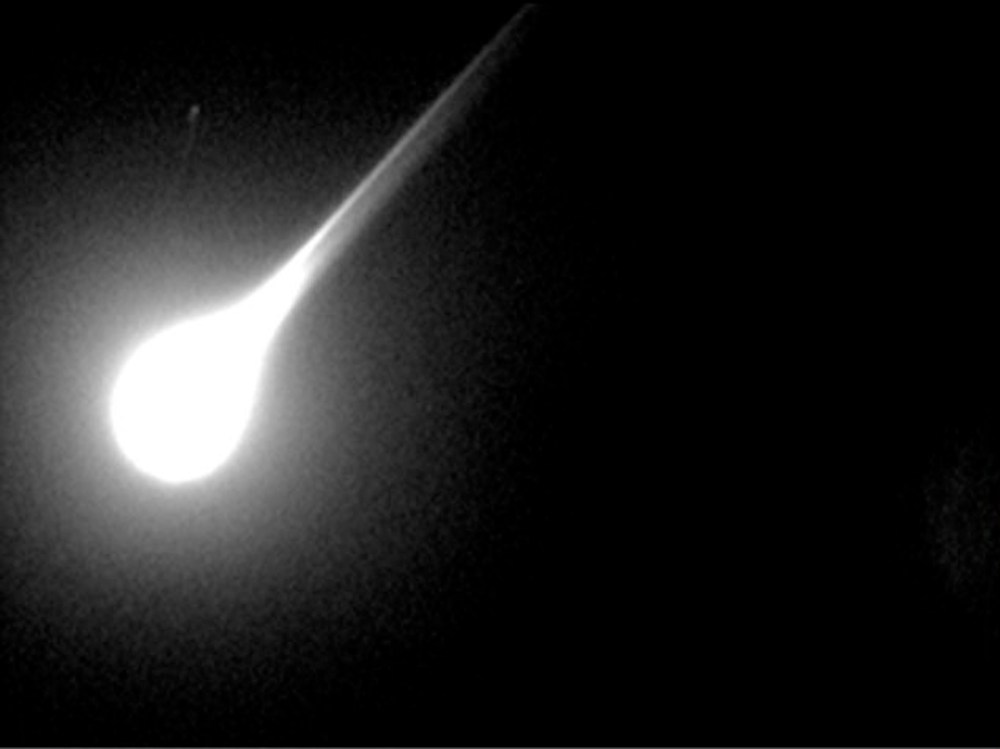
One of the closest asteroid approaches and fly-bys of the Earth’s atmosphere happened on February 14th. The very next day, a meteor hit Russia’s Chelyabinsk region. The two celestial events were unrelated. “One was predicted; the other was not,” House Space Committee members Reps. Rush Holt and Donna Edwards wrote. And unless the government is able to maintain NASA’s pre-sequester funding levels, the U.S. may not be able to predict what’s falling towards us–or when–for much longer.
The House Committee on Science, Space, and Technology had Part 1 of its hearing on Threats from Space. John P. Holdren, Senior Adviser to President Obama on science and technology, testified before the House panel on Tuesday, along with U.S. Air Force Space Command’s General William L. Shelton and Charles F. Bolden Jr. from NASA.
NBC reports that “representatives from both parties were receptive to the idea of putting more resources into the effort to counter cosmic threats,” but more money in a time of cries for austerity and sequester furloughs is not easy to come by. Committee Chairman Lamar Smith acknowledged the painful reality, saying he doesn’t expect NASA to “somehow defy budget gravity and get an increase when everyone else is getting cuts.” But, he said, scientists must still be able to explore.
That may be difficult when the panel’s technology wish list–an infrared-sensing telescope that Holdren describes as an “asteroid hunter”–could cost $500 million to $750 million. The witnesses described a telescope similar to one already being developed by the B612 Foundation, a nonprofit. Another item with a tricky price tag would be the $2 billion over 12 years that Holdren estimates it will take to put astronauts on a near-Earth object (that is, an asteroid) by 2025, a goal set by the Obama administration.
But while Washington figures out the sequester, NASA is working towards a Congressionally-mandated goal of detecting 90% of NEOs larger than 140 meters, a goal which Holdren says they won’t reach until 2030 even if spending levels remain at their pre-sequester levels. The orbiting infrared telescope could help NASA reach its goal that much more quickly. His urgency is understandable: while 95% of objects larger than 1 kilometer are being tracked, Holdren says, only about 10% of asteroids bigger than 140 meters are accounted for in NASA’s Near-Earth Object program. Put another way, we’re tracking only 1,300 to 2,000 asteroids of a possible 13,000 to 20,000 at a size that “could devastate the better part of a continent” if they were to strike land. It’s true, however, that the probability of these objects hitting Earth is very low. “A deadly ‘city-killer’ asteroid has a probability of about one in 20,000 years,” Holdren said. However, that doesn’t mean that Earthlings have another 19,999-years-and-11-months to prepare a defense. Smith’s post-hearing press release concluded: “Today’s hearing provided an overview of the U.S. government’s plans and programs to track, classify and mitigate the threat of NEOs. Witnesses estimated that between 13,000 and 20,000 objects exist that are over 140 meters and considered “near Earth.” Of those objects, we only have knowledge of and track around 10 percent. In order to improve on these capabilities, witnesses discussed the need for better international collaboration and more space-borne telescopes to track NEOs.” Part 2 of the hearing is scheduled for April and will address international, commercial private sector, and philanthropic initiatives to survey the skies for asteroids and comets.
Ali Vitali is MS NOW's senior congressional correspondent and the host of "Way Too Early." She is the author of "Electable: Why America Hasn’t Put a Woman in the White House … Yet." Recommended


