The Rachel Maddow Show WEEKNIGHTS 9PM ETMorning Joe WEEKDAYS 6AM ETDeadline: White House with Nicolle Wallace Weekdays 4PM ETThe Beat with Ari Melber Weeknights 6PM ETThe Weeknight Weeknights 7PM ETAll in with Chris Hayes TUESDAY-FRIDAY 8PM ETThe Briefing with Jen Psaki TUESDAYS – FRIDAYS 9PM ETThe Last Word with Lawrence O’Donnel Weeknights 10PM ETThe 11th Hour with Stephanie Ruhle Weeknights 11PM ET
Deborah Kenny is the founder of the Harlem Village Academies, a network of five charter schools located in Harlem.
A conversation with Deborah Kenny
By
The Cycle Staff
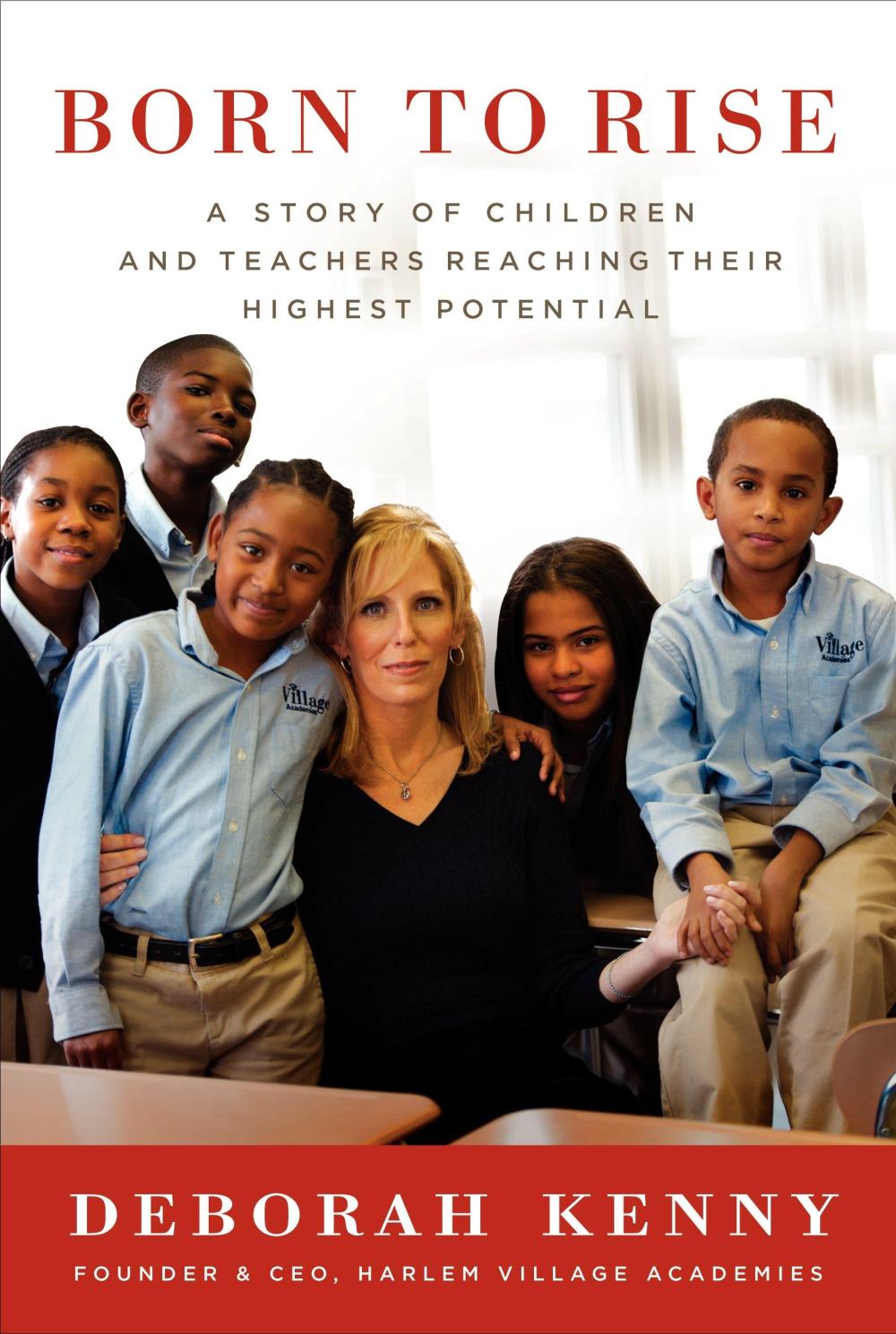
Deborah Kenny is the founder of the Harlem Village Academies, a network of five charter schools located in Harlem. She believes that any child can become an independent thinker and can learn to live a meaningful life. In her book “Born To Rise” she shares her inspiring personal story about the journey she took after her husband’s death to open the schools in Harlem and to establish that all children regardless of circumstances can learn at high levels.
Her story is an inspiration to all and she reveals the secret to creating a powerful workplace culture that attracts talented people and brings out each individuals passion. This morning the testing scores were released and the Harlem Village Academies ranked #1 of all public and charter school in Harlem in both 8th grade reading and math. This is just one reason why Oprah named her one of the most powerful women in the nation.
Be sure to tune in at 3pm et for the full conversation and below find an excerpt from “Born To Rise”.
Excerpt:
CHAPTER 1
SEARCHING
“OKAY, READY FOR YOUR THREE CLUES?” he asked. “This country starts with a V and it’s in South America. The capital is Caracas and the people speak Spanish.”
It was another round of “Kenny family geography,” a game my husband, Joel, had invented to keep our three young kids busy during car rides.
“That’s four clues!” shouted Rachel, our youngest, then age six.
“The first letter of the country doesn’t count,” our eight-year-old, Chava, stated firmly. “We get that for free.”
“It’s Venzulia!” fired Avi, nine, and very much the oldest.
“Nice try, Av,” said Joel from behind the wheel. “You’re close.”
“Trust me, Dad, it’s Venzulia,” Avi repeated emphatically.
Suddenly we heard a lot of shrieking and giggling as our three children began another game they liked even better. They called it “boxing,” but they were actually just playfully hitting each other.
“Knock it off!” Joel said, grinning. “Avi, I told you that you’re close. Think about it.”
“Dad, I’m going to ask you one last time. Is it Venzulia?”
Joel and I burst out laughing.
It was a golden Sunday in June of 1998, and we were headed to a science museum in Connecticut. The kids had been looking forward to this trip for weeks. They’d been eager to see the exhibit about marine biology ever since we’d rented a video about whales the month before.
We zipped north along the Saw Mill River Parkway in Westchester,
New York—just twenty more minutes, I told the kids—when Joel said he felt a bit dizzy. We figured it was the flu.
But the next morning Joel felt even fainter—strange for a guy who never complained and never got sick—so I drove him to a doctor, just to check.
The doctor ran a few blood tests and said he’d be back shortly with the results. A half hour went by. Then a full hour.
Finally, the doctor came back into the room. “I don’t want to alarm you,” he said softly, “but this could be serious. Joel, there is a chance you have a leukemic condition.”
He tried to keep us calm. “Nothing is definite yet. But you need to have a spinal tap.”
We drove back home and I started making calls to figure out what to do. As I arranged an appointment for the next day, Joel lay very still on the bed staring at the ceiling. Just looking at him, so silent and scared, devastated me. But I tried not to let that show. “The tests will come back negative,” I said, holding his hand. “All of this will be over tomorrow.”
That night, it was impossible to sleep. I spent the dark hours before sunrise praying silently, asking God to protect Joel.
The next morning we drove to Mount Sinai Hospital in Manhattan for the spinal tap. It was an excruciating procedure, but it was the only way to figure out exactly what was wrong, and it had to be done immediately. I sat by his side as we breathed together the whole time, holding hands. When it was finally done, we expected to go home. Instead, the specialist sent us to the third floor.
Joel and I didn’t acknowledge the two words that accosted us when we stepped off the elevator: “Oncology Unit.” As we waited in an empty room, I was petrified but I buried that feeling. Instead, I tried to distract Joel with questions about his dissertation and he tried to distract me with jokes.
Suddenly, some ten doctors, nurses, and residents swarmed the room. I stopped breathing. The doctor looked straight into our eyes, and spoke immediately: “I’m sorry, Joel. You have leukemia.”
Joel was the person in the world I most admired, one of those rare individuals born to a higher purpose. I was enchanted by him from the moment we met.
I was twenty-four years old and had just ended a relationship with a Harvard law student who was smart, ambitious, and good-looking. But I hadn’t connected with him on a deep level. I was hoping to meet someone with soul.
Within half an hour of our first date, Joel and I were discussing spirituality. As we walked around Greenwich Village in lower Manhattan, I learned that he played guitar, loved nature, painted, and was a Dallas Cowboys fan. The four Kenny brothers, he explained, played football almost every day in their backyard as kids, and they never missed a Cowboys game.
Joel, quiet but confident, was not intimidated by me. His mother, Shirley, was a college president who had worked full-time as an English professor while raising five children in McLean, Virginia, with Joel’s father, a history professor.
In between our dates, he wrote me love letters with pink hearts hand-drawn in colored pencil on the envelopes. Before long we started talking about the future. He told me about his desire to teach, to write books, to have a big family, and to compose his own music. I was falling in love. Like me, Joel had studied religion and philosophy in college. I’d never been with another person who thought debating the nature of Truth was an ideal way to spend a Saturday night.
For as far back as I can remember, I’d been this way. In high school, my parents worried that I was too serious. They encouraged me to try more activities, to lighten up, to “be well rounded.” My response was to write an editorial—“The Myth of the Well Rounded
Child”—in the school newspaper, in which I argued that it was more valuable to pursue one thing intensely than to participate in a wide variety of school activities.
I didn’t fit into any clique, and I didn’t care much about being popular. I spent prom night with Sara, one of my best friends, talking in her kitchen and eating tuna melts.
The summer camp Sara and I attended was a welcome change from the superficiality of high school. While the kids loved to socialize and have fun, it was the kind of place where it was cool to be smart and everyone fit in. The camp was dedicated to Jewish values and social justice. The chorus of our camp song was “You and I will change the world”—and everyone actually believed it, including me. It was bliss.
It was at camp where I met the teacher who would change my life:
Mel Reisfeld. He was an extraordinary and often irreverent educator, and for many decades the camp’s heart and soul. He was the coolest adult we kids had ever met. Mel could captivate hundreds of campers and counselors for hours with lectures about history, heritage, and social justice. My favorite stories were about his activism—how in 1963, he got in a car with a friend and two students and drove to D.C. for the March on Washington to hear Dr. Martin Luther King Jr.; how he led efforts to raise funds for Biafra when Africans were starving; how he had helped organize one of the very first walkathons for the March of Dimes; and how he joined in protests to support farm labor leader Césár Chavez. “We have to care about people,” he would always say. Mel also loved to provoke us. One night at dinner he gave eight of us the following challenge: “How many of you know how to say ‘@!$%#’ in another language?” We tried to impress him with our linguistic skills for the next hour.
Despite—or perhaps because of—his irreverence, Mel was a role model for the other counselors, many of whom had been activists in the 1960s. They were all, like Mel, independent thinkers who challenged societal norms. I related to their worldview: challenging the establishment made immediate sense to me.
One of my camp counselors introduced me to brown rice, juice fasting, and yoga. My mother was beside herself when at age fourteen I decided to become a vegetarian. “What about protein?” she worried. “The idea that protein is more important than other nutrients is a myth perpetuated by the meat and dairy industries,” I assured her. This was the late 1970s, when “health food” was considered bizarre. I didn’t care that everyone thought I was a bit nuts.
By junior year of high school, I felt even more disconnected from my peers. The pursuit of success seemed trivial to me. Instead, I was drawn to the discussions I’d had at camp about religion and social justice. I started keeping a journal and collecting quotes that inspired me. “A shallow mind is a sin, a person who does not struggle is a fool,” I copied down from Chaim Potok’s book In the Beginning.
And in my senior year I started writing down the questions that were on my mind: What is the meaning of life? Being happy is great, but is being happy a purpose in and of itself? What’s my plan for the future? I’ll pick a major to get a job to work my way up, to get a better job to be promoted to . . . then what? In twenty years I’ll be exactly where I am now, wondering what it was all for. What’s my ultimate purpose?
My mom threw a big party for my high school graduation. In our living room with a house full of family and friends she recited a poem that she had written in my honor. “If a woman does not keep pace with her companions,” it started, “perhaps it is because she hears a different drummer.” I felt lucky to have such supportive parents.
At the University of Pennsylvania, I spent a lot of time at coffee shops, stacks of books piled before me, talking late into the night with friends about the meaning of life. Early freshman year, I had discovered Rainer Maria Rilke. I must have read Letters to a Young Poet a hundred times. “Nobody can counsel and help you—no one. There is only one single way,” Rilke wrote. “Go into yourself. Search . . . Dig into yourself for a deep answer. And if this answer rings out true, if you meet this solemn question with a strong and simple, ‘I must,’ then build your life according to this necessity. Your whole life, even into its slightest and most indifferent hour, must be a sign of this urge and a testimony to it.” What would my life be a testimony to, I wondered.
My advisor allowed me to craft an independent major that enabled me to explore comparative religion, literature, and philosophy—and I was thrilled. My father wasn’t. He’d been pushing the doctor/lawyer track since I was in grade school. “What are you going to do?” he asked. “Open a philosophy store?”
I had no idea what I’d do with it, but I didn’t care. I just wanted to find answers to my questions.
My favorite course was American Intellectual History. It was listed as a senior seminar, limited to twelve students. I was a sophomore when I walked into the room, and it was overf lowing with almost fifty students, standing in every corner, some huddled near the door.
“I’m so sorry,” the professor said, “but we are oversubscribed. Will everyone who is a junior please raise your hand.” Some twenty students raised their hands, and the professor apologetically asked them to come back the next year. He then asked any of the remaining seniors who were not fully committed to consider leaving, and another dozen walked out of the room. Fifteen students remained, including me.
“The course structure will be the same each week,” he said. “You will read a book and write a paper grappling with the author’s ideas. When you arrive to class, be prepared to defend your understanding of the text. You will be called on.”
I knew that it would not be long before the professor looked at his roster and discovered that I was a sophomore. But I was dying to study the works of great American thinkers like Thoreau, Emerson, and the other Transcendentalists. I admired their rebellion against the intellectual establishment of their time and I was fascinated by their idealistic spiritual quest. Emerson had written about the “endless inquiry of the intellect”—I had to be in this class!
So I spent fifteen hours writing a paper that week, and made an appointment to meet with the professor.
“I asked to see you because I want to let you know that I am a sophomore,” I admitted in his office. “Even though you didn’t require a paper this first week, I wrote one to show you how committed I am, how much I want to take this course.” He told me I could stay that day, and he would make a final decision the following week.
When I arrived the next week, the professor handed me back my unrequired paper. On the front was a red C-. “You can stay,” he said. “But do better next time.” I was in heaven.
I spent many evenings in the library. One Sunday as I was walking along the brick path from my dorm to the library I stopped right in the middle of campus and wondered: if I were able to read every book in the library, would I then understand Truth?
On weekends I’d end up in long conversations in dorm rooms with other students, but I spent much more time with adults: my Shakespeare professor, the campus rabbi, my dorm advisor Dr. Martin Seligman. And with a grad student I’d met at the only health food store on campus who told me that Ram Dass, the counterculture icon and author of Be Here Now, was coming to Philadelphia.
Ram Dass, originally named Richard Alpert, had been a prominent Harvard professor when he experimented with LSD in the early 1960s with Aldous Huxley, Allen Ginsberg, and Timothy Leary. Though he justified it as research into the nature of human consciousness, Harvard kicked him out—and countless kids got turned on to his message. I had no interest in drugs, but I was very interested in the ideas that he espoused.
I arrived early to a packed auditorium. Ram Dass addressed all of the things I had been thinking about. “What am I doing here?” he asked. “Who are you? What is God?” He spoke about the illusion of separateness, and transcending the rational mind’s limitations through meditation. “Somewhere along the line you realize you aren’t who you thought you were.” He quoted Einstein, Kabbalah, Confucius, a Tibetan lama, Ramana Maharshi, and a Benedictine monk. “In the sixties,” he said, “we used to think strong people are rational and analytic, weak people and women are intuitive. But look how it turned out! Isn’t it far out?”
I had taped the lecture with a small recorder, and when I got back to my dorm room I transcribed it into my journal. As I was writing, my friends Robert and Jon walked in and asked what I was doing. We stayed up all night as I told them what Ram Dass had said. It all made sense to me, much more so than the life I had experienced growing up.
Not that there had been anything wrong with my childhood: I was raised by loving parents. My mom was a homemaker and freelance journalist and my dad was brief ly a schoolteacher, then a stockbroker. They gave me a tremendous amount of freedom, and knowing that they would do anything for me gave me confidence and stability. Still, I just always felt like there was more to life than financial or career achievement.
When my mom and dad came to visit me in college one weekend,
I was sitting in my dorm room with a few friends. “What are you studying?” my mother asked, looking skeptically at the books on my shelf. She’d brought me another copy of Ayn Rand’s Atlas Shrugged, just in case I had misplaced the copy she had given me the year before. “What are you kids doing tonight?” my father asked my friends, embarrassing me as usual. “We’re going to a party,” they replied. “Make sure to take Debbie with you,” he said. My friends laughed. “She doesn’t go to parties.”
After my friends left, he immediately turned to me, “Go with them, Debbie! You’ll have fun! What’s wrong with a little socializing?” I brushed him off. “It’s boring,” I replied. “It’s just music, drinking, and people.” My parents started cracking up. “What’s so funny?” I asked. “That’s what a party is!” they replied.
But I had no interest. Instead, I typed other students’ papers for a dollar a page. I wanted to save enough money to take the train to Boston during winter break to meet raw foods pioneer Ann Wigmore. We met in her apartment and she introduced me to sprouts and wheatgrass juice. Then, during spring break that year, I found my way to a farm in Woodstock, Connecticut, where I spent a week in a cabin on a lake with Ann’s colleague, another pioneer of raw foods, Viktoras Kulvinskas, and a dozen of their friends. I had read two of his books and wanted to learn more. “Realize there is life in everything,” he wrote. “Realize you are not what you’ve been taught. Allow consciousness to unite with you. And some day, we won’t stop smiling. When we walk, we’ll float. And light will pour from our eyes.” I spent the week eating sprouts, learning meditation, and hanging upside down every morning from ropes on the ceiling.
As intrigued as I was by these practices, part of me remained skeptical.Some of the people
I met were serious thinkers, but some, quite clearly, were quacks. The healthy-eating aspect of it stayed with me, but I became increasingly unimpressed with what I considered a shallow and somewhat self-centered approach to spirituality. I believed religion and spirituality had to be less about attaining enlightenment—perfecting oneself—and more about subordinating oneself and sacrificing for the greater good.
What I enjoyed more than anything was being with my friends from camp. So every summer for a few years I worked as a camp counselor. I asked Mel to place me in his group—he was the senior counselor and everyone wanted to work for him and learn about leadership.
And being at camp allowed me plenty of time to read and to talk with my friends about Emerson, Kabbalah, and William James. I’d often talk with my friend Steve while listening to him playing guitar. If you study religion deeply enough, I asked one day, don’t you think eventually it will lead to understanding Truth? “It depends. Which religion?” Steve asked. “They’re all so different.”
On the surface, Steve was right—all religions seemed quite different. But at a deeper level, I’d discovered that the mystical teachings were similar. I thought about a poem by T. S. Eliot that I had posted inside my bunk at the beginning of the summer, “We shall not cease from exploration / And the end of all our exploring / Will be to arrive where we started / And know the place for the first time.” Maybe that was it. Maybe I needed to take one path and follow it as far as it would go. I would study my own religion more intensely—not because it was truer than any other, but because I already knew about it, and if I went deep enough, maybe I could come to understand the universe.
“Mail call!” exclaimed Diane, the camper in charge of mail for the week. She had a letter for me from Semester at Sea, a program for college students to study abroad on a boat trip around the world. I had completely forgotten that I had applied. And now I had just been accepted.
“That is so cool!” Diane yelled. A few of my friends gathered around.
“You are so lucky!” said my friend, David.
“Wow, you get course credit for this?”
“What countries will you get to see?”
I tucked the letter inside my journal. “I’m not going,” I said to them.
“What do you mean?” Diane asked.
“I need to explore the inner world, not the outer world,” I said.
“I’m going to spend a semester meditating and studying Kabbalah in
Israel.”
“Well, now it’s official,” said David. “You’ve lost your @!$%#ing mind!”
That next semester, I studied mysticism from dawn to dusk. At first, it was incredibly exciting. We would meditate, pray, and attend classes all morning, then read for hours in the afternoon. I would stay up late every night with our group, talking as we looked out on the thousand-year- old mountains and ancient caves. But eventually I felt that I’d come up against a wall: understanding the universe was infinitely impossible. “The more I learn,” I wrote in my journal, “them more I realize how much I don’t know. The world of knowledge is so vast. I’ll never get there.”
I went to the library to talk with the school’s rabbi. He was an amazing teacher: unassuming, modest, and brilliant. “I’ve spent several years trying to understand the purpose of life,” I said. “But now I’m realizing how insignificant my life is in the grand scheme of things.” He smiled calmly. “That’s a very useful stage,” he said. “When you realize that you do not matter, all of a sudden there are all these other people who do matter. Life is about service to others. I mean—what else is there?”
I walked straight back to the dorm, took my journal out of the top drawer, and sat still for a moment. After years of searching, I had come to a conclusion. As I considered what he said, and as I thought about the massive amount of human suffering in the world, I realized that contemplating philosophy all this time had been a luxury. I had found the meaning I had been searching for in the simple idea of using my life in service to others. “I thought I had come up against a wall,” I wrote. “It turns out, it was a door.
In Joel, for the first time, I found a spiritual partner who saw things the same way. He had studied religion and philosophy, and had explored the same kinds of ideas in college, and he’d come to many of the same conclusions as I had. He was my perfect match.
When we got married in 1987, I had recently started a doctoral program at Columbia University’s Teachers College; Joel would soon pursue his doctorate in medieval mysticism downtown at New York University.
My first assignment in graduate school was to write about my educational philosophy. My essay was titled “Becoming an Educator.” To me, education was about shaping students’ worldview and character. “In its highest form, education means being an embodiment of the message one wishes to communicate,” I wrote. “Rather than imposing ideas on the student, the true teacher creates a framework within which the student may make something of himself.”
When I enrolled, I hadn’t fully realized that Teachers College was a bastion of liberal views. (I had started the same year as former Weather Underground member Bill Ayers, although he was twenty years older than me.) Maxine Greene, the celebrated education philosopher, was one of my favorite professors. She believed that the purpose of education was to help students understand their connection to, and responsibility for, all of humanity. Professor Greene and virtually everyone I encountered felt that the role of educators was to inspire and empower students to become critical thinkers who contribute to a democratic and compassionate society.
I was deeply enamored with these ideals, and I asked Professor Greene to be my thesis advisor. I loved every aspect of Teachers College: taking courses in comparative education, student teaching in Brooklyn, and learning about curriculum planning.
Meanwhile, I had three babies by the time I was twenty-nine. Over the course of ten years, between raising them while holding various jobs to pay the bills, I worked my way through graduate school.
I had considered becoming a public school principal after completing my degree, but a professor talked me out of that. “You wouldn’t last a minute in a bureaucracy,” she said. I hadn’t yet heard about charter schools, and none existed in New York. “So what if I start private schools for underserved communities?” I had suggested. “Then you won’t be an educator—you’ll spend ninety-nine percent of your time worrying about money,” she said.
I didn’t know what to do. Then a friend told me about a career planning
workshop and I signed up. After a full day of exercises, the leader sat down with me. “All seven indicators show clearly you have a business mind, but your heart wants to work with children or parents. So why not combine those and look into companies that make children’s products—maybe books or toys?” That sounded interesting. So I set out to meet with companies like Scholastic, Stride Rite, Hasbro, and Parenting magazine.
The summer before our kids started kindergarten and first and second grade, we decided to move to Westchester to take advantage of the quality public schools. We also wanted our children to have a moral education, so for two hours on Sunday mornings and Tuesday and Thursday afternoons, they went to religious school. Late one Sunday afternoon, I overheard Avi and Chava talking in the family room. “Will you please share your Legos with me?” he asked her.
“No,” she said without looking up. “But God says we’re supposed to share,” he offered. “No, I don’t want to,” she replied. “But if you don’t share, I’m gonna kill you.” Okay, so they weren’t saints!
Sunday night was family reading night—I would spread out a blanket in the living room, make a big bowl of popcorn, and we’d all spend the night reading while listening to Vivaldi. In the winter, we would get a fire going, but in the summer, the kids would always end up outside playing hide-and- seek or catching fireflies with their neighborhood friends.
I had a definite sense of the values I wanted to impart, and went about parenting by doing things in a deliberate way. I taught the children from a very young age to give to charity; I explained that they should give until they were slightly uncomfortable or had to miss out on something. I signed up our family to participate in an interfaith sandwich-making project for the homeless, and took the kids to classical music concerts each winter at Lincoln Center and Carnegie Hall.
Joel went about parenting by always making the kids his first priority. He had infinite patience: even when he was in the middle of writing, he would drop his work the moment one of them asked for something—to work in the garden, help with a science project, or fix a toy. He was kind and intellectually curious, and the kids naturally absorbed those qualities. And he spoke to them the same way he spoke to adults, with a dry wit that made me laugh all the time.
In the summer of 1998, he was just a few months away from defending his dissertation. Now those three words from the doctor—“ I’m sorry, Joel”—had devastated him.
In the hospital, while the nurses took him for more blood tests, the oncologist approached me. “Joel needs to start chemo immediately. He could die in a matter of days if we do not begin treatment.”
“Okay, I’ll put off the start date for my new job. About how long is the treatment?” I asked the doctor. I had just been hired by Time Warner as vice president of marketing and business development for The Parenting Group, which published Parenting magazine. In addition to marketing, I would be responsible for developing products for new mothers and their children.
“It’s going to be a very long road,” said the doctor. “You definitely should start the job.” I couldn’t imagine doing that.
“But he needs me,” I replied.
“He’s going to need you more later. You have to take care of yourself, take care of your kids, and keep your job.”
“I just can’t see myself going to work,” I said. The doctor was sympathetic but adamant. “Someone has to support the family. He could be in treatment for one or two years.” As the doctor spoke, tears started streaming down my face.
“You are going through what everyone goes through at this time,” he said.
The next day, Joel’s parents, who had been at a conference in Greece, arrived along with his brothers and sister from Washington, D.C. We filled them in on all that had transpired. With everyone gathered around his hospital bed, Joel started making jokes as he always did. The nurses had already identified him as their favorite patient. “It’s time for your EKG,” one of them said. “I’d rather have a K-E-G,” he replied. Another nurse came by to bring his lunch. “Has anyone died? Maybe then I’d get my food faster,” he deadpanned. And on it went.
I had no previous experience with hospitals but I quickly learned the ropes. I became an advocate for Joel’s needs, the most important of which was sleep. I would stay half-awake all night sitting up in a chair that I positioned at the foot of his bed, facing the door. This way, when a nurse entered I would indicate to her that she should whisper, and suggest that she didn’t need to turn on a light in order to take Joel’s temperature. It was amazing how nurses would walk in with a booming voice yelling “How are we doing?” at two-thirty in the morning. “He’s sleeping,” I would say, always smiling and whispering, hoping they would realize he should not be woken up every two hours.
We had told our children that Daddy was sick, but we hadn’t given any details. On a Saturday in July, shortly after the diagnosis, I brought them to visit him. The minute he saw the children, his eyes became misty. But he put on an outward display of brightness for their sake.
When it was time to go, I told the kids to sit on the chairs in the hall for a minute. As soon as they walked out of the room, Joel started sobbing. “I need to be here for them,” he said.
“You will. You’ll get through this and everything is going to be fine,” I said, holding both his hands. “I’ll be back tomorrow morning. I’ll call you tonight.”
“You will. You’ll get through this and everything is going to be fine,” I said, holding both his hands. “I’ll be back tomorrow morning. I’ll call you tonight.”
“I love you,” he said.
“I love you, too. This will all be over soon. I promise.”