








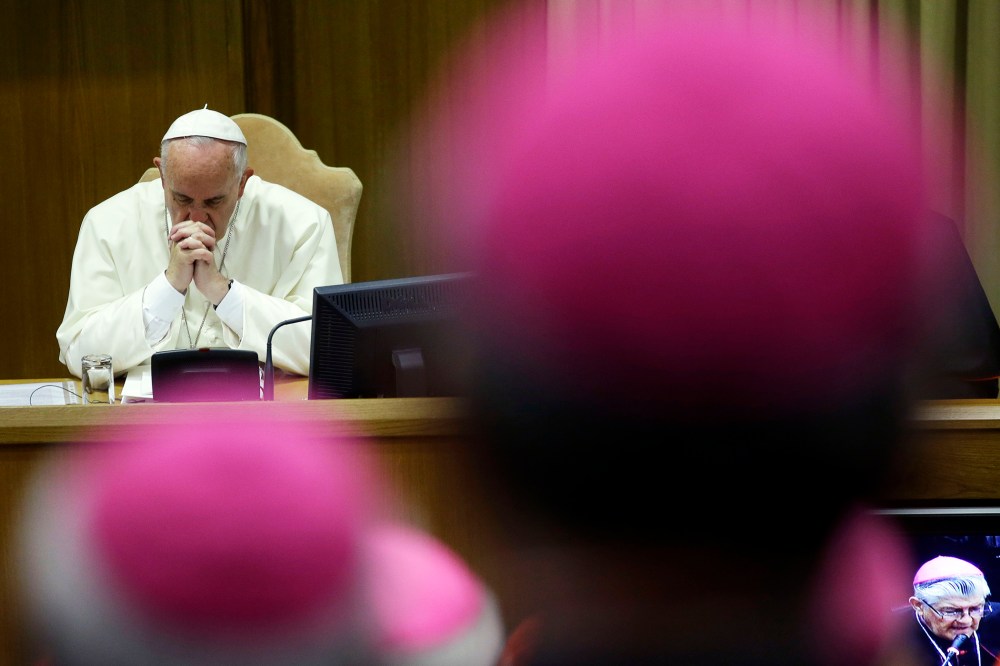
A new document from the Vatican stating that gay people “have gifts and qualities to offer to the Christian community” drew mixed responses from some Catholics in the U.S. on Monday. Liberal Catholic leaders hailed the statement as a significant step to a more inclusive environment for gays and lesbians, while conservatives sought to downplay it as less of an overture and more of an ongoing move towards a more progressive church.
However, some experts say the new statement, which asks Catholics whether gays and lesbians should be welcomed into the church, aligns with the pope’s views and they caution that the statement is not yet complete. The document was issued during a formal meeting of church leaders, or synod, which will continue throughout the rest of the week. The church is not expected to issue a final document until next week.
RELATED: Vatican asks, ‘Can we accept gays?’
The document seems to align with Pope Francis’ focus on outreach — he has made it a point in the past to speak the role of women in society, abortion, and issues affecting the poor. Seven-in-ten U.S. Catholics believe that Francis represents a major change in direction for the church, according to a Pew Poll released in March of this year. After today’s meeting, conservative Catholics don’t seem to agree, but they may appreciate the Francis’ efforts to make the church a more welcoming and merciful place.
%22What%20the%20synod%20is%20trying%20to%20do%20is%20…%20to%20let%20these%20people%20know%20that%20the%20church%20is%20place%20of%20welcome%20not%20place%20of%20judgment.%22′
Dr. John Grabowski, associate professor of moral theology at The Catholic University of America, warns that the document released today is merely a provisional text. “We don’t even yet have a definitive English translation, and some people are reading a little too much into it with some of the reactions I’ve seen out there.” He finds that “some people have certain expectations about Pope Francis and they try to fit things that happen into these expectations.”
Overall, Grabowski emphasizes the “more pastoral tone making the church a welcoming place for everyone, a place of hospitality for everyone very much in keeping with the pope’s ministry and message.” Asked if he viewed this declaration as a monumental shift in doctrine, he sees no evidence of one. “But when the pope says there’s a moral teaching of love and mercy, I think you’re seeing impact of that here in the tone. We need to have a posture where everyone knows that they’re welcome and invited.”
Inclusion, according to Grabowski, is the primary aim of this document. “What the synod is trying to do is take people who have felt excluded because of the church’s teaching, because of same-sex orientation or divorce,” he said, and “to let these people know that the church is place of welcome not place of judgment.”
“There will be blowback both positive and negative,” Grabowski notes, “but generally among people who aren’t really reading carefully.” People who are “dialed in” will recognize that this is unsurprising.
Professor William Mattison, associate dean for undergraduate studies at The Catholic University of America, agrees with his colleague. “The document is not any bombshell or any significant departure with regard to same-sex marriage or change,” he said. Mattison does, however, point out that
the “change in emphasis on recognizing the ways that Catholics need to reach out to gay people and to people in difficult situations, recognize the goodness that’s there.” While issues like homosexuality and divorce are ubiquitous in the West, Mattison said that this synod has actually placed equal weight on topics like polygamy, inter-religious marriage between Christians and Muslims, and the difficulties Christians face due to migration. “The conversation on the floor was actually broad, so it’s interesting that the document focused on those things,” he said. %22There%E2%80%99s%20sloppiness%20in%20the%20document.%20It%E2%80%99s%20just%20a%20working%20draft.%22′ Mattison echoes Grabowski’s theme of mercy. He views this document as “emblematic of Pope Francis’ theme on mercy of God and mercy that we’re called to have toward each other.” However, he warns of the dangers of releasing an unfinished document so quickly: “There’s sloppiness in the document. It’s just a working draft.” Brian Burch, president of Catholic Vote, reinforces the points made by both Mattison and Grabowski. “It offers no definitive teaching,” he says, “but instead serves to foster additional discussion and reflection for the coming week. […] Efforts to reduce the document to a few hot-button issues for mass media consumption, or to advance certain ideological agendas, does a disservice tot eh conversation occurring in Rome.” Meanwhile, some left-leaning Catholics are quick to hail the shift in Pope Francis’s approach. Catholics in Alliance for the Common Good released a statement today directly referring to the “shift in the Church’s pastoral approach towards the LGBT community.” They also expressly “agree with the bishops that gay and lesbian Catholics have ‘gifts and qualities to offer to the Christian community.’”
Willa Frej Recommended


