








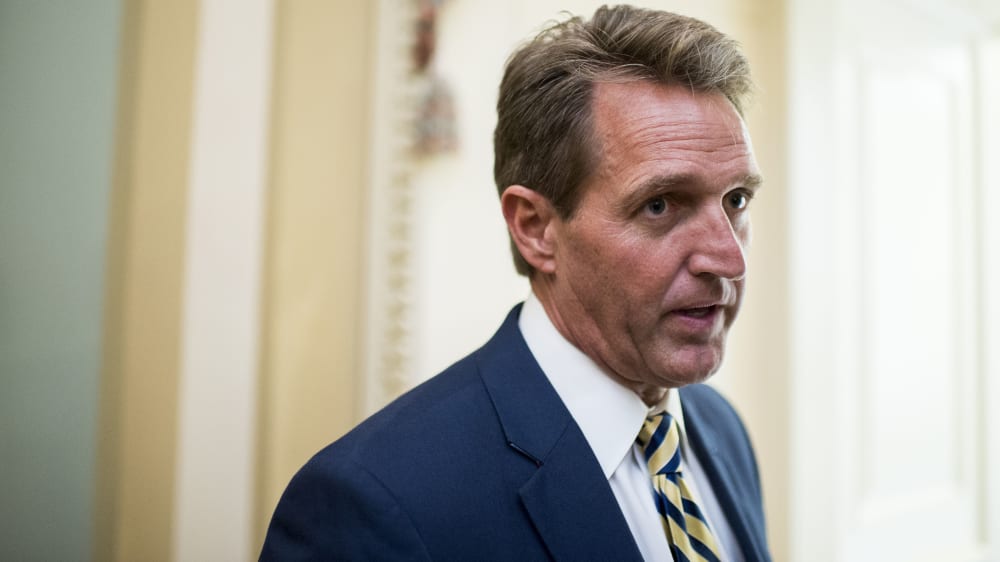
Sen. Jeff Flake (R-Ariz.) is one of his party’s most articulate critics of Donald Trump. What the Arizona Republican has not done, however, is match his rhetoric with action.
I made the case in January that I actually like Flake’s speeches, op-eds, and books criticizing the president. I also recognize that it takes some political courage to speak out the way he has. But I keep waiting for the Arizona senator to actually do something — to follow up his welcome words with deeds — instead of preparing the next speech, op-ed, and book.
With this in mind, it’s only fair that I give credit where credit is due: TPM noted that Flake is prepared to use his power to push new legislation to check the White House.
In response [to Trump’s new trade tariffs], Sen. Jeff Flake (R-AZ) said Thursday that he will soon draft a bill to block the tariffs from taking effect, calling Trump’s move “a marriage of two lethal poisons to economic growth — protectionism and uncertainty.”
“Trade wars are not won, they are only lost,” he said in a statement. “Congress cannot be complicit as the administration courts economic disaster. I will immediately draft and introduce legislation to nullify these tariffs, and I urge my colleagues to pass it before this exercise in protectionism inflicts any more damage on the economy.”
Now, it’s probably worth having a conversation about the fact that Republicans were willing to put up with a whole lot of offensive presidential conduct before this week, and only agreed to take some meaningful legislative action once it was an economic issue on the line. For now, however, let’s put that aside.
Let’s instead note that many GOP lawmakers, including close allies of the president, are at least sending the right signals about checking Trump’s latest moves. “I don’t think Republicans will put up with this, and I personally believe that we may be able to stop it in the Congress,” Sen. Orrin Hatch (R-Utah said yesterday.
This is, of course, an important and realistic option. As we discussed the other day, the Constitution may empower Congress to “regulate commerce with foreign nations,” but the White House has gradually expanded its power in this area, especially when it comes to tariffs (though the last time Congress changed the law, the idea was to empower the executive branch to eliminate tariffs, not create new ones).
With this in mind, it would take a new law to block Trump’s proposed tariffs on steel and aluminum – such as something alone the lines of Jeff Flake’s idea. Alternatively, as the Washington Post noted, GOP leaders “could try to halt the tariffs by inserting something into a must-sign piece of legislation, such as the government-funding bill that is due later this month.” The question is one of intestinal fortitude. Republicans haven’t been shy about criticizing the new tariffs, but it’d be fairly bold for a GOP-led Congress to approve legislation blocking a policy adopted by a GOP-led White House. Slate‘s Jim Newell made a compelling case that we should lower our expectations: “If Flake is leading the charge, that means the congressional Republicans who matter, and who care about maintaining a good relationship with the president, are too scared. Not too scared to criticize the decision—most of the top Republican players in Congress have voiced their opposition—but too scared to use powers granted to them by Article I to reverse it.” Watch this space.
Steve Benen is a producer for "The Rachel Maddow Show," the editor of MaddowBlog and an MS NOW political contributor. He's also the bestselling author of "Ministry of Truth: Democracy, Reality, and the Republicans' War on the Recent Past." Recommended


