








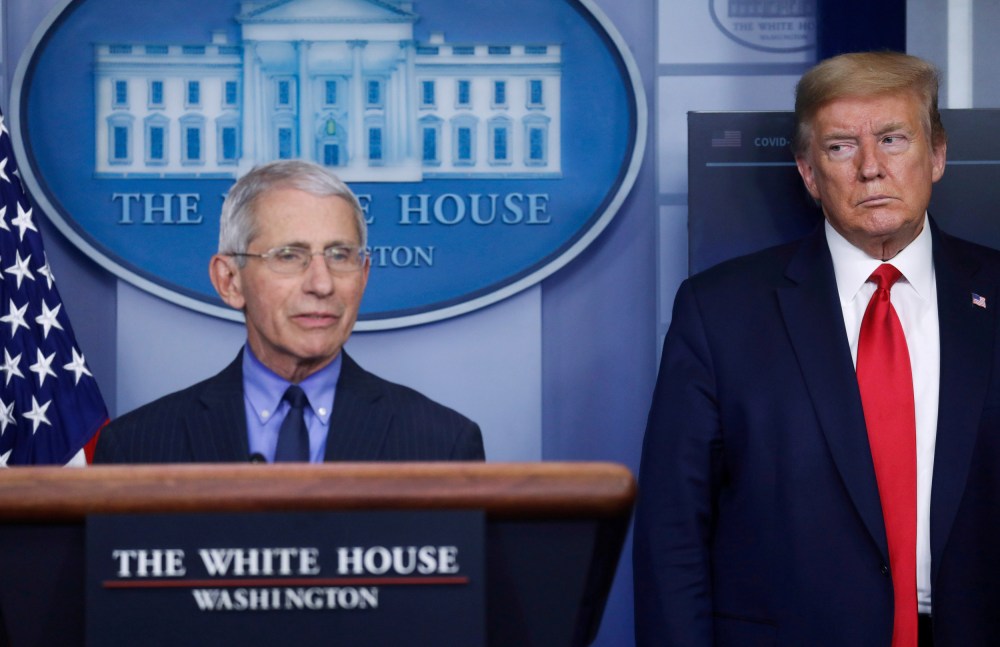

On March 23, as the coronavirus crisis in the United States was coming into focus, Donald Trump held a White House press briefing and was asked whether he planned to follow Dr. Anthony Fauci’s recommendations. “Sure,” the president replied. “I would certainly — he’s very important to me, and I would — I will be listening to him.”
That was Act One: a period in which Trump saw Fauci, the director of the National Institute of Allergy and Infectious Diseases, as a trusted source who could help guide the White House’s response to the pandemic. Act Two, which unfolded gradually over the ensuing months, saw the president start to ignore and marginalize Fauci, who had the audacity to present Trump with information that was politically unsatisfying.
We’ve now reached Act Three, in which the president’s indifference has transitioned into overt hostility. As NBC News reported, the White House is now “seeking to discredit” Fauci.
In a remarkable broadside by the Trump administration against one of its own, a White House official said Sunday that “several White House officials are concerned about the number of times Dr. Fauci has been wrong on things.” The official gave NBC News a list of nearly a dozen past comments by Fauci that the official said had ultimately proven erroneous.
Those who don’t work in politics or journalism may not be familiar with “oppo dumps,” but they’re fairly common. The practice is relatively straightforward: political operatives will do extensive opposition research against an opponent, and instead of releasing one or two damaging tidbits at a time, the operatives package all of their research together and release it all at once. These “dumps” of opposition research are intended to be devastating by their sheer volume: the recipient is supposed to see the size of the research project and come away with the belief that the targets are as controversial as their critics claim.
We’ve now reached the point at which the White House is conducting oppo dumps on the country’s leading infectious disease expert — during a deadly pandemic, and amidst rising infection and fatality rates. Indeed, multiple organizations received the anti-Fauci research.
There are a handful of relevant angles to this. Right off the bat, it’s worth appreciating just how absurd the circumstances are. As Sen. Chris Murphy (D-Conn.) noted over the weekend, “Don’t let this feel normal. It’s nuclear grade bananas to have White House staff sending reporters opposition research on their own top infectious disease doctor in the middle of a worsening pandemic that has already killed 130,000.”
Making matters worse, Team Trump doesn’t appear to be spending its time wisely. White House officials have the resources and interest to smear the director of the National Institute of Allergy and Infectious Diseases, but it doesn’t have a national testing strategy, a PPE distribution plan, or any kind of strategy to re-open schools.
But perhaps most important is coming to terms with the rationale behind the anti-Fauci smear campaign. There’s fresh reporting, for example, that Trump is “galled” by the fact that the infectious disease expert has a higher approval rating than he does.
It doesn’t help that the president is reflexively hostile toward experts as part of his antagonistic attitude toward governing. (For more along these lines, see my book.) Most importantly, however, Fauci has become an impediment to the White House’s plans. Trump and his team effectively want to stop fighting the coronavirus pandemic and start encouraging Americans to pretend everything has returned to normal. Fauci and other experts have adopted a far more responsible line, which obviously undercuts the message emanating from the West Wing. And so, the calculus is simple: the more Fauci’s reality-based assessments prove inconvenient, the more the Team Trump finds it necessary to discredit Fauci. The White House wants the public to stop listening to the authorities and start listening to the president. My point isn’t that Fauci and other leading experts are infallible. They’re obviously not. But Fauci, his colleagues, and his scientific contemporaries are focused on evidence and best practices — which is more than anyone could say about their misguided political critics.
Steve Benen is a producer for "The Rachel Maddow Show," the editor of MaddowBlog and an MS NOW political contributor. He's also the bestselling author of "Ministry of Truth: Democracy, Reality, and the Republicans' War on the Recent Past."
Latest Post
Recommended


