










Two weeks ago, on Jan. 25, the U.S. House formally brought an article of impeachment against Donald Trump to the U.S. Senate for a trial. The next day, Sen. Rand Paul (R-Ky.) tried to short-circuit the process, introducing a motion to reject the proceedings altogether based on the idea that trying a former official is unconstitutional.
Senators rejected the gambit, allowing the process to move forward, but 45 Senate Republicans endorsed the idea that the trial itself was improper. Yesterday, the first day of the former president’s trial, offered members — or in this case, “jurors” — an opportunity to consider the same question after hearing presentations from House impeachment managers and Trump’s defense lawyers. The results were nearly, but not quite, identical.
The Senate voted Tuesday to proceed with the impeachment trial of former President Donald Trump, with six Republicans joining all Democrats. The 56-44 vote rejected an argument from Trump’s attorneys that it is unconstitutional to try a former president, a debate that took up much of the first day of arguments from the House impeachment managers and Trump’s legal team.
As the Senate’s roll call shows, only six of the chamber’s 50 Republicans voted with Democrats on the question: Louisiana’s Bill Cassidy, Maine’s Susan Collins, Alaska’s Lisa Murkowski, Utah’s Mitt Romney, Nebraska’s Ben Sasse, and Pennsylvania’s Pat Toomey. The contingent was identical to the group that rejected Rand Paul’s effort two weeks ago, except for Cassidy, who voted with his party last month, but who broke ranks yesterday.
It may be tempting to simply stop here and wait for the trial to move forward over the next several days, but it’s worth appreciating the fact that we learned quite a bit on Day One of the proceedings.
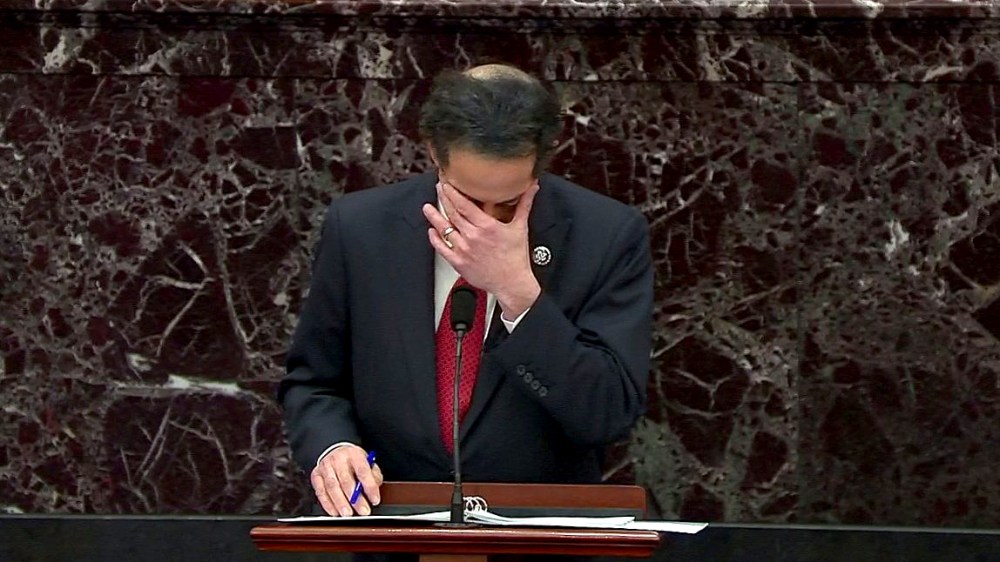
We learned that House impeachment managers brought their A game. Senators heard from Reps. Jamie Raskin (D-Md.), Joe Neguse (D-Colo.), and David Cicilline (D-R.I.), each of whom were devastating in their presentations, making a powerful, compelling, and factual case. Even many Republicans grudgingly conceded how impressive they were.
We learned that that their Team Trump counterparts had no A game. In these divisive times, it was nice to see practically everyone — left, right, and center — marvel at Bruce Castor’s confusing and spectacularly unpersuasive presentation, which he appeared to be making up as he went along. His colleague, David Schoen, was only marginally better. The gap in quality between the Democratic attorneys and Trump’s defense team was jarring, and at one point, Castor conceded that he and his colleagues “changed” their presentation because the House impeachment managers’ presentation was so “well done.” The candor was welcome; the largely incoherent presentation was not.
We learned that Senate Republicans remain largely indifferent to the merits of the case. To a large extent, yesterday was a test for GOP senators: would they hear both sides, recognize how awful Team Trump’s position is and how poorly it was presented, ignore precedent, and vote the way the former president wanted them to? As the dust settled, 44 out of 50 Senate Republicans — 88% of the caucus — flunked the test. We learned Team Trump did not impress its client. The former president, whose obsession with watching television is well documented, was reportedly “furious” with his defense team. It’ll be interesting to see whether he agrees to pay them or not. The proceedings’ second day will get underway this afternoon, with House impeachment managers having 16 hours to make their case. They’re expected to wrap up tomorrow, and it’s not yet clear whether the Democrats intend to take up the full 16 hours. (They did not use all of their allotted time yesterday, finding it unnecessary to respond to the presentation from Trump’s lawyers.) On Friday and Saturday, the former president’s defense team will also get 16 hours to present their case. Watch this space.
Steve Benen is a producer for "The Rachel Maddow Show," the editor of MaddowBlog and an MS NOW political contributor. He's also the bestselling author of "Ministry of Truth: Democracy, Reality, and the Republicans' War on the Recent Past."
Latest Post
Recommended


