








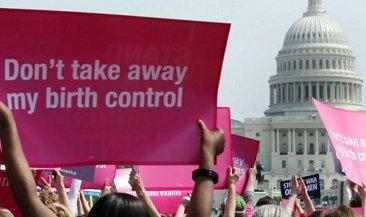
First up from the God Machine this week is a court case out of Pennsylvania that’s likely to be pretty important in the right’s drive to block contraception access.
At issue is a cabinet-making company called Conestoga, whose Mennonite owners oppose birth control on religious grounds. They filed suit challenging the contraception provisions in the Affordable Care Act, arguing that their faith applies to their for-profit business — the Hahn family, which owns Conestoga, doesn’t like birth control, so the family wants to leave contraception access out of the company’s health plan.
As of yesterday, that argument didn’t go over well in court.
A federal appeals court said Friday that the owners of a private company could not challenge the contraception mandate in President Obama’s healthcare law.
The 3rd Circuit Court of Appeals said the owners of Conestoga, a cabinet-making company, could not challenge the mandate because of their personal religious beliefs.
It’s a pretty straightforward decision — corporations may be people (my friend), but according to the 3rd Circuit, the Hahn family can have its religious beliefs, but the cabinet-making company does not have religious beliefs of its own.
“We simply conclude that the law has long recognized the distinction between the owners of a corporation and the corporation itself,” wrote Judge Robert Cowen. “A holding to the contrary — that a for-profit corporation can engage in religious exercise — would eviscerate the fundamental principle that a corporation is a legally distinct entity from its owners.”
The ruling added, “The [contraception provision] does not impose any requirements on the Hahns. Rather, compliance is placed squarely on Conestoga. If Conestoga fails to comply with the Mandate, the penalties … would be brought against Conestoga, not the Hahns.”
This may seem like common sense, but the arts-and-crafts chain Hobby Lobby has filed a nearly identical lawsuit — its owners don’t like birth control for religious reasons, either — and as Sarah Posner recently explained, this company has had far more success at the 10th Circuit.
And when two federal appeals courts disagree on the same question, the U.S. Supreme Court generally intervenes to settle the dispute. We may, in other words, soon see a major legal showdown over whether corporations have their own distinct freedom of religion that affords businesses the right to block their employees’ access to contraception.
Also from the God Machine this week: * Sen. Ted Cruz (R-Texas), talking to a religious right audience, made a spirited case against marriage equality. “On marriage there is no issue in which we need to be more on our knees because the momentum is with the opponents of traditional marriage. We’re facing an assault on marriage.” He scolded “unelected judges” who think “we know better” on marriage, and urged pastors to “to speak to your congregations and to mobilize the people, and mobilize them more than anything to pray.” * In North Carolina, state Rep. Nelson Dollar (R) defended his party’s hyper-aggressive budget plan by insisting, “Today is the day when history will mark this General Assembly did what was morally right in the eyes of God.” Well I guess that settles it, then. (Thanks to reader D.R. for the tip.) [Update: Taking a closer look at the context, Dollar’s defense of the regressive state GOP budget also included support for “eugenics compensation,” which is clearly a relevant detail.] * There’s an interesting fight underway in Ohio, where a proposed Holocaust memorial featuring Jewish imagery, drawing complaints from the Freedom From Religion Foundation. * And the White House this week hosted a Ramadan celebration, including an Iftar dinner. President Obama noted at the event that throughout the nation’s history, “Islam has contributed to the character of our country.”
The place for in-depth analysis, commentary and informed perspectives. Recommended


