








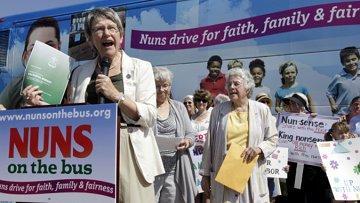
First up from the God Machine this week is the emergence of a religio-political force that’s long been rumored, but has often struggled to materialize: a “religious left” that can serve as a credible counter-force to the “religious right.”
This week, the religion, policy and politics project at Brookings Institution and the Public Religion Research Institute published a study with some unexpected results. The survey, co-authored by E.J. Dionne, William Galston, and PRRI leaders, document an important trend: religious social conservatives represent about 28% of the population, but they’re slowly being eclipsed by a younger, diverse group of religious progressives.
Religious progressives are significantly younger and more diverse than their conservative counterparts. The mean age of the religious progressive population is 44 — just under the mean age in the general population of 47 — while the mean age of religious conservatives is 53. Twenty-three percent of Millennials (ages 18-33) are religious progressives, while 17 percent are religious conservatives.
It’s a similar demographic issue that’s facing the Republican Party: among Americans 66 and older, 47% self-identify as religious conservatives and only 12% consider themselves religious progressives. Among Americans 33 and younger, religious conservatives not only trail religious progressives, the right also finds itself outnumbered by secularists.
Complicating matters, religious progressives are not only gaining a generational advantage, they’re also rejecting the basic foundation of conservatives’ religio-political activism: “Nearly 8-in-10 (79 percent) religious progressives say that being a religious person is mostly about doing the right thing, compared to 16 percent who say it is about holding the right beliefs.”
We won’t see the cultural impact of these changes overnight, but the report points to a problem conservatives will struggle to overcome: a future in which a shrinking percentage is moved by the religious right movement’s social agenda and a growing percentage embraces progressive goals for religious reasons. For too long, the political world considered “religious issues” and “conservative issues” as synonymous, and fairly soon, that will no longer apply.
Jack Jenkins added, “Religion has long been co-opted by religious conservatives as a vehicle for political gain, but this study hints that the future of faith-based political advocacy could rest with the left-leaning faithful.”
Also from the God Machine this week:
* As hard as it is to believe, Hobby Lobby, which claims corporations are people with their own religious liberties, won a temporary court injunction yesterday, allowing it to exclude birth control from its employee health plan.
* Florida Gov. Rick Scott (R), feeling a little defensive, has formally declared a “Statewide Day of Prayer for Unity.” The day the gubernatorial proclamation calls for Floridians to pray is tomorrow (thanks to my colleague Tricia McKinney for the tip). * In addition to the survey results discussed above, the First Amendment Center published a report this week on Americans’ support for, and understanding of, constitutional principles. A narrow 51% majority believes the U.S. Constitution established “a Christian nation” — the opposite is true — though that number has dropped in recent years (thanks to reader R.P. for the heads-up). * Right-wing religious activists are coming to the defense of Maine Gov. Paul LePage (R), with Michael Heath, the former director of the Christian Civic League, insisting the governor has been “sodomized by the left.” The remarks were not well received in Maine, where Democratic leaders condemned the comments as “hateful and bigoted” (thanks to my colleague Laura Conaway for the tip). * In a sign of the times, the Vatican is now offering “indulgences” to followers of Pope Francis’ messages on Twitter. * And add TV preacher Pat Robertson to the list of conservatives who are convinced that people who wear hoodies should necessarily be considered criminals.
The place for in-depth analysis, commentary and informed perspectives. Recommended


