








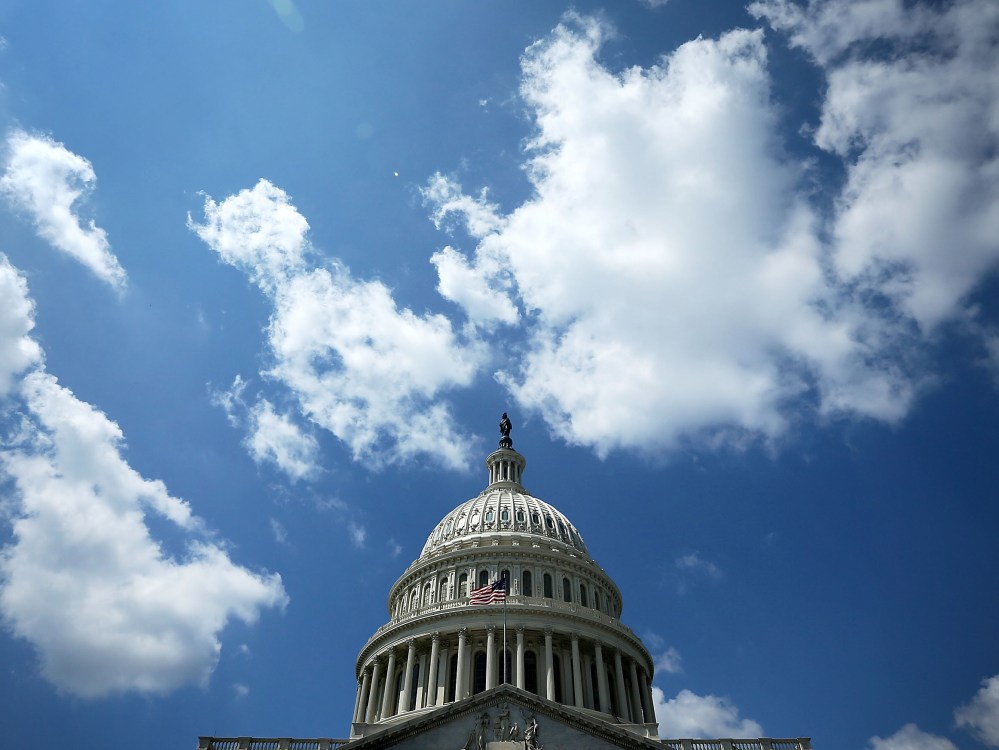
First up from the God Machine this week is a new faith group on Capitol Hill that, for the first time in history, exists for members of Congress who aren’t religious.
There are literally hundreds of caucuses on Capitol Hill, including caucuses for various faith traditions, but as Vox noted this week, the Congressional Freethought Caucus is new and emblematic of changing attitudes toward non-theists.
This week, Democratic Reps. Jared Huffman (CA), Jamie Raskin (MD), Jerry McNerney (CA), and Dan Kildee (MI) announced the formation of a new caucus, known as the Congressional Freethought Caucus, to safeguard the interests of nontheists in government, and to promote policies based, in their view, on reason and science.
A press statement emailed to journalists said, “The mission of the caucus is to promote public policy based on reason and science, to protect the secular character of our government, and to champion the value of freedom of thought worldwide.”
According to the statement, the caucus will actively work to “protect the secular character of our government”; promote science-bred public policy; counter discrimination against atheists, agnostics, and humanists; and provide a “forum for Members of Congress to discuss their moral frameworks, ethical values, and personal religious journeys.”
For now, those four founding members are the caucus’ only members. But given the traditional expectations that politicians must be religious to get elected to pubic office in the United States, the fact that four federal lawmakers would choose to create a Freethought Caucus at all is a … well, “miracle” is probably the wrong word in this context, but it’s pretty extraordinary.
Roy Speckhardt, executive director of the American Humanist Association, added, “The very existence of this congressional caucus for freethinkers and humanists is a marker of how far the movement for secular and nontheist equality has come. This significant step is also a new beginning for our country as both religious and nonreligious leaders work to better the nation.”
The Pew Research Center has reported that religious “nones” — a shorthand used to refer to people who self-identify as atheists or agnostics, as well as those who say their religion is “nothing in particular” — now make up roughly 23% of the U.S. adult population, a number that’s risen quickly in recent years.
In fact, it’s even reached the point at which a Congressional Freethought Caucus can exist.
Also from the God Machine this week: * The resolution of a story I’ve noted in previous installments: “The Republic of Iraq has finally taken possession of thousands of ancient artifacts illegally shipped to the U.S. by Hobby Lobby in an international smuggling operation more befitting an Indiana Jones villain than America’s favorite arts-and-crafts retailer.” * For those who follow religious news closely, the recent dramatic developments at the Religion News Service are a big story. * Australian Cardinal George Pell “was ordered by an Australian magistrate to face trial over sexual abuse allegations, a decision that may make him the most senior Roman Catholic prelate to be forced to defend himself in court over a scandal that has swept through Catholic communities around the world.” * The New Jersey Supreme Court recently issued a unanimous ruling blocking public funding of 12 churches that received aid in the form of historic preservation grants. The decision “could reverberate beyond New Jersey and reignite a national debate over the separation of church and state.”
Steve Benen is a producer for "The Rachel Maddow Show," the editor of MaddowBlog and an MS NOW political contributor. He's also the bestselling author of "Ministry of Truth: Democracy, Reality, and the Republicans' War on the Recent Past." Recommended


