








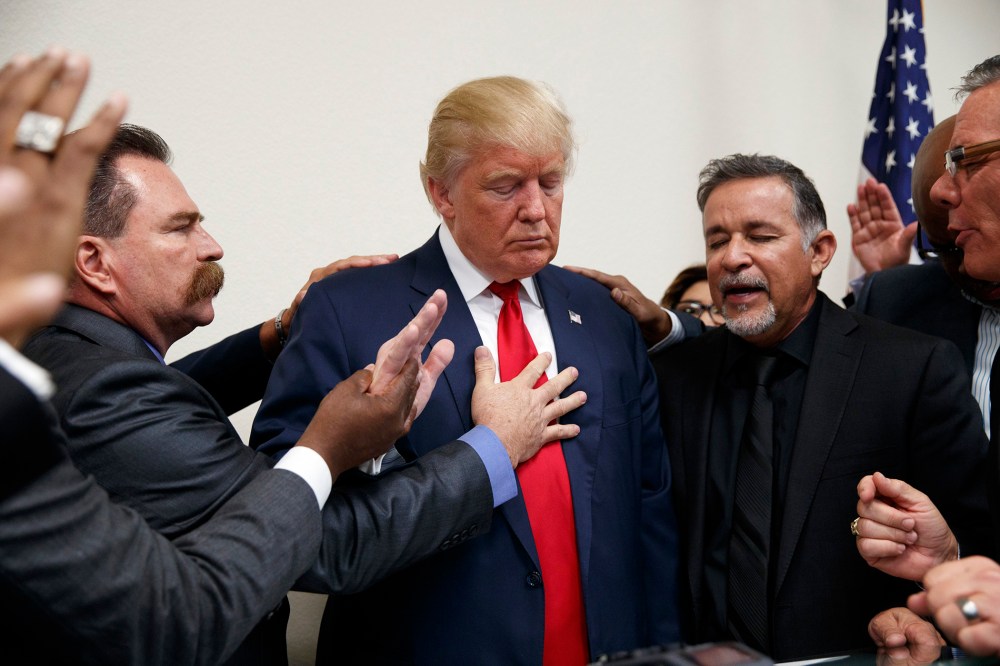
First up from the God Machine this week is a look at Donald Trump’s relationship with politically conservative evangelical Christians, which actually appears to be strengthening, despite controversies that would seem to push in the opposite direction.
To be sure, as Trump rose to prominence in Republican politics, he and the religious right movement made an odd pairing. He is, after all, a secular, thrice-married casino owner with a lengthy history of “character” issues, while Christian conservatives generally have little use for these kinds of politicians.
But what’s especially interesting about this awkward marriage is that Trump’s support among evangelicals is going up, even as the public is confronted with new scandals about the president, adult-film entertainers, and hush-money payments. Vox noted yesterday:
White evangelical support of Donald Trump is at an all-time high, according to a new study. The poll, conducted by the Public Religion Research Institute in March, found that a full 75 percent of white evangelicals surveyed had a positive opinion of Donald Trump, compared to just 22 percent holding an unfavorable view. […]
Given that 81 percent of white evangelical voters voted for Trump, these latest findings suggest that the well-document turmoil of Trump’s presidency has done little to dissuade his core supporters. Nor are his supporters necessarily banking on the only Republican option out there: According to the poll, 69 percent of white evangelicals would prefer Trump, rather than another Republican candidate, as the 2020 presidential nominee,
That last number may be the most important. A variety of evangelical leaders have already made the case publicly that they’re comfortable with a marriage of convenience with the president: so long as he keeps delivering on the religious right’s priorities, the argument goes, the religious right will embrace moral relativism and look the other way on Trump’s personal failings.
But if 69% of these voters prefer Trump to a different Republican — which is to say, someone else who would presumably be just as eager to deliver on conservative Christians’ political goals — it suggests the movement is taking this relationship beyond convenience and actually investing in Trump personally. The polling results suggest they like him, not just what he’s doing for them.
In January, as the Stormy Daniels controversy was first reaching the public, Family Research Council President Tony Perkins said the religious right and the movement’s adherents agreed that Trump should “get a mulligan” when it came to reports about his personal misdeeds. But “mulligan” suggests evangelicals may be less forgiving if, say, Trump were caught up in new scandals that cast his character in a negative light.
Given the available data, it’s starting to look like Trump may have a limitless supply of “mulligans” when it comes to politically conservative evangelical Christians.
Also from the God Machine this week: * How is it that Focus on the Family is now considered a church by the Internal Revenue Service? Right Wing Watch had an interesting report on this the other day. * It’s been an unusually brutal year for megachurch pastors: “Prominent pastor Bill Hybels announced Tuesday he is stepping down from his Chicago-area megachurch Willow Creek, just weeks after the Chicago Tribune published allegations of misconduct from several women. Hybels, who with his wife co-founded one of the nation’s largest churches in 1975, was a spiritual adviser to President Bill Clinton around the time of the Monica Lewinsky scandal.” * On a related note: “Frank S. Page has resigned as president and chief executive officer of the Southern Baptist Convention’s Executive Committee, effective [March 27], over what is described as ‘a morally inappropriate relationship in the recent past.’” * There’s no shortage of faith-based programming in the United States, but this is a new one: “Scientology TV, a network dedicated to the religion, officially launched [on March 12] at 5 p.m. PT with a message from Church leader David Miscavige, making a rare on-camera appearance.”
Steve Benen is a producer for "The Rachel Maddow Show," the editor of MaddowBlog and an MS NOW political contributor. He's also the bestselling author of "Ministry of Truth: Democracy, Reality, and the Republicans' War on the Recent Past." Recommended


