








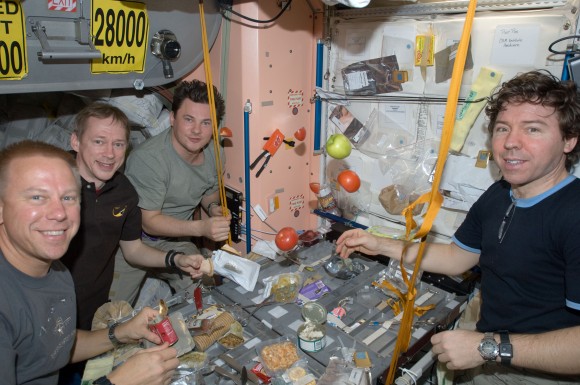
What do you call irradiated smoked turkey, thermostabilized candied yams, and freeze-dried green beans? Thanksgiving in space.
While you were sitting around your dining room tables surrounded by friends and family, enjoying your turkey, tofurkey, or turduken, six people were orbiting just over 200 miles above your head having a feast of a different kind. Astronaut food has come a long way from the iconic neapolitan freeze-dried ice cream of the Apollo Program.

NASA food scientists are working toward not only improving the menu on the International Space Station (ISS), but also developing feasible menus (and long-term food supplies) for long-duration space flights. One of the biggest hindrances to eating in space is weight, of the food that is. Every pound counts. Payloads sent into space are designed to maximize content while minimizing weight. One of the best ways to reduce the weight of food without compromising the end product is to remove the water content. Hence the ubiquitousness of “freeze-dried” food in the space program.
While technology hasn’t changed drastically since the inception of the space program, the duration of the missions has (from days to weeks to months), and consequently a demand for a greater variety of food has changed with it. NASA now offers astronauts over 200 individual options for reheating and rehydrating aboard the space station at meal time (thought probably not all on the same flight).

Two of the factors affecting what a given astronaut eats are: 1) their food preferences before launch, and 2) their food preferences once they’ve had a meal in space — which aren’t always the same.
It turns out that microgravity alters your sense of taste. Physiologically, the fluids in your body redistribute evenly from head to toe instead of being pulled to your lower body by gravity. This results in facial swelling (including the nasal cavities) that often makes astronauts feel like they have a cold. And we all know what food taste like when we are stuffed up. In fact, this isn’t the only way your sense of taste is affected.
Flavor perception actually depends on several factors, one of which is smell. When you eat, there are odor molecules coming off your food that go into your nose both as you bring the food to your mouth, and as you chew the food inside your mouth. In the simplest terms, your brain then combines the signal from your taste buds and your odor receptors to interpret the flavor of the food. In space, though, different things are happening: astronauts are either sucking food directly out of plastic pouches (no chance for odor molecules to come off the food before eating) or the hot food that they are eating from a container is giving off odor molecules in all directions instead of rising with the heat like on Earth (and so their receptors capture a much smaller fraction of odor molecules). Consequently, astronauts will frequently request foods with stronger flavors to counter these effects. According to NASA food scientist Vickie Kloeris, one of the most popular items for a while has been freeze-dried shrimp cocktail, thanks to the accompanying horse radish dipping sauce. For more information on how food is prepared for launch to the ISS, check out this article. For the full details NASA released about food during the Shuttle Program, look here. And for more info directly from NASA’s food scientist, watch this interview. Here’s some geek that doesn’t require any special processing: Keep on geeking! @Summer_Ash
Summer Ash Recommended


