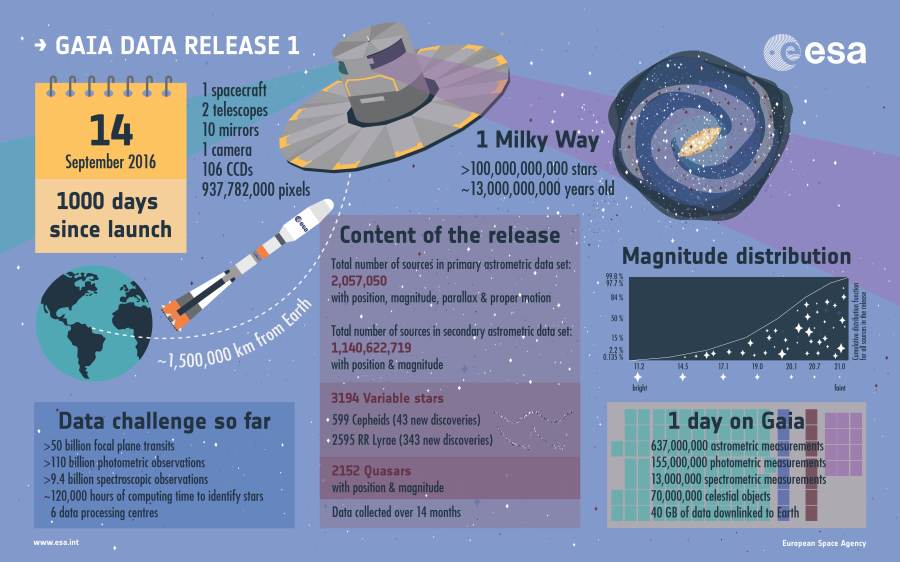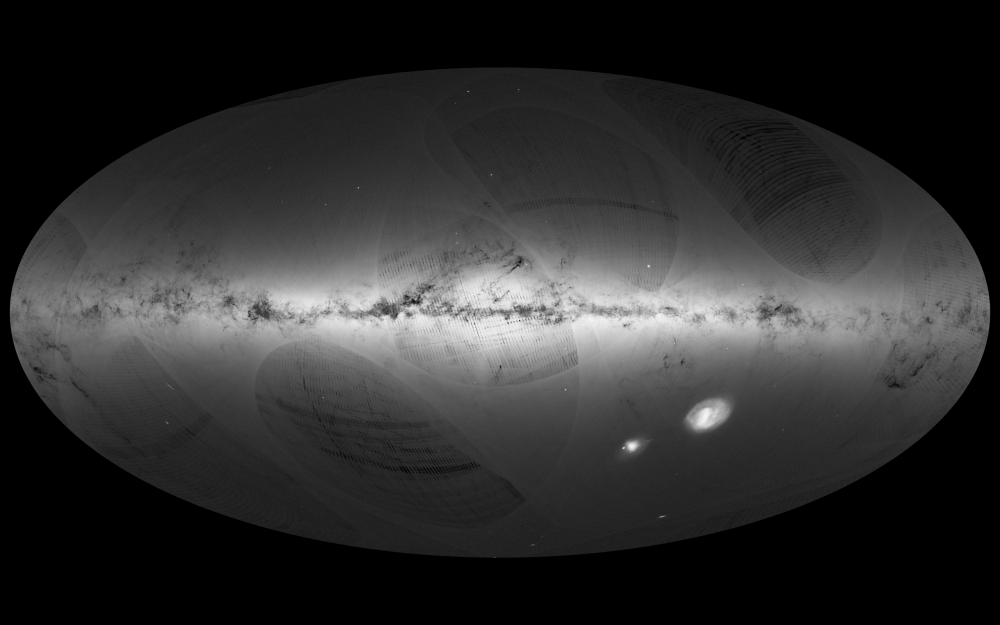
The European Space Agency (ESA) just released a map of the sky with over a million stars, as observed by the Gaia satellite.
Gaia was launched in December of 2013 from the Soyuz Launch Complex in Kourou, French Guiana. It orbits the Sun along with Earth in the L2 lagrange point, meaning it is always on the opposite side of Earth from the Sun. Gaia’s objective is to measure the positions and velocities of over one billion stars in our galaxy, thereby creating the most detailed 3D map of the Milky Way to date. There are approximately 100 billion stars in the Milky Way, so while Gaia can only observe a fraction of these, it’s still orders of magnitude larger than our current surveys. In fact, the vast majority of the stars Gaia is observing have never had their distances accurately determined.
In order to do this, the satellite will observe each star ~70 times during its five year mission with a one billion pixel camera (as compared to your phone camera which has less than 10 million pixels). The accuracy of Gaia’s mapping ability is equivalent to measuring the diameter of a human hair from 1000 kilometers away. Not too shabby…
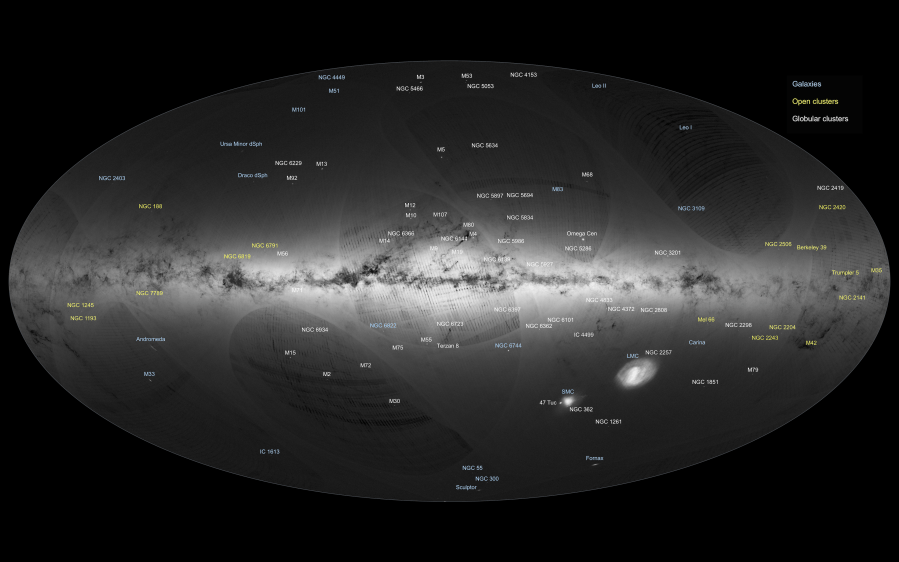
In the annotated version of the map released this week, the disk of the Milky Way is visible as a horizontal dust lane. The labeled objects include open and globular star clusters belonging to our galaxy as well as some of our neighboring galaxies in the Local Group and the Virgo Supercluster.
Gaia’s first data release includes positions and brightness measurements for 1142 million stars with distances and velocities for roughly 2 million of them. Mapping our galaxy star by star is important because not all stars are the same. Their motions and compositions can tell us a lot about where they were born and what has happened to them since. We like to think about the Milky Way as a spinning pancake of sorts, but the stars inside it are far from fixed. In fact, a roller or skating rink is much more accurate since each star is moving with respect to each other star. Gaia will enable us to distinguish between pair skating, group skating, and skaters playing crack the whip (with stars instead of skaters of course). Here’s some more geek from the week: Keep on geeking!@Summer_Ash, In-house Astrophysicist
Summer Ash Recommended