








In the last Congress, House Majority Leader Eric Cantor (R-Va.) played a critical role in blocking reauthorization of the Violence Against Women Act. In this Congress, Cantor was so eager to get VAWA passage over with, he told House Republicans yesterday to either clear the way for the already passed Senate version or risk causing a “civil war” within the party.
The warning appears to have had an effect. Indeed, the VAWA plan we discussed yesterday was executed this morning exactly as intended.
The final legislation passed the lower chamber by a vote of 286 to 138 after a protracted battle over an expansion of the law and its impact in tribal communities. A majority of Republicans voted against the legislation, with 87 GOP members and all Democrats supporting it.
Republican leaders first tried to pass a House-drafted version of the bill, which Democrats said did not do enough to protect gay couples, immigrants and Native Americans. That measure failed by a vote of 166 to 257.
The House then passed the same five-year reauthorization that was approved by Senate by an overwhelming majority in February.
Because the House passed the expansive Senate version — and rejected the watered-down alternative — VAWA will now go directly to the White House, where it will receive President Obama’s signature.
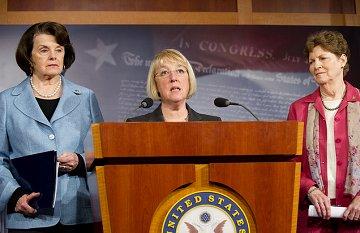
Sen. Patty Murray (D-Wash.), who has been the Democratic point person on the Violence Against Women Act, told me this morning, “This is a long delayed, hard won, and badly needed victory for millions of women, especially those who were told that they weren’t worthy of VAWA’s protections. It means that finally, after over 16 months of struggle, tribal women, the LGBT community, immigrants, and women on college campuses will have the tools and resources this life-saving bill provides.
For those counting on the law’s protections and resources, today’s vote is obviously excellent news. But in a purely political context, the difficult process offered some illuminating lessons.
First, after 20 years of overwhelming bipartisan support, opposition to the Violence Against Women is now the mainstream Republican position. About half the Republicans in the Senate voted against the law, as did more than half the Republicans in the House.
As recently as 2005, there was a Republican majority in the House, for example, and VAWA was reauthorized in a lopsided, near-unanimous vote. Since then, the number of House GOP members opposed to the law has grown from 2 to 138. What was a fringe position in 2005 is now the GOP majority position in 2013.
Second, we’re learning something important about House Speaker John Boehner (R-Ohio) and the so-called “Hastert Rule.” For those who need a refresher, under modern Republican norms, the Speaker only considers legislation that enjoys “majority of the majority” support — if most GOP House members oppose a measure, it won’t even be considered, whether it can pass the chamber or not.
The non-binding rule is great for party discipline, but lousy for democracy and governing. For Boehner’s part, the Speaker had long believed in enforcing the “Hastert Rule,” but he’s finding far more flexibility on the issue than we’re accustomed to seeing. When it was time to approve the “fiscal cliff” deal, Boehner ignored the rule to pass a bipartisan Senate plan. When he needed to pass relief aid to Hurricane Sandy victims, he bypassed the rule again. At the time, the Speaker said these were isolated incidents that wouldn’t be repeated, but here we are again — most of Boehner’s caucus opposed the Violence Against Women Act, but he brought it to the floor and passed it anyway. To reiterate a point from several weeks ago, this may seem like inside baseball, but it’s extremely important. If Boehner, in the name of getting stuff done, is open to bringing important bills to the floor, and passing them with mostly-Democratic support, there’s an opportunity for real governing in the near future. It means comprehensive immigration reform is more likely, and popular measures on preventing gun violence may have a credible chance of success. If the Hastert Rule is unraveling, that’s very good news, indeed.
The place for in-depth analysis, commentary and informed perspectives. Recommended


