








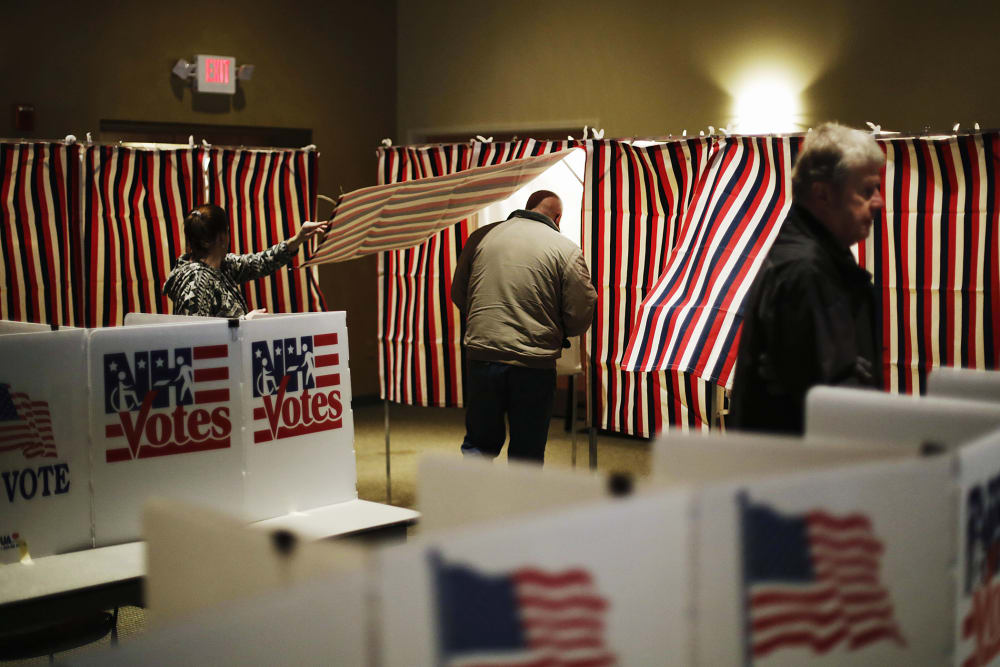
Toward the end of Donald Trump’s interview with The Daily Caller this week, reporters asked the president for his thoughts on voting troubles in Florida. As is usually the case with Trump, his answer meandered for a while, and eventually arrived at the Republican’s concerns about losing New Hampshire in the 2016 presidential race.
“If you look at what happened in New Hampshire, where thousands of people came up and voted from a very liberal part of Massachusetts and they came up in buses and they voted.
“I said, ‘What’s going on over here?’ My people said, ‘You won New Hampshire easily except they have tremendous numbers of buses coming up.’ They’re pouring up by the hundreds, buses of people getting out, voting.”
Trump added, “So what do you do? Recall the election. Recall the election. I mean, there, you should be able to recall the election.”
I haven’t the foggiest idea what he means by “recall the election,” but the president’s preoccupation with this conspiracy theory — about an election in which he won — offers a peek into Trump’s misguided perspective on voter fraud that doesn’t exist.
Circling back to our previous coverage, this is one of those odd beliefs he just can’t shake. Just weeks into his presidency, Trump met with a group of senators to discuss Neil Gorsuch’s Supreme Court nomination. The president, for reasons that weren’t altogether clear, insisted at the meeting that he would’ve won New Hampshire had it not been for widespread voter fraud.
According to a Politico report, after Trump insisted illegal votes were cast by people “brought in on buses,” there was “an uncomfortable silence” in the room.
A year later, in February 2018, the president spoke at a Republican National Committee dinner, and again claimed that the only reason he narrowly lost New Hampshire in 2016 was voter fraud.
Given his intense and ongoing interest in the subject, someone probably ought to alert him to this report from WMUR, published in May.
An exhaustive review by state election officials, including a first-time comparison of voter information shared with 27 other states, has turned up virtually no evidence of possible voter fraud in New Hampshire, those officials said Tuesday.
Secretary of State William Gardner, other officials from his office and a top election law attorney from the attorney general’s office made a more than two-hour presentation to the state Ballot Law Commission, which is charged with resolving disputes related to election laws. The review consumed 817 work hours by members of the attorney general’s office with help from the Department of Safety.
The review process was actually pretty interesting. New Hampshire officials started with the highly dubious Crosscheck system, which pointed to more than 94,000 possible examples of people casting more than one ballot. Secretary of State Bill Gardner was able to quickly narrow that list down to 4,579. After accounting for middle names and initials, the list shrunk again to 3,624.
Using a variety of related methods, the state continued to gradually narrow the list from 955 to 142 to 91 to five. Does that mean New Hampshire found five real-world examples of actual voter fraud? Not exactly. As Slate’s Mark Joseph Stern explained a while back, “One college student voted in the wrong location on the faulty instruction of an election official. An elderly woman appears to have filled out her recently deceased husband’s absentee ballot. Two people cast a ballot in Dixville Notch’s famous midnight primary without establishing domicile there. Just one person actually voted twice; he was fined $2,500 and threatened with criminal prosecution if he ever did it again.” That’s it. That’s all the evidence showed. There was literally nothing to suggest out-of-state voters — with or without the benefit of buses — cast any ballots in New Hampshire at all. The point isn’t that the results are surprising. They were actually quite predictable. Rather, the point is that Trump and his team peddled a ridiculous conspiracy theory and not only expected the public to believe it, but also hoped their bogus claims could help create a demand for new voting restrictions across the country. And six months after the comprehensive report on the New Hampshire elections, Trump is still pointing to the same conspiracy theory, insisting that he won New Hampshire “easily,” despite losing in the state. The more the president points to anecdotes like these to justify new voter-suppression policies, the more important it is to remember that he doesn’t appear to have any idea what he’s talking about.
Steve Benen is a producer for "The Rachel Maddow Show," the editor of MaddowBlog and an MS NOW political contributor. He's also the bestselling author of "Ministry of Truth: Democracy, Reality, and the Republicans' War on the Recent Past." Recommended


