








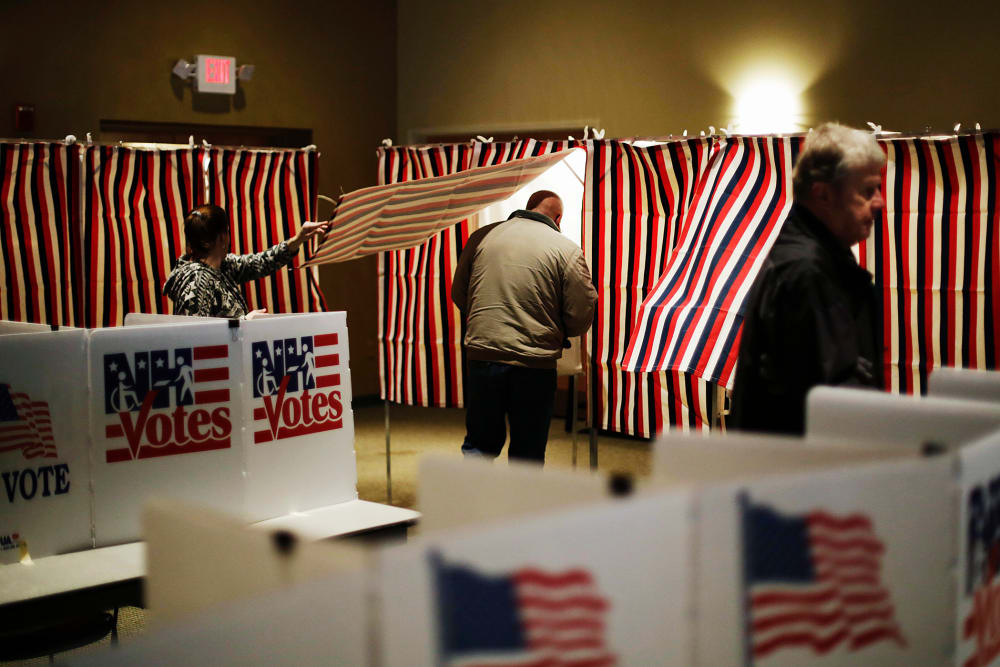
A year ago this week, Donald Trump hosted a meeting at the White House with 10 senators to discuss Neil Gorsuch’s Supreme Court nomination. The president, for reasons that weren’t altogether clear, took the opportunity to tell the lawmakers at the meeting that he would’ve won New Hampshire had it not been for widespread voter fraud.
According to a Politico report, after Trump insisted illegal votes were cast by people “brought in on buses,” there was “an uncomfortable silence” in the room.
It’s easy to understand why. There was, of course, literally no evidence to support any of the president’s odd assertions, and the claims faced fierce pushback from New Hampshire’s secretary of state and attorney general. The former chairman of the state Republican Party even offered to pay $1,000 to anyone with any evidence of even one voter being bused into the Granite State to cast an illegal ballot.
No one ever collected.
And yet, there was the president last week, speaking at a Republican National Committee dinner, and returning to the subject once again.
[Trump] argued that he would have won New Hampshire in 2016 had it not been for voter fraud, saying that liberal voters were bussed in from Connecticut and Massachusetts.
I had to double-check the date on the Politico piece to make sure it wasn’t an old story. It wasn’t: in February 2018, Trump was still repeating made-up nonsense about losing in New Hampshire in November 2016.
And while it’s difficult to understand why a sitting president would behave this way in public, there’s a broader self-defeating angle to all of this that’s also worth appreciating.
Over the weekend, for example, Trump seemed eager to suggest, falsely, that the Republicans’ “Nunes memo” helps him in some way. Citing an article that he found compelling, the president said via Twitter that there was an abuse intended to “influence the 2016 election.”
That would be the election that Trump managed to win. I remember, in the closing days of that race, that Trump invested enormous energy in telling the public that the American system was “rigged.” It seemed obvious that he was laying the groundwork to explain his looming failure as a candidate, and it was easy to imagine Trump spending the months and years following the election making up all kinds of nonsense about fraud that never actually occurred. But Trump is such a unique political animal that he doesn’t seem to appreciate a simple truth: candidates who win elections don’t generally take deliberate steps to undermine public confidence in that election. And yet, the president can’t seem to help himself. Perhaps it’s because Trump is still struggling with the fact that he came in second, losing the popular vote by nearly 3 million votes. Maybe he still hopes to advance new voter-suppression policies, and he thinks rhetoric like this will make his task easier. Whatever the root cause, Trump is lying in a way that suggests he’s uncertain about the legitimacy of his own election.
Steve Benen is a producer for "The Rachel Maddow Show," the editor of MaddowBlog and an MS NOW political contributor. He's also the bestselling author of "Ministry of Truth: Democracy, Reality, and the Republicans' War on the Recent Past." Recommended


