








Ahead of French President Emmanuel Macron’s state visit this week, he had a limited set of diplomatic goals. Near the top of the list: France’s leader hoped to convince Donald Trump not to reject the international nuclear agreement with Iran.
The result was an awkward dynamic: many Americans had to hope the French president could convince the leader of the United States not to do something that would be detrimental to the United States.
By all accounts, it didn’t work. As Macron prepared to leave D.C., he conceded that his efforts to persuade Trump probably came up short, and he now expects the Republican to try to kill the deal by the looming May 12 deadline.
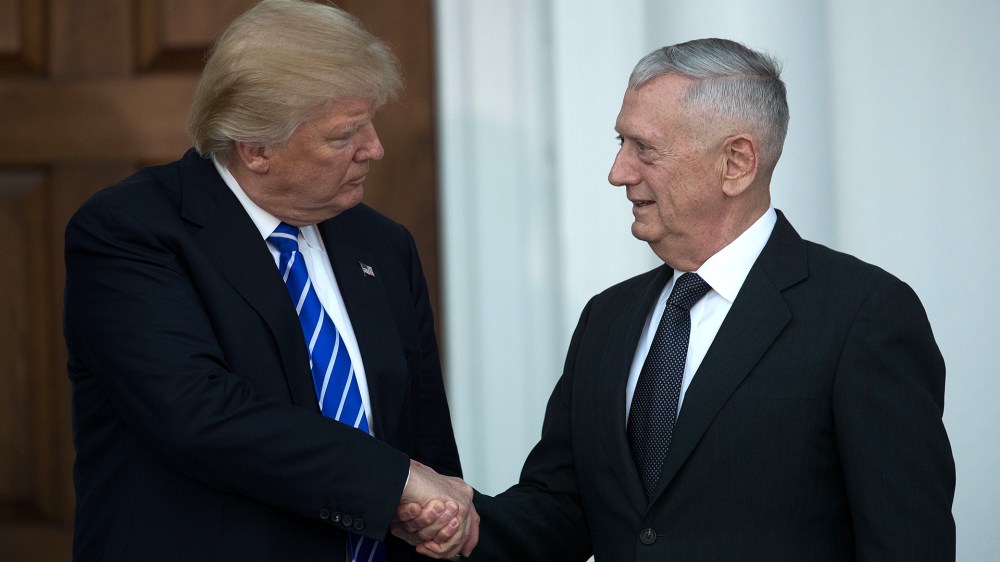
But as it turns out, the French president isn’t the only one presenting Trump with important information on the policy. The Associated Press reported yesterday that Defense Secretary Jim Mattis defended a key aspect of the policy during congressional testimony.
Without explicitly giving his opinion about whether the United States should stick with the agreement, Mattis said that after reading the full text of the deal three times, he was struck by provisions that allow for international verification of Iran’s compliance. He said that since becoming defense secretary in January 2017, he also has read what he called a classified protocol in the agreement.
“I will say it is written almost with an assumption that Iran would try to cheat,” he said in testimony before the Senate Armed Services Committee. “So the verification, what is in there, is actually pretty robust as far as our intrusive ability to get in” with representatives of the International Atomic Energy Agency to check on compliance.
All of which sounds like an excellent reason not to destroy the international agreement.
This was not the first time Trump’s Defense secretary has made a public case in support of the policy his boss detests. In October, Mattis also told Congress that honoring the Iran nuclear deal is in the national security interests of the United States.
What’s more, he’s hardly alone. Less than a month ago, Israeli Defense Forces Chief of Staff Lt. Gen. Gadi Eizenkot conceded that the Iran nuclear deal “is working.”
That same week, a bipartisan group of more than 100 U.S. national security experts — including dozens of retired military officers and more than 30 former ambassadors — issued a joint statement urging Trump to remain in the Iran nuclear deal.
Two weeks before that, Army Gen. Joseph Votel, the head of U.S. Central Command, expressed his own support for the agreement to the Senate Armed Services Committee, describing the policy as effective and important. “Right now I think it is in our interest” to stay in the agreement, he concluded.
It’s almost as if there were some kind of international consensus among those who know what they’re talking about.
Even Republican Rep. Ed Royce, the chairman of the House Foreign Affairs Committee and a critic of the Iran deal, recently said he wants to see the United States stick with the agreement, rather than abandon it. Sen. Jeff Flake (R-Ariz.) said something similar. That same week, officials at the British embassy in D.C. created an easy-to-understand guide to understanding why the existing policy is working. The trouble, of course, is that Donald Trump doesn’t seem to want to understand. When he delivered a speech on the issue in the fall, his remarks were littered with obvious falsehoods. Slate noted at the time it was “the most dishonest speech he has ever given from the White House” — and given Trump’s record for mendacity, that’s saying something. There’s no great mystery here: the president convinced himself he opposes a policy he knows very little about. Trump has called the deal “terrible” and “horrible,” without fully explaining how he arrived at such a conclusion. As a candidate, he declared, “My number one priority is to dismantle the disastrous deal with Iran.” Just one month into his candidacy, he said the Iran deal “poses a direct national security threat.” Two weeks later, Trump added that the international agreement “will go down as one of the dumbest [and] most dangerous misjudgments ever entered into in [the] history of our country.” After wrapping up the GOP nomination, he went so far as to say the deal is likely to “lead to nuclear holocaust.” As president, Trump went into “meltdown” mode when his own team has told him that the policy is actually working as intended, because the facts were simply inconceivable to him. He knows the policy is a disaster, so when reality pointed in a different direction, Trump found it necessary to reject reality. As of this week, nothing has changed, and the American president’s discomfort with the facts persists.
Steve Benen is a producer for "The Rachel Maddow Show," the editor of MaddowBlog and an MS NOW political contributor. He's also the bestselling author of "Ministry of Truth: Democracy, Reality, and the Republicans' War on the Recent Past." Recommended


