








In recent weeks, when there’s been news about Donald Trump’s doctor, the focus has been on Navy Admiral Ronny Jackson, the White House physician whom the president briefly nominated to lead the VA.
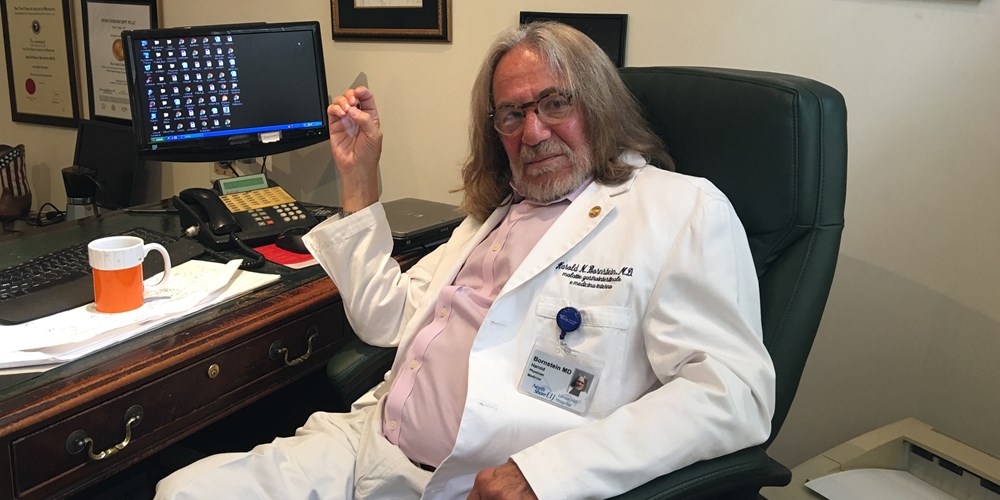
Today, NBC News has a striking report on Trump’s other doctor.
In February 2017, a top White House aide who was Trump’s longtime personal bodyguard, along with the top lawyer at the Trump Organization and a third man, showed up at the office of Trump’s New York doctor without notice and took all the president’s medical records.
The incident, which Dr. Harold Bornstein described as a “raid,” took place two days after Bornstein told a newspaper that he had prescribed a hair growth medicine for the president for years.
In an exclusive interview in his Park Avenue office, Bornstein told NBC News that he felt “raped, frightened and sad” when Keith Schiller and another “large man” came to his office to collect the president’s records on the morning of Feb. 3, 2017. At the time, Schiller, who had long worked as Trump’s bodyguard, was serving as director of Oval Office operations at the White House.
It’s quite a tale. On Feb. 1, 2017, Bornstein, the quirky gastroenterologist who made quite an impression during the presidential campaign, spoke to the New York Times about medications prescribed for Trump, one of which is Propecia, which treats hair loss.
Rhona Graff, Trump’s longtime assistant, apparently called him soon after to say, “So you wanted to be the White House doctor? Forget it, you’re out.’ “
Two days later, according to Bornstein’s version of events, Keith Schiller and Trump Organization Chief Legal Officer Alan Garten appeared at the doctor’s office, took records, and asked Bornstein to remove a picture of him and Trump from his office wall.
It’s a bizarre story. I have no expertise in medical ethics, but the fact that Bornstein spoke to a newspaper about a patient’s medication without permission was itself an odd move, and the fact that two of the president’s aides took a physician’s medical records without authorization is equally problematic.
Making the story stranger, Bornstein is now “celebrating” Ronny Jackson’s troubles, apparently because the Navy admiral had the job that Bornstein believed should be his. In case anyone’s forgotten, in late 2015, during the race for the Republican presidential nomination, Team Trump released an unintentionally hilarious, four-paragraph letter from Bornstein asserting that Trump’s “physical strength and stamina are extraordinary” and his lab tests results were “astonishingly excellent.” The doctor added at the time, “If elected, Mr. Trump, I can state unequivocally, will be the healthiest individual ever elected to the presidency.” We learned several months later that Bornstein wrote the letter in five minutes while a limo, dispatched by Trump, waited for the document. In September 2016, as the election neared, Bornstein released another one-page summary of a Trump physical. That was long before he felt “raped, frightened and sad” by the “raid” on his office.
Steve Benen is a producer for "The Rachel Maddow Show," the editor of MaddowBlog and an MS NOW political contributor. He's also the bestselling author of "Ministry of Truth: Democracy, Reality, and the Republicans' War on the Recent Past." Recommended


