








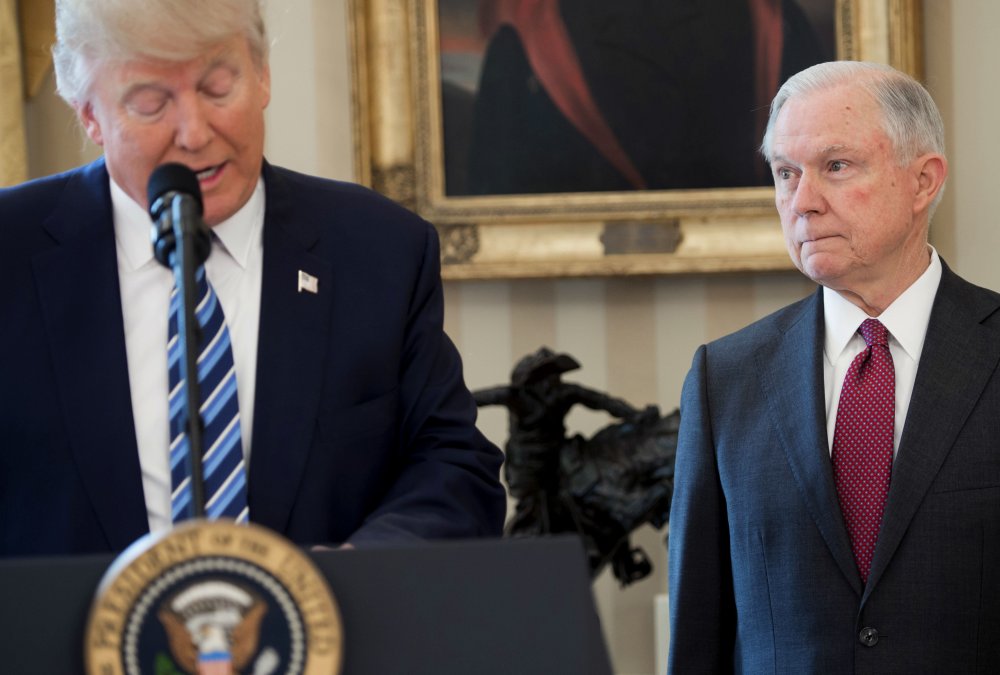
At the end of Donald Trump’s odd interview on Fox News this morning, the president threw something of a tantrum on the air, in response to a question about answering questions from Special Counsel Robert Mueller. Trump’s response was a lengthy tirade, leading to this:
“You look at the corruption at the top of the FBI, it’s a disgrace. And our Justice Department — which I try and stay away from, but at some point I won’t — our Justice Department should be looking at that kind of stuff, not the nonsense of collusion with Russia.”
As Trump tried to ramble some more, the Fox hosts rushed him off the phone, with one of them reminding the president he has “a million things to do.” That, in itself, was a remarkable moment: ordinarily, journalists talking to an interview-shy president would want to keep the conversation going as long as possible. This morning, the hosts of “Fox & Friends” themselves ended the interview, stopping a highly agitated Trump before he could embarrass himself further.
Curious media strategies notwithstanding, it was no small development to hear the president — the subject of an ongoing investigation — talk openly about intervening with the Justice Department. In fact, Trump was rather explicit during the interview, arguing that he wants federal law enforcement officials to stop investigating his alleged crimes and start investigating his perceived foes.
The president attacked former FBI Director James Comey as a criminal, for example, adding that Justice Department officials aren’t “doing their job” by failing to investigate him. “I’ve taken the position — and I don’t have to take this position and maybe I’ll change — that I will not be involved with the Justice Department. I will wait until this is over. It’s a total — it’s all lies and it’s a horrible thing that’s going on…. I’m very disappointed in my Justice Department.”
For those keeping score, the sitting president is attacking his Justice Department, calling for an investigation into the former FBI director, and threatening to seize greater control over the levers of federal law enforcement power.
And yet, it seems like just another day in Donald Trump’s America. Jon Chait added, “The Department of Justice is constructed around restraints designed to prevent any such interference, because the power to use federal law enforcement as a weapon to protect the president and his party, and to harass the opposition, is so terrifying it has to be prevented at all costs. Trump is, on national television, making existential threats to the rule of law.” Alas, it wasn’t the first time. Last fall, for example, the president said, “You know the saddest thing, because I’m the president of the United States, I am not supposed to be involved with the Justice Department. I am not supposed to be involved with the FBI. I’m not supposed to be doing the kinds of things that I would love to be doing. And I’m very frustrated by it.” Those dangerous impulses have apparently not gone away.
Steve Benen is a producer for "The Rachel Maddow Show," the editor of MaddowBlog and an MS NOW political contributor. He's also the bestselling author of "Ministry of Truth: Democracy, Reality, and the Republicans' War on the Recent Past." Recommended


