









The federal government could, right now, direct American manufacturers to make the kinds of materials needed to address the coronavirus crisis: ventilators, protective masks, gloves, etc. In fact, as we discussed last week, there’s a law called the Defense Production Act that authorizes the executive branch to ramp up production of these supplies in order to address a crisis.
Donald Trump’s position on putting this law to use should be straightforward. It’s not.
On Wednesday of last week, the president announced via Twitter that he’d “signed” the Defense Production Act — a law was originally approved 70 years ago — but added that he’d only “invoke it in a worst case scenario in the future.”
A day later, Trump added that he’d put the Defense Production Act into action “if we were desperately in need of something,” suggesting he was unaware of the fact that we’re desperately in need of all sorts of things.
On Friday, a reporter asked the president whether he’s agreed to actually invoke the law and begin implementing it. His response seemed relatively clear, at least at first blush:
“I did it yesterday. We invoked it, I think, the day before we signed it — the evening of the day before — and invoked it yesterday. We have a lot of people working very hard to do ventilators and various other things. Yes…. We are using [the Defense Production Act].”
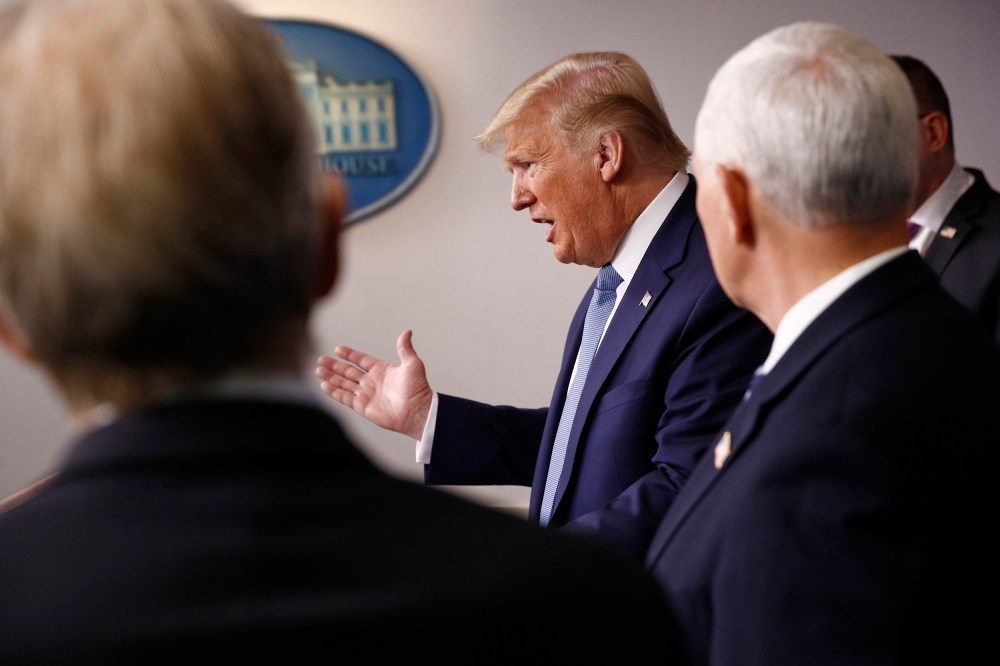
Soon after, during the same briefing, a reporter sought some clarification about whether the administration has actually begun using the Defense Production Act to require businesses to help produce key materials. “You know, so far, we haven’t had to,” the president replied.
As if this weren’t quite confusing enough, a reporter asked yesterday why Trump isn’t simply using the legal authority he already has. The president suggested he has some kind of ideological concerns.
“Well, we are using it now. The fact that I signed it, it’s in effect. But, you know, we’re a country not based on nationalizing our business. Call a person over in Venezuela; ask them how did nationalization of their businesses work out. Not too well. The concept of nationalizing our business is not a good concept.”
Directing manufacturers to produce necessary supplies is not the same thing as nationalizing industries themselves.
At the same briefing, Peter Navarro — a trade advisor who’s involved in the coronavirus response for reasons that remain unclear — added, “We’re getting what we need without putting the heavy hand of government down.”
That may have been an ideologically satisfying thing to say, but since so much of the country is not getting what’s needed, the line wasn’t altogether true. Not to put too fine a point on this, but what in the world is going on here? Why is Trump trying to hide between perceived nuances surrounding words like “invoke” and “use”? Why can’t the White House keep its story straight? Perhaps the answer has something to do with who’s helping influence Team Trump. The New York Times reports today, “The U.S. Chamber of Commerce and the heads of major corporations have lobbied the administration against using the act.” The corporate lobbying effort, the article added, has been persuasive to Larry Kudlow and Jared Kushner, both of whom have been directly involved in the federal response to the pandemic. At his re-election campaign kickoff event last summer, Trump boasted, “We stared down the unholy alliance of lobbyists and donors and special interests, who made a living bleeding our country dry. That’s what we’ve done.” It wasn’t true at the time; it seems slightly worse now.
Steve Benen is a producer for "The Rachel Maddow Show," the editor of MaddowBlog and an MS NOW political contributor. He's also the bestselling author of "Ministry of Truth: Democracy, Reality, and the Republicans' War on the Recent Past."
Latest Post
Recommended


