








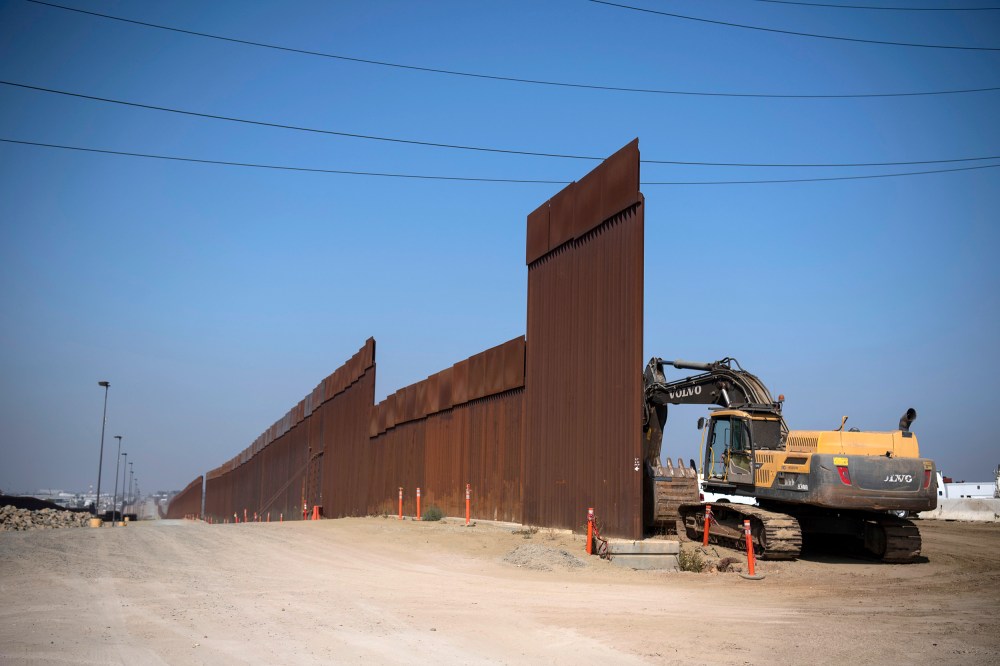

Four years later, one of Donald Trump’s most absurd campaign promises is still very much on his mind. The Los Angeles Times reported overnight:
President Trump said his administration may impose a “toll” on cars crossing into the U.S. from Mexico to finance construction of his promised wall on the southern border. “They’re going to pay at the border, at the gate, cars going through, we’re going to do a toll — or we may do a toll,” Trump said during an event in Yuma, Ariz., where he touted construction of the wall.
He went on tell reporters, “Mexico is paying for the wall, yeah.”
Sigh.
Let’s take a moment to review how we arrived at this point. Trump and his campaign team didn’t invest too much energy into a policy platform in 2016, but they were willing to issue a brief document explaining how and why Mexico would pay for a giant border wall. The document said it would be “an easy decision” for Mexican officials to make: our neighbors to the south would agree to a “one-time payment” of between $5 billion and $10 billion to the United States, and the GOP administration would apply the expenditure to a wall.
This position paper, incidentally, is still publicly available on Trump’s website.
The “one-time payment” plan never really made sense, and after the president took office, it quietly went away. But the idea that Mexico would pay for a wall remained the Republican’s position for much of his presidency, though Trump’s posture has shifted repeatedly.
In late 2018, for example, the president said that instead of Mexicans paying for the wall, the wall would pay for itself through incredible savings, none of which exist in reality. Soon after, his position shifted again: instead of saying Mexico will pay for a wall, Trump decided that Mexico is already paying for a wall through a revamped NAFTA.
That was foolish for a variety of reasons, none of which the post-policy president seemed to understand, which has apparently given way to a brand new pitch: Trump is prepared to impose “tolls” on cars built south of the border as they enter the U.S. marketplace.
At this point, I’d love to write about the merits (or lack thereof) behind such an idea, but to call this an “idea” is itself too generous. Who would pay the toll? How much would it be? How would it affect the price of vehicles for American consumers? Would this be in line with existing U.S. trade agreements? Trump doesn’t have answers to any of these questions, not just because he’s indifferent to the substance of governing, but because he’s almost certainly not serious about the toll idea at all. Not to put too fine a point on this, but Trump just says stuff. There’s no real forethought or policy planning; he just blurts out random thoughts that he thinks will help get him through the day. If pressed for more details on the toll plan, the Republican will very likely promise a blueprint “in two weeks,” wait for people to forget the vow, and move on to the next thing. Given the context, Trump is probably embarrassed — at least to the extent that it’s possible for him to feel shame — that he made such a fuss about Mexico paying for a border wall, and then failed spectacularly to follow through on his high-profile promise. As Election Day draws closer, he can’t very well say, “I blew it,” so he’s scrambling to throw together a pseudo-plan that sounds plausible. Or put another way, it’s a fresh con, intended to take the place of an old con. No one should be fooled.
Steve Benen is a producer for "The Rachel Maddow Show," the editor of MaddowBlog and an MS NOW political contributor. He's also the bestselling author of "Ministry of Truth: Democracy, Reality, and the Republicans' War on the Recent Past."
Latest Post
Recommended


