








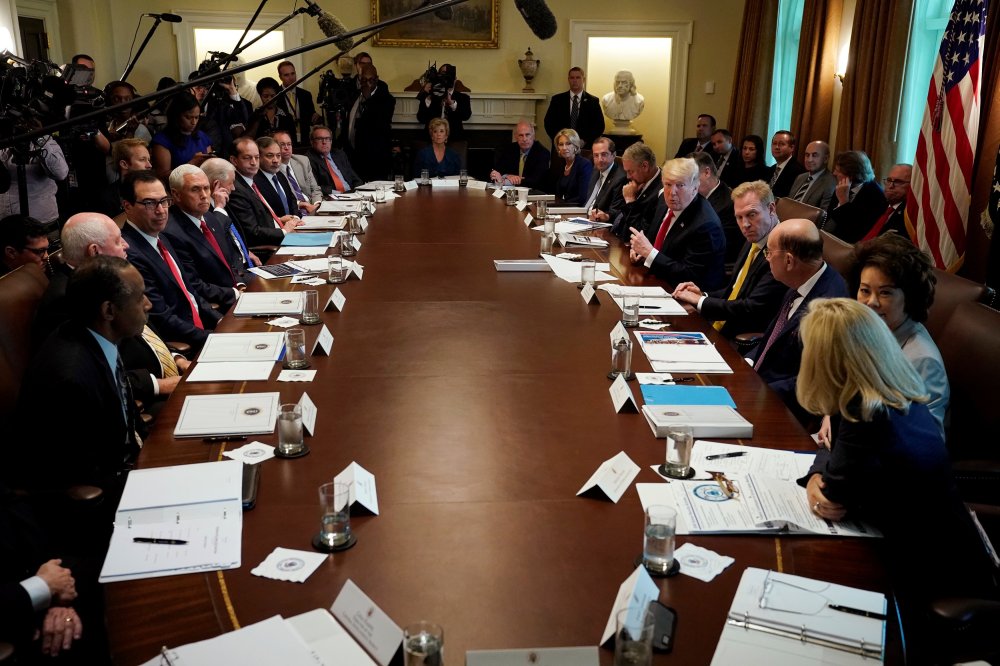
The Constitution spells out a fairly straightforward process for a White House cabinet: a president nominates someone for a position, the Senate considers the nominee, and members vote on whether to confirm the selection or not. It’s a model that’s served the United States well for quite a while.
Donald Trump’s approach is a little different. As things stand, this president has an acting attorney general and an acting Defense secretary, neither of whom has been confirmed. Trump also has an acting Interior secretary, an acting United Nations ambassador, an acting budget director, an acting EPA administrator, and an acting White House chief of staff.
“I sort of like ‘acting,’” he told reporters a month ago. “It gives me more flexibility.” In his interview with “Face the Nation,” the president told CBS News’ Margaret Brennan something similar.
BRENNAN: You have an acting AG until you get [William] Barr confirmed–
TRUMP: Yes.
BRENNAN: An acting defense secretary. An acting chief of staff. An acting interior secretary.
TRUMP. It’s OK. It’s easier to make moves when they’re acting…. Really, I like acting because I can move so quickly. It gives me more flexibility.
He went to pretend that he asked retired Gen. James Mattis to resign, which is wholly at odds with everything we know about the former Pentagon chief’s departure.
Regardless, it’s curious to see Trump suggest there are two equally legitimate approaches to cabinet secretaries — the one described by the Constitution, and the “flexible” one that works better for him — as if it’s up to him to pick the model he likes.
David Graham had a good piece along these lines in The Atlantic yesterday. No matter how much Trump likes the flexibility, the Constitution doesn’t: It requires the president to put nominees to Senate approval in part to avoid chaotic policy making and mismanagement of government. The Constitution does allow recess appointments, and past presidents have sometimes made extensive use of them, including to install candidates the Senate opposes while calling for their confirmation. Trump, however, isn’t bothering. He doesn’t care whether the Senate has a role, and apparently he’d rather it not, because that makes it easier for him to fire people. If the White House had to worry about Democratic senators blocking the president’s nominees, this might be vaguely more defensible. But given the Republicans’ Senate majority, and the fact that it’s no longer possible for senators to filibuster cabinet nominees, Team Trump has no excuse. Even some in his party are getting tired of it. Referring to the acting officials in Trump’s cabinet, Sen. James Lankford (R-Okla.) told the Washington Post, “It’s a lot, it’s way too many. You want to have confirmed individuals there because they have a lot more authority to be able to make decisions and implement policy when you have a confirmed person in that spot.” Whether Lankford and his colleagues are prepared to do anything about these concerns remains to be seen.
Steve Benen is a producer for "The Rachel Maddow Show," the editor of MaddowBlog and an MS NOW political contributor. He's also the bestselling author of "Ministry of Truth: Democracy, Reality, and the Republicans' War on the Recent Past." Recommended


