








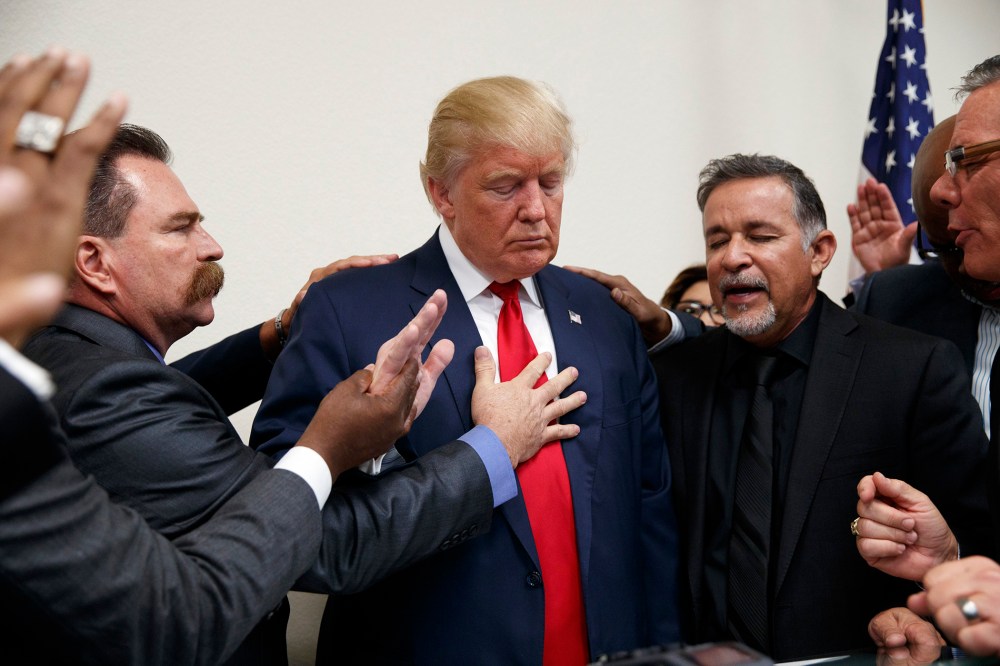
In the early 1950s, when lawmakers were adding “under God” to the Pledge of Allegiance and changing all American money to include the phrase “In God We Trust,” Congress also created an official annual Prayer Day for the nation. As regular readers may recall, Congress, under pressure from the religious right, changed the law in 1988 to set the National Day of Prayer as the first Thursday in May.
Which, of course, was yesterday.
With this in mind, Donald Trump hosted a White House event yesterday to honor the occasion, and the president made some notable comments. He claimed, for example, that he and his team persevere in the midst of “witch hunts” by “thinking about God.” Trump also took credit for changing the religiosity of American society, insisting, “[P]eople are so proud to be using that beautiful word, ‘God,’ and they are using the word God again and they are not hiding from it.”
Naturally, the president soon added, “I always said you are going to be saying, ‘Merry Christmas’ again and that is what has happened.”
But of particular interest was Trump’s boast about a specific provision in federal tax policy:
“One of the things I am most proud of is the Johnson Amendment. You can now speak your mind and speak it freely. […]
“I said I was going to do that….That was one of the things I said. They took away your voice politically and these are the people I want to listen to politically but you weren’t allowed to speak. They would lose their tax-exempt status.
“That’s not happening anymore so we got rid of the Johnson Amendment. That’s a big thing.”
Well, it would be a big thing, except Trump didn’t get rid of the Johnson Amendment. He keeps telling people that he did, but this accomplishment only exists in his mind.
Let’s take a minute or two to set the record straight again.
The Johnson Amendment is a part of federal tax law that prohibits tax-exempt entities, including houses of worship, from intervening in political campaigns. Trump yesterday said the law prevented religious voices from speaking, which is absurd — leaders of the faith community have been speaking for generations, and this tax law provision never stopped them.
What faith leaders could not do, however, was maintain a tax exemption while telling parishioners how to vote.
In response to demands from some of his far-right supporters, Trump tried to get Congress to eliminate the Johnson Amendment. That effort failed. The president later issued an executive order, encouraging the Treasury Department to be lenient in enforcing this part of the law, but Trump can’t “get rid of” tax law provisions he doesn’t like without congressional approval. His executive order had little practical meaning. The bottom line is simple: the Johnson Amendment remains intact. The law hasn’t changed, no matter how many times Trump pretends otherwise. What’s far less clear is why Trump keeps getting this wrong. Is he genuinely that confused about his own record? Does he hope his supporters won’t know the difference between what he’s done and what he’s failed to do? It’s entirely possible that the answer to both questions is, “Yes.” Postscript: At the same event yesterday, Vice President Mike Pence told attendees, “From early in this administration, President Trump has taken steps to ensure that the federal government will never, ever penalize anyone for their religious beliefs ever again.” That might be less absurd if, early on in this administration, Trump hadn’t taken steps to impose a Muslim ban.
Steve Benen is a producer for "The Rachel Maddow Show," the editor of MaddowBlog and an MS NOW political contributor. He's also the bestselling author of "Ministry of Truth: Democracy, Reality, and the Republicans' War on the Recent Past." Recommended


