








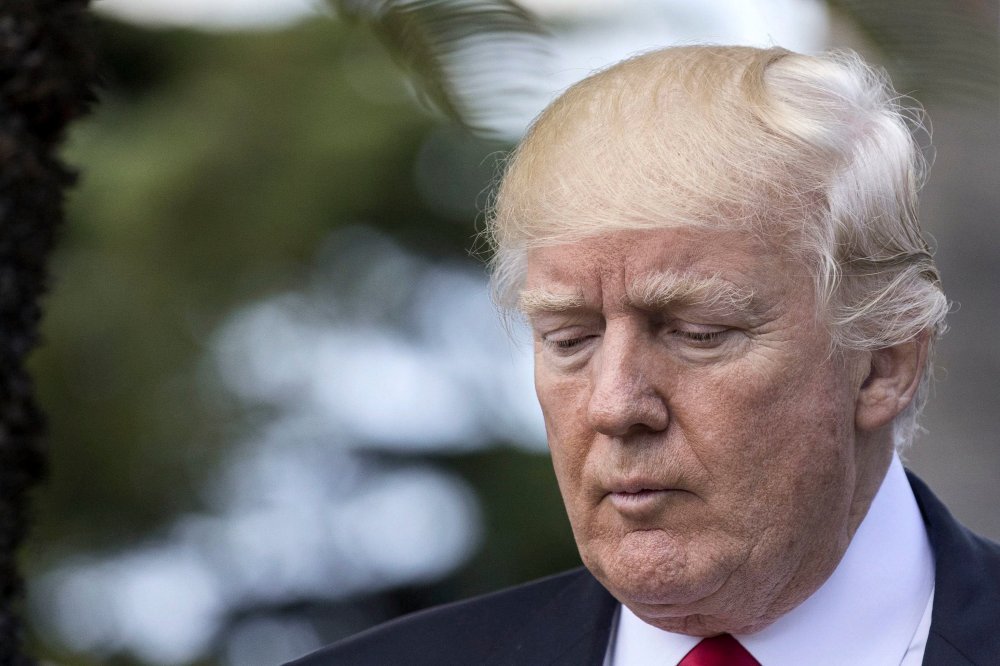
Several hours after his racist criticisms of four Democratic congresswomen sparked outrage, Donald Trump returned to the subject last night, insisting that the representatives are worthy of his contempt.
“So sad to see the Democrats sticking up for people who speak so badly of our Country…. Their disgusting language and the many terrible things they say about the United States must not be allowed to go unchallenged.”
Note the use of the phrase “our country,” as opposed to “their country” — as if Trump can claim allegiance to the United States in ways his domestic critics cannot. It’s an extension of the Republican’s eagerness to define his opponents as The Other.
But that’s hardly the only problem.
Stripped of context or relevant details, Trump’s pushback might seem vaguely compelling to those who haven’t paid much attention: it’s hardly ridiculous to think an American president would defend his or her country against those who say “terrible things” about it.
Two fairly obvious problems quickly emerge, however. The first is the dubious premise: Trump is going after Reps. Alexandria Ocasio-Cortez (D-N.Y.), Ilhan Omar (D-Minn.), Ayanna Pressley (D-Mass.), and Rashida Tlaib (D-Mich.) for allegedly speaking “badly” of the United States, but there’s no reason to accept the premise at face value.
These Democratic lawmakers have had plenty of criticisms for the Trump administration and its agenda, but that’s not the same thing as criticizing the country itself.
The second is the disconnect between the message and the messenger. Indeed, if Trump wants to talk about American politicians who “speak badly” of the U.S., perhaps we should start the conversation with the president’s criticisms of his own country.
Because if anyone lacks the patriotic high ground in this debate, it’s Donald J. Trump.
As regular readers know, two weeks after taking office, Trump sat down for an interview in which he was reminded that Russian President Vladimir Putin is “a killer.” Trump replied, “There are a lot of killers. We’ve got a lot of killers. What, do you think our country’s so innocent?”
As we discussed at the time, Americans generally aren’t accustomed to hearing their president be quite this critical of the United States – out loud and in public. What’s more, the idea that the U.S. chief executive sees a moral equivalence between us and an autocratic thug came as a reminder that Trump doesn’t always hold his country in the highest regard.
Indeed, he hasn’t exactly been subtle on this point. In December 2015, then-candidate Trump was asked about Putin’s habit of invading countries and killing critics. “He’s running his country, and at least he’s a leader,” Trump replied, “unlike what we have in this country.” Reminded that Putin has been accused of ordering the murder of critics and journalists, Trump added, “Well, I think our country does plenty of killing also.” In a July 2016 interview with the New York Times, the Republican went on to argue that the United States lacks the moral authority to lead, because we’re just not a good enough country to command respect abroad. “When the world looks at how bad the United States is, and then we go and talk about civil liberties, I don’t think we’re a very good messenger,” he said. There’s never been a president, from either party, who’s been so cavalier about America lacking in credibility. Sentiments such as “When the world looks at how bad the United States is…” are usually heard from America’s opponents, not America’s president. The Atlantic’s Jeffrey Goldberg noted during the campaign that Barack Obama “has never spoken as negatively about America as Donald Trump has.” This is also the president who explicitly rejected the idea of “America exceptionalism,” questioning aloud whether the United States really is “more outstanding” than other nations. If Trump is concerned about American politicians who’ve criticized their own country, he can start by taking on the guy in the mirror.
Steve Benen is a producer for "The Rachel Maddow Show," the editor of MaddowBlog and an MS NOW political contributor. He's also the bestselling author of "Ministry of Truth: Democracy, Reality, and the Republicans' War on the Recent Past." Recommended


