








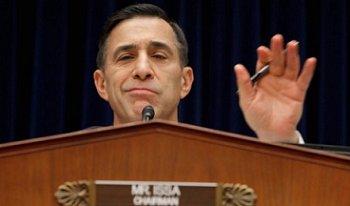
Back in October 2010, Rep. Darrell Issa (R-Calif.) told Rush Limbaugh he considers President Obama “one of the most corrupt presidents in modern times.” Ruth Marcus noted soon after, “If Issa believes this, he is deranged. If he doesn’t and is saying it anyway, he is dangerous.”
The jury’s still out on which of these is true, but Issa is still pushing the same bizarre line.
Rep. Darrell Issa (R-CA) told Bloomberg TV that the Obama government is “proving to be” the “most corrupt in history.”
Said Issa: “We are busy in Washington with a corrupt government, with a government that I said perhaps because of the money, the amount of TARP and stimulus funds, was going to be the most corrupt government history and it is proving to be just exactly that.”
Marcus’ deranged-or-dangerous frame continues to ring true.
Part of the problem here is that Issa desperately wants Americans to believe the Obama administration is corrupt, but can’t point to any legitimate examples of corruption. In his Bloomberg interview, the conservative Republican chairman of the House Oversight Committee pointed to Solyndra, which proved to be meaningless, and the GSA conferences, which isn’t an example of corruption (and which the administration uncovered in the first place).
Indeed, the great irony of Issa’s strange attack is that the Obama administration, after more than three years in office, has been remarkably scandal-free. After the corruption, investigations, grand juries, and criminal probes that dominated the Bush/Cheney era, it’s a pleasant change of pace.
The other part of this that strikes me as interesting is the messenger himself: given Darrell Issa’s background, it’s tempting to think he’d be a little more circumspect about slinging mud at anyone.
Every time I see Issa throw around wild accusations about Obama’s imaginary wrongdoing, I’m reminded of Issa’s own real-world scandals. Last year, the New Yorker’s Ryan Lizza had a fascinating piece reviewing Issa’s rise in wealth and power, despite the “troubles” the right-wing congressman has had along the way.
Many politicians have committed indiscretions in earlier years: maybe they had an affair or hired an illegal immigrant as a nanny. Issa, it turned out, had, among other things, been indicted for stealing a car, arrested for carrying a concealed weapon, and accused by former associates of burning down a building. Lizza wasn’t being hyperbolic. The man falsely accusing Obama of corruption, and tasked with investigating potential White House wrongdoing, has spent a fair amount of his adult life as a suspected criminal. Lizza’s report highlighted Issa having one run-in with the law after another, including arrests and indictments. There are also many suspected crimes — he’s accused of deliberately burning down a building and threatening a former employee with a gun — which did not lead to formal charges, but which nevertheless cast the congressman in a less-than-flattering light. The New Yorker report also noted an incident in which Issa crashed into a woman who needed to be hospitalized, driving away before the police could arrive because, as he told the person he hit, he didn’t have time to wait. Issa didn’t face charges, but he was sued over the matter, and agreed to an out-of-court settlement. And in case that weren’t quite enough, the same article also notes instances in which Issa appears to have lied about his background. The congressman, for example, claimed to receive the “highest possible” ratings during his Army career, despite the fact that at one point he “received unsatisfactory conduct and efficiency ratings and was transferred to a supply depot.” Issa also claimed to have provided security for President Nixon in 1971, which wasn’t true, and said he won a national Entrepreneur of the Year award, but didn’t. This is the guy preoccupied with bogus allegations about administration wrongdoing?
The place for in-depth analysis, commentary and informed perspectives. Recommended


