








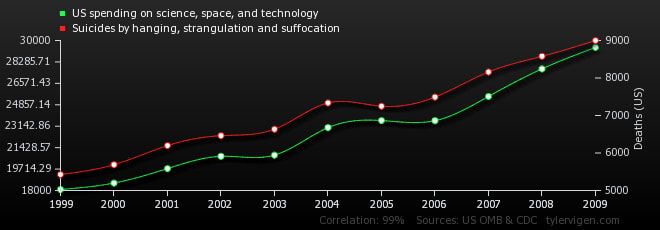
One of my all‐time favorite lessons to teach students about science is “Correlation does not equal causation,” meaning that just because two things happen together or change over time in the same way, one isn’t necessarily causing the other. It’s an extremely nifty caveat to keep in mind; a great tool to have in your skeptic’s toolbox. It should be one of the first things you bust out when confronted with plots in the newspaper, on the internet or on TV claiming to demonstrate a causal relationship between two things.
The new website Spurious Correlations takes the fallacy to the extreme, and in the process makes this principle a lot more fun to talk about. You can browse through correlations and even make your own, pitting your choice of variables against each other.
Even cooler is how Tyler Vigen (the website’s creator) intends for the absurdity of the correlations he presents to teach you how to think like a scientist: “[Y]ou saw data, you formed a hypothesis about that data in the form of a causal mechanism, and then you rejected the hypothesis based on your personal experience with the world.” He goes on to say: “That’s a big deal! That’s something computers can’t do. Research is about discovery, but only humans can actually make discoveries.”
Here’s more geek for you to discover: Have a great and geeky week! @Summer_Ash
Summer Ash Recommended


