









The Pew Research Center recently conducted a national survey asking Americans whether they believe “problems could be dealt with more effectively if U.S. presidents didn’t have to worry so much about Congress or the courts.” Fortunately, most of the public rejected such an approach.
But it’s worth pausing to note how Republican voters in particular responded to the question.
The survey by Pew Research Center, conducted July 10-15 among 1,502 adults, finds that Republicans’ views on this question have changed markedly since last year. About half of Republicans and Republican-leaning independents (51%) now say it would be too risky to give presidents more power, down from 70% last year.
The share of Republicans who say presidents could operate more effectively if they did not have to worry so much about Congress and the courts has increased 16 percentage points since then, from 27% to 43%.
Among Americans who describe themselves as conservative Republicans, the results are even more dramatic: last year, only 26% of these voters wanted to see a more powerful president, freed from having “to worry so much” about the co-equal branches of government. This year, among self-identified conservative Republicans, that number doubled to 52%.
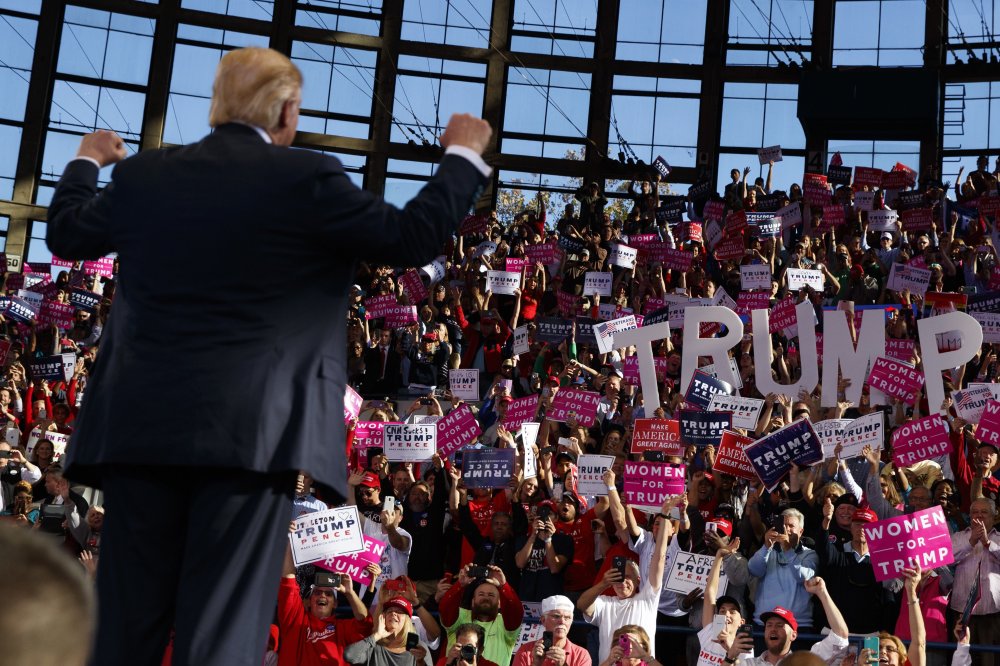
In other words, it’s become increasingly common in GOP circles not just to support Donald Trump, but also to be hostile toward checks and balances that our system of government imposes on him.
The sitting president hasn’t been shy about sharing his authoritarian instincts and his sympathy for systems of government in which chief executives largely do as they please. Evidently, Trump’s attitudes have started to shape his base’s thinking, too.
To be sure, the shift against checks and balances is probably more about party than principle. Most Republican voters were hostile toward the idea of expanded executive power when Barack Obama was in office, and I suspect they’ll start opposing the idea again the moment the next Democratic president is inaugurated.
Or put another way, these GOP voters don’t necessarily think presidents could do a better job solving problems without “having to worry so much” about Congress and the courts; they simply think Donald Trump could do a better job with expanded authority.
One can hope that Republican support for a Madisonian model of government will rebound once the Trump era comes to a close.
But the Pew Research Center’s report got me thinking about our earlier coverage of remarks former Supreme Court Justice David Souter delivered in 2012 — long before anyone envisioned Trump’s rise to power — about the dangers and cost of “civic ignorance.”
“I don’t worry about our losing republican government in the United States because I’m afraid of a foreign invasion. I don’t worry about it because I think there is going to be a coup by the military as has happened in some of other places. What I worry about is that when problems are not addressed, people will not know who is responsible. And when the problems get bad enough, as they might do, for example, with another serious terrorist attack, as they might do with another financial meltdown, some one person will come forward and say, ‘Give me total power and I will solve this problem.’
Recommended


“That is how the Roman republic fell. Augustus became emperor, not because he arrested the Roman Senate. He became emperor because he promised that he would solve problems that were not being solved.
“If we know who is responsible, I have enough faith in the American people to demand performance from those responsible. If we don’t know, we will stay away from the polls. We will not demand it. And the day will come when somebody will come forward and we and the government will in effect say, ‘Take the ball and run with it. Do what you have to do.’
“That is the way democracy dies. And if something is not done to improve the level of civic knowledge, that is what you should worry about at night.”
Seven years after Souter made those comments, nearly half of Republican voters — and a narrow majority of conservative Republican voters — believe an American chief executive could deal with problems more effectively if he or she “didn’t have to worry so much about” competing branches of the American government.
Souter warned of a person, with little regard for democratic norms and political institutions, who could come forward seeking power, assuring the public that he’ll solve our problems, exploiting fears and civic ignorance.
The hypothetical person the retired justice described would presumably tell the electorate that only he could keep Americans safe. Only he could fix the political system. Only he could “make possible every dream you’ve ever dreamed.”
Souter’s warnings were striking in their foresight.
“That is the way democracy dies. And if something is not done to improve the level of civic knowledge, that is what you should worry about at night.”
Steve Benen is a producer for "The Rachel Maddow Show," the editor of MaddowBlog and an MS NOW political contributor. He's also the bestselling author of "Ministry of Truth: Democracy, Reality, and the Republicans' War on the Recent Past."
