








When a nation tries to recover from an economic downturn, there are a variety of things policymakers have no control over. After the Great Recessions, for example, neither the White House nor Congress could control the Eurozone crisis, a natural disaster in Japan, or unrest in the Middle East.
It’s an unpredictable world with inter-connected economies and volatility often lurking just out of sight. But this realization only reinforces a lesson congressional Republicans have forgotten: U.S. policymakers should, at a minimum, not make matters worse.
Consider, for example, what unemployment would be if government weren’t trying to create jobs and lay off public-sector workers at the same time.
Federal, state and local governments have shed nearly 750,000 jobs since June 2009, according to the Labor Department’s establishment survey of employers. No other sector comes close to those job losses over the same period. Construction is in second worst place, but its 225,000 cuts are less than a third of the government reductions. To be sure, construction and other sectors performed worse during the depths of the recession, but no area has had a worse recovery.
A separate tally of job losses looks even worse. According to the household survey, which is where the unemployment rate comes from, there are nearly 950,000 fewer people employed by the government than there were when the recovery started in mid-2009. If none of those people were counted as unemployed, the jobless rate would be 7.1%, compared with the 7.7% rate reported on Friday.
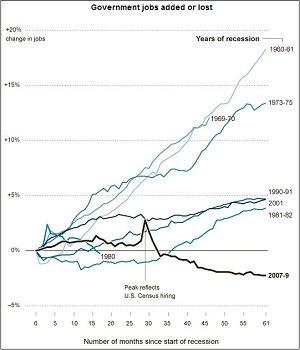
I’m including this New York Times chart to reinforce a larger point: during every recent economic downturn, we didn’t slash public-sector employment. Policymakers simply understood that forcing more Americans out of work would not bring down unemployment or improve the economy.
This recent historical context is important for a couple of reasons. The first is the realization that those calling for more public-sector hiring aren’t proposing some radical, hyper-liberal approach to employment policy. We’re simply talking about adopting the same approach used by policymakers in both parties in every economic downturn over the last half-century.
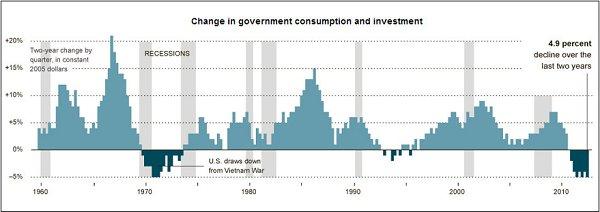
The second has to do with the radicalization of Republican policymaking. Remember, under the Recovery Act, Democrats in Washington prevented mass government layoffs by providing resources to state and local governments, keeping teachers, cops, firefighters, and others on the job and out of the unemployment lines.
But when stimulus funds dried up, the layoffs began.
Shortly after the 2010 midterms — a cycle in which GOP candidates said they were focused on “jobs, jobs, jobs” — House Speaker John Boehner said if thousands of public-sector workers were forced from their jobs as a result of spending cuts, “So be it.” Republicans, the argument went, would try to lower unemployment while watching more people lose their jobs. This is, of course, madness. It’s true that the resilient American economy has improved slowly anyway, and that the pace of hiring has increased. But the country could have been in a far stronger position right now were it not for these austerity measures, which have no modern precedent, and which could have easily been avoided. The great irony, of course, is that congressional Republicans remain convinced that the high jobless rate is the result of Obama administration policies, blissfully unaware that unemployment would be nearly a full point lower were it not for government layoffs they have the power to prevent.
The place for in-depth analysis, commentary and informed perspectives. Recommended


