








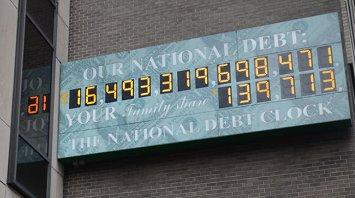
A couple of years ago, when congressional Republicans launched the first-ever debt-ceiling crisis, there were plenty of polls early on that showed the public on the far-right’s side — most Americans, oblivious to what the debt ceiling is, said they didn’t want the limit raised.
When the public was told, “By the way, if the debt ceiling doesn’t go up, the economy will likely crash, and even having this debate is doing real damage to the nation,” the polls started changing.
Two years later, Americans have apparently forgotten what they learned.
Americans overwhelmingly do not think Congress should raise the nation’s debt limit as President Barack Obama and Congress prepare once again to wage battle over the issue, according to the latest NBC News/Wall Street Journal poll.
By a 44-22 percent margin, Americans oppose raising the debt ceiling, which again puts the president in the difficult position of needing to make the case for an unpopular policy with a deadline quickly approaching.
Let this be a reminder to the political world: there’s nothing quite as useless as a debt-ceiling poll. Folks have no idea what the debt ceiling is, what default is, what bond markets are, or what the full faith and credit of the United States means, so polling on the subject tells us nothing.
I remember a friend of mine a while back comparing this to surveys asking Americans which medical treatments are safer than others — respondents may have opinions on the matter, and they may have heard bits and pieces of information about competing options, but they lack the knowledge and understanding to give those attitudes constructive value.
By all appearances, people hear “debt ceiling” and think the policy is about adding to the national debt, which folks have been conditioned not to like. In their minds, if the debt ceiling doesn’t go up, the nation will have less debt, which they figure is a good thing.
None of this makes any sense, and it’d be literally dangerous for policymakers to take Americans’ attitudes on this seriously.
This is, of course, counterintuitive for much of the political world. We’ve come to believe, righty, that the public’s judgment is basically sound and fair, and public officials have a responsibility to take Americans’ wisdom seriously. But as I argued during the last crisis, the responsible thing for policymakers to do is simply ignore debt-ceiling polls. The public has no meaningful understanding of this issue, and doesn’t understand what would happen in the event of failure. Indeed, at a certain level, the American public is counting on elected officials to do right by the country, even if the public doesn’t know it. This is one of those classic dynamics in which policymakers must accept the fact that they know more about the subject matter than Americans at large, so they have to do the right thing, even if the uninformed find it distasteful — taking solace in the fact that a debt-ceiling-induced disaster would be far more unpopular. If the debt ceiling is breached, and there’s an economic catastrophe, it’s not as if members of Congress can go back to their districts and say, “See? I did exactly what you wanted me to!” (The appropriate response from constituents would be, “We needed you to know better than us.”) On this, the public is badly misguided and its judgment is to be disregarded for the country’s own good.
Steve Benen is a producer for "The Rachel Maddow Show," the editor of MaddowBlog and an MS NOW political contributor. He's also the bestselling author of "Ministry of Truth: Democracy, Reality, and the Republicans' War on the Recent Past." Recommended


