








If you’ve never spent time in Washington, D.C., you may not appreciate how inspiring a trip to the National Archives can be. It’s an institution that houses and protects many of the nation’s most precious historical treasures, including the original copies of the U.S. Constitution and the Declaration of Independence, both of which are on display to the public in the building’s main rotunda.
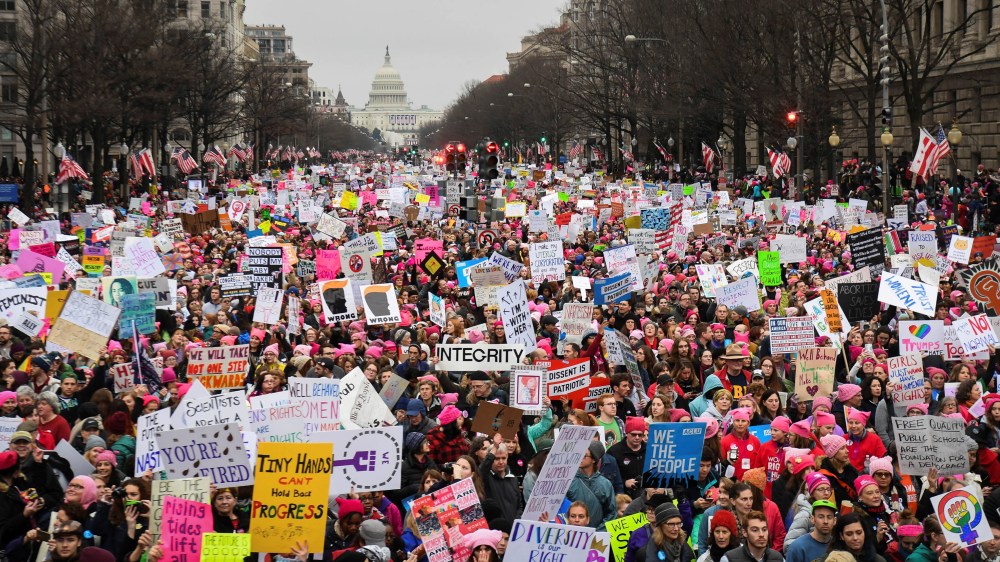
But the National Archives also routinely creates fascinating historical exhibits, featuring original documents, materials, and photographs, including one recent exhibit on women’s suffrage. Promotional materials included photographs from the 2017 Women’s March, which was one of the largest and most impressive displays of citizen activism in recent memory.
As the Washington Post reported, this was not without controversy.
The Archives acknowledged in a statement this week that it made multiple alterations to the photo of the 2017 Women’s March showcased at the museum, blurring signs held by marchers that were critical of Trump. Words on signs that referenced women’s anatomy were also blurred.
In the original version of the 2017 photograph, taken by Getty Images photographer Mario Tama, the street is packed with marchers carrying a variety of signs, with the Capitol in the background. In the Archives version, at least four of those signs are altered.
A placard that proclaims “God Hates Trump” has “Trump” blotted out so that it reads “God Hates.” A sign that reads “Trump & GOP — Hands Off Women” has the word Trump blurred out.
In other words, the National Archives gave historical images a little touch-up, so as to avoid “political controversy,” as an Archives spokesperson put it. In the process, the institution created an entirely different political controversy.
It’s worth emphasizing that I’m not aware of any evidence of Donald Trump or anyone associated with him pressuring the Archives to alter these photographs. It appears that wasn’t necessary: the Archives anticipated pushback from the right and acted pre-emptively.
The U.S. National Archives and Records Administration retreated over the weekend and acknowledged that officials “made a mistake.” That was, to be sure, the appropriate response, and it was good to see the Archives acknowledge the misstep quickly, while vowing to take steps to ensure the mistake isn’t repeated.
But it also brought to mind the political atmosphere the institution and others like it are operating in: no one from the White House had to threaten the Archives into obscuring anti-Trump signs, because officials apparently internalized the political hazards. It’s easy to imagine the conversation among staff and administrators who organized the exhibit, wondering aloud about whom Team Trump might fire if conservative media learned of the exhibit, saw the promotional materials, and ignited a controversy over signs that made Republicans feel unhappy or uncomfortable. In a statement, the Archives added, “We have removed the current display and will replace it as soon as possible with one that uses the unaltered image.” One can only wonder what will unfold if and when that happens.
Steve Benen is a producer for "The Rachel Maddow Show," the editor of MaddowBlog and an MS NOW political contributor. He's also the bestselling author of "Ministry of Truth: Democracy, Reality, and the Republicans' War on the Recent Past." Recommended


