








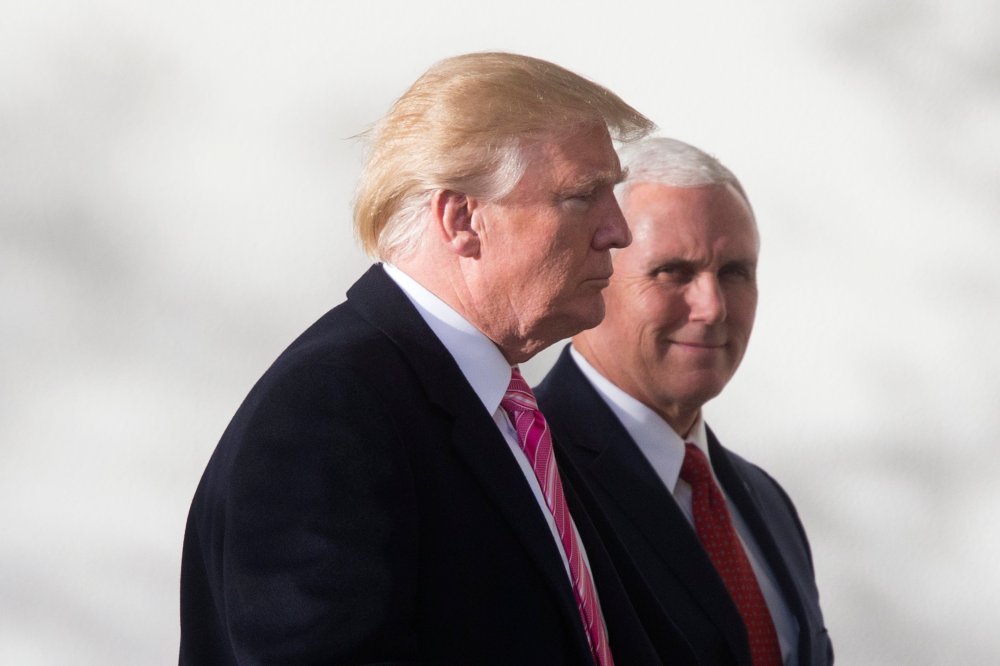

At a White House event yesterday, Republicans gathered on the South Lawn to pat themselves on the back. They’d just passed a regressive and unpopular tax plan — their first meaningful legislative accomplishment of 2017 — and GOP officials were eager to celebrate.
But first, they had to offer gushing praise to Donald Trump.
House Speaker Paul Ryan (R-Wis.), for example, thanked Trump for his “exquisite presidential leadership.” Sen. Orrin Hatch (R-Utah) soon added, “You’re one heck of a leader.” Vice President Mike Pence gushed to the president, “Thank you for your leadership.”
But in practical terms, what does that mean, exactly? I realize that in any political achievement, a president will claim credit when something goes his or her way, but when it came to passing the Republican tax plan for the wealthy, what is it that Trump did to help make this happen?
The Washington Post published a fascinating piece overnight that shed light on the president’s role in the process.
In the debate over the just-approved tax overhaul bill, President Trump saw himself primarily as the marketer in chief — focused on pressuring Republicans to drop the jargon and sell the legislation in a way the public would understand.
So, for example, it was Trump who told Republicans to steer clear of the phrase “tax reform,” because he considered it vague. The president rejected the idea of a border adjustment tax — which was once a key component of the plan — because he thought the name sounded funny. (The Post reported, “It is one reason the plan was scuttled, senior congressional leadership aides said.”)
According to one senior GOP aide involved in the negotiations, when it came time to set tax rates under the party’s plan, Trump “always wanted the individual rates to be multiples of 5,” not for any substantive reason, but because the president simply thought those numbers sounded nicer.
At one point, Trump declared, for example, in reference to the corporate tax rate, “Twenty is a pretty number.”
To characterize this as “presidential leadership” on a major piece of legislation, which will have a profound impact on the world’s largest economy, is to strip the phrase of all meaning.
Indeed, throughout the brief debate, Trump didn’t do any of the things Americans might ordinarily expect from a president trying to lead on an issue. He delivered no speeches detailing the plan’s benefits. He hosted no town-hall forums touting its virtues. He conducted no major media interviews answering questions about the plan’s provisions.
The president played no meaningful role in shaping the plan’s core elements. How is this “leadership”? In fact, this may be an inconvenient detail, but what those singing Trump’s praises yesterday failed to note is that he didn’t even get what he requested from the legislation. The president asked for a 15% corporate rate, which was rejected. He drew a “red line” at a 20% corporate rate, which his own party ultimately ignored. He wanted to close the carried-interest loophole, only to see it survive. Of the seven new tax brackets, most of them aren’t even multiples of 5. As for his role as “the marketer in chief,” let’s also not forget that the GOP tax plan is the least popular major piece of legislation to pass in three decades. I don’t blame Trump for rejoicing — he’ll finally be able to hold a real bill-signing ceremony for something important — but he provided no meaningful leadership at all. This legislation signed despite him, not because of him.
Steve Benen is a producer for "The Rachel Maddow Show," the editor of MaddowBlog and an MS NOW political contributor. He's also the bestselling author of "Ministry of Truth: Democracy, Reality, and the Republicans' War on the Recent Past." Recommended


