








A couple of weeks ago, as the Obama campaign’s criticism of Mitt Romney’s controversial private-sector background intensified, the Republican campaign offered an underwhelming comparison. As Team Romney saw it, President Obama’s rescue of the American automotive industry was comparable to Bain Capital’s private equity practices.
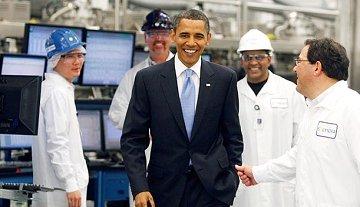
The comparison really didn’t make any sense, and soon faded away. This week, however, there’s a new comparison: Bain Capital is roughly equivalent to the administration’s investment in Solyndra.
I can almost see the underlying point. Obama invested in green energy companies to improve American competitiveness, create jobs, and boost energy innovation, while Romney invested in companies to generate returns for investors. To the extent that both saw opportunities and made investments that carried risks, there’s a superficial similarity.
But as Molly Redden explained, any serious analysis shows that the comparison quickly falls apart.
First off, Romney allies typically explain away Bain’s failures as just the way capitalism works — sometimes, bad companies are swallowed by the market. Solyndra, whose solar technology was priced out of the market by cheaper Chinese solar panels, is a pretty classic example of this, and by citing its Adam Smithian demise in response to attacks on Bain, Romney allies have diminished their ability to dismiss Bain’s loser companies as just the natural cycle of capitalism.
Recommended


But the larger risk of this approach is that comparing any of Bain’s failures to Solyndra asks voters to examine private equity alongside public stimulus. The former is a game in which a tiny group of stakeholders set out to create as much value as possible for themselves: buying companies, often loading them up with debt they can’t bear, and extracting exorbitant fees for themselves before they reintroduce the company to the public and it either fails or succeeds. It’s essentially a no-risk racket…. Then there’s government stimulus, which is aimed at benefitting the public, and which the Obama administration has distributed with considerable success.
Bain and Solyndra, Redden added, “are really nothing alike.”
That’s true, but notice that over the course of two days, the argument was nevertheless pushed by Romney, Karl Rove’s attack operation, George Will, Michael Barone, and House Budget Committee Chairman Paul Ryan (R-Wis.).
It’s almost as if Republicans all receive the same memo at the same time, telling them what to say in public.
The place for in-depth analysis, commentary and informed perspectives.
