








The federal judiciary has been a refuge of sorts since Donald Trump became president. Those seeking justice, and unable to find it in the actions of the White House and the Republican-led Congress, have turned to the courts, which have thwarted at least some of the administration’s excessive efforts.
This has certainly been true when it comes to the controversy over Trump’s Muslim ban, with a variety of courts rejecting the policy — in multiple iterations — as an unconstitutional infringement on the rights of a religious minority the president doesn’t like.
But in the end, one court has the final say — and it has a five-justice conservative majority.
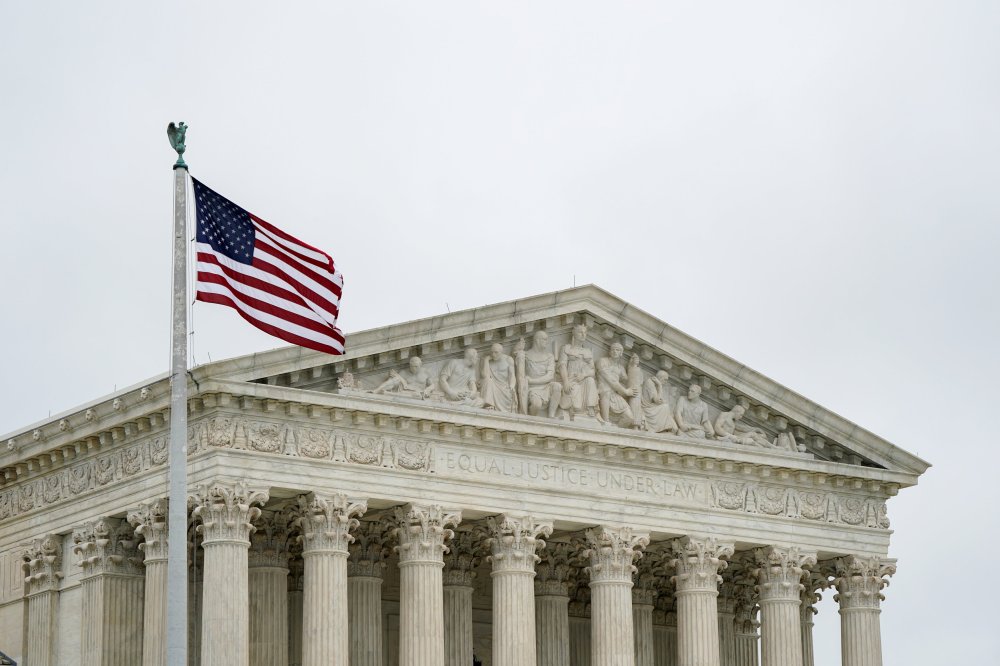
The U.S. Supreme Court, in a 5-4 ruling, upheld President Donald Trump’s restriction on travel to the United States from a handful of Muslim countries on Tuesday, giving the White House its first high court victory on the merits of a presidential initiative.
Chief Justice John Roberts, writing for the majority, made it clear that the court viewed the ability to regulate immigration as squarely within a president’s powers and he rejected critics’ claims of anti-Muslim bias.
The full ruling in Trump v. Hawaii is online here. Roberts, alongside four other justices appointed by Republican presidents, characterized the White House’s policy as a permissible governmental policy “premised on legitimate purposes.”
The chief justice, looking past the president’s own explanation for the purpose of the policy, added, in reference to Trump’s order on the matter, “The text says nothing about religion.”
I’ll confess to being slightly confused. A few weeks ago, when siding with a cake-maker who discriminated against gay customers in Masterpiece Cakeshop v. Colorado Civil Rights Commission, the same five justices took very seriously the rhetoric from members of the Colorado Civil Rights Commission when siding with the plaintiffs. Three weeks later, those jurists are comfortable looking only at the text of a policy and have no interest in the words of the president who’s executing the policy?
In a concurring opinion, Justice Anthony Kennedy seemed to suggest that he wasn’t pleased with Trump’s rhetoric, but he concluded that Trump’s policy is nevertheless legally sound.
“There are numerous instances in which the statements and actions of Government officials are not subject to judicial scrutiny or intervention,” Kennedy wrote, without mentioning the president by name. “That does not mean those officials are free to disregard the Constitution and the rights it proclaims and protects. The oath that all officials take to adhere to the Constitution is not confined to those spheres in which the Judiciary can correct or even comment upon what those officials say or do. Indeed, the very fact that an official may have broad discretion, discretion free from judicial scrutiny, makes it all the more imperative for him or her to adhere to the Constitution and to its meaning and its promise.” Justice Sonia Sotomayor, meanwhile, offered a more pointed perspective in a dissent. …Sotomayor, in a dissent joined by Justice Ruth Bader Ginsburg, fiercely contested the court’s Establishment Clause holding. Sotomayor cited a litany of Trump’s anti-Muslim comments, noting that the travel ban was first advertised “openly and unequivocally as a ‘total and complete shutdown of Muslims entering the United States.’ “ Trump, Sotomayor noted, “has never disavowed any of his prior statements about Islam,” and instead “has continued to make remarks that a reasonable observer would view as an unrelenting attack on the Muslim religion and its followers.” She wrote that the court has a responsibility to look beyond Trump’s pretextual justifications for the ban to acknowledge the obvious: It is “motivated by animosity toward a disfavored group.” Sotomayor added that the Supreme Court’s five-member majority arrived at its result by “ignoring the facts, misconstruing our legal precedent, and turning a blind eye to the pain and suffering the Proclamation inflicts upon countless families and individuals, many of whom are United States citizens.” History will likely remember what the Supreme Court did today, and it will not be kind.
Steve Benen is a producer for "The Rachel Maddow Show," the editor of MaddowBlog and an MS NOW political contributor. He's also the bestselling author of "Ministry of Truth: Democracy, Reality, and the Republicans' War on the Recent Past." Recommended


